
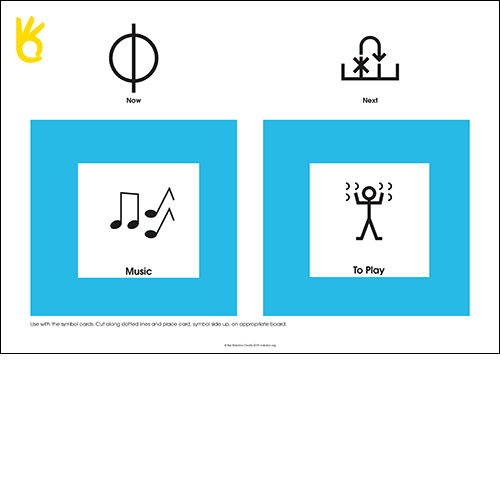
Now and Next
Helping with transitions
How “Now and Next” Helps with the Back-to-School Transition
As both a parent of a Makaton user and a Makaton tutor, I see “Now and Next” from two sides. At home, it’s a tool that helps our mornings run more smoothly and keeps my child calm.
In my professional role, I see how powerful it can be for many children, young people, and adults who benefit from extra communication support.
“Now and Next” boards are particularly helpful at this time of year because they:
Explain what will be happening next – giving a clear visual of what’s coming helps reduce uncertainty, especially when language alone isn’t enough.
Support understanding – the visual information reinforces what has been said, so even if a person doesn’t fully process spoken words, they can still follow the routine.
Act as a reminder – not just for theperson, but for us as parents and carers too. Having the board prompts us to keep repeating what’s going to happen, which gently prepares the person for a change or transition.
This visual structure is key when a person has language difficulties, struggles with transitions, or simply feels anxious about what’s coming next
What “Now and Next” Means for Us
The idea is simple:
- Now shows what is happening right this minute.
- Next shows what is coming immediately afterwards.
This two-step structure reduces uncertainty, supports transitions, and makes routines predictable.
At home, for example:
- Now: Get dressed
- Next: Eat breakfast
That clear sequence works far better for my child than vague instructions like “get ready.”
Why We Use “Next” Instead of “Then”
When I first heard about “Now and Next,” I wondered why people didn’t just use “First and Then.” After all, it often feels more natural when we’re speaking.
But both in my own home and through my work, I’ve learned why “Now and Next” is usually the better choice:
Now vs. First – Now is immediate and easy to understand — it simply means what’s happening right this second. First can be trickier, because it implies a sequence: to understand first, you also need to understand that something else will follow later. That’s a more complex concept and takes more processing.
Next vs. Then – Next is concrete — it means the very next thing. Then is more abstract — it might mean later, or even refer to the past (“back then”).
For many learners, Now and Next is easier to grasp because it makes both the present and the immediate future crystal clear. Then can come later, once someone is developmentally ready to manage longer sequences.
Growing Into “Then”
Once someone is secure with Now and Next, you can start to expand:
- Now: Reading
- Next: Playtime
- Then: Lunch
That extra step can help build a broader understanding of time, but only when the person is ready. At home, I’ve found the same applies — slow and steady is best.
Sometimes Just “Now” is Enough
Not everyone needs “Next.” Some children and adults live very much in the present and benefit most from just knowing what is happening now. I’ve seen this with my own child at times, and with learners in my sessions. And that’s perfectly valid.
How Should I Use a Now & Next Board?
A “Now and Next” board works best when it’s simple, consistent, and visual. Here’s how to use one effectively:
Setting it up
-
Keep visuals simple and familiar – use images, symbols, or photos the person already recognises
-
Place two symbols on the board: one for what the person is currently doing (Now) and one for what will happen immediately afterwards (Next).
-
Motivate through sequencing – after a less-preferred activity, use the Next column to show something positive and engaging.
Introduce the Activity
-
Tell the child: “Now it’s ____, next it will be ____,” while pointing to the symbols. Keep the board in clear view at their eye level so they can check it whenever they need to.
Follow Through
-
Be consistent and keep it reliable – if the board shows “music is next,” ensure that’s the next activity. Consistency helps the person feel confident and reassured.
Transition to the Next Activity
- When an activity ends, say: “____ has finished.” Encourage the person to take that symbol off the Now column.
- Prepare for change – update the board as soon as you know a transition is coming, so the person has time to adjust.
- Move the symbol from the Next column into the Now space, then add a new activity into Next. Repeat together: “Now it’s ____, next it will be ____.”
- Gradually increase independence – as the person becomes more confident, let them move the symbols themselves or help set up the board. This gives them ownership, builds independence, and helps them feel more in control of their day.
The Resources That Helped Us
As a Makaton premium member, I’ve found the free resources invaluable:
- The Now and Next template (free to download)
- The Back to School Now and Next resource (also free)
These are simple, practical tools that help smooth the transition back to school.
For even more flexibility, there’s the Now and Next template with over 40 symbols and their corresponding signs for common everyday activities, available from the Makaton shop for just £3.70. I recommend this a lot in my tutor role, and we use it at home too. Find it at Makaton.org
But I also know that not everyone has access to membership or can afford to buy extra resources. If that’s the case, there are still lots of ways to make your own:
-
Draw simple Now and Next symbols – basic sketches work perfectly. You don’t need to be an artist; it’s about communication, not perfection.
-
Use photos – take pictures of your child’s own belongings or familiar places (for example, their coat, toothbrush, or the school gate).
-
Use magazine cut-outs or printed images – anything clear and recognisable will work.
-
Involve your child – let them help choose or draw the pictures, which can make them more engaged with the process.
The most important thing is that the visuals are meaningful to the person using them. Whether that’s shop-bought symbols, hand-drawn pictures, or family photos, what matters is that they help communicate clearly what is Now and what is Next.
Final Thoughts
“Now and Next” has been a game-changer for me, both as a parent and as a tutor. It takes something that can feel overwhelming — transitions and routines — and breaks it down into small, manageable steps. Whether someone needs just Now, Now and Next, or is ready to expand to Now, Next, and Then, the approach adapts to them. As the new school term begins, this simple tool can make daily life calmer, clearer, and more predictable — for children and for families too.
Tags:
Is It a Symbol, or Is It PECS? Clearing Up the Confusion
If you’ve spent any time around schools, therapists, or parent groups, you’ve probably heard people say things like: “He uses PECs” or “Can I have a PEC for snack?” The word PECS has become shorthand for any picture, symbol, or visual support. But that’s not quite right.
Symbols are not the same as PECS
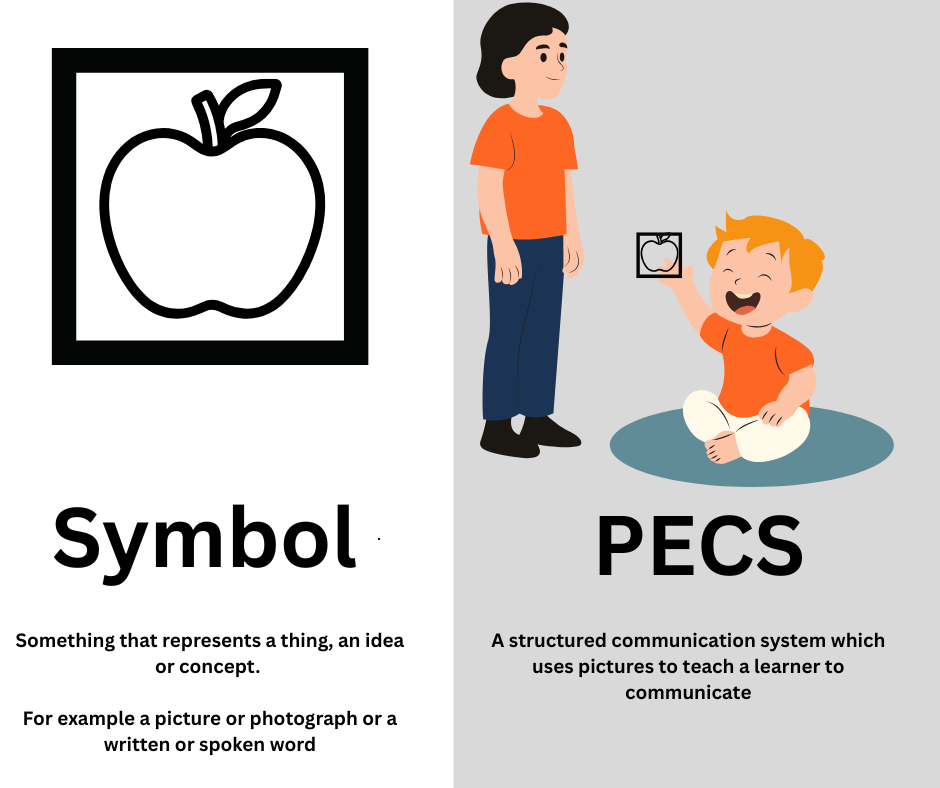
A symbol is anything that represents a concept — this is often thought of in picture form but a symbol could be an object, a written word, a spoken word, or a picture. In this context, when we talk about symbols, we usually mean pictorial representations: a simple image or drawing that helps to represent meaning.
The PECS system is different. It’s a structured programme that uses pictures as part of its teaching method. Any symbol set can be used within PECS (although the programme has its own “Pics for PECS” images). But that doesn’t mean a symbol is a PEC. A visual of any type is not PECS — it’s just a symbol being used to support communication.
Why this matters
When we mix up “symbols” with “PECS,” we risk narrowing how we think about communication. PECS is focused on exchanging a picture to make a request. But communication is so much richer than that. It’s about sharing ideas, telling jokes, showing feelings, saying “no,” asking questions, or just enjoying connection.
A better way: total communication in action
More enlightened approaches to communication have moved away from a strict PECS or ABA-style framework. Instead, they focus on modelling communication without pressure or expectation, within a total communication approach.
What is Total Communication?
Total communication does not mean using every method all at once. Instead, it’s an approach that supports all forms of communication, not just spoken words.
This might include:
-
Gestures, facial expression, and body language
-
Signing or Makaton
-
Touch, movement, and sensory cues
-
Sounds, vocalisations, or music
-
Symbols, pictures, or AAC devices
-
Creative expression such as art or dance
The aim is to find the right combination of methods for each individual — the mix that helps them connect, share, and be understood. One method often strengthens the meaning of another. For example, if someone’s signing isn’t very clear, a symbol alongside it can help clarify what they’re trying to communicate.
Total communication is also about creating a positive environment where communication can flourish, ensuring successful interactions and supporting real connection.
-
Music and rhythm – a tidy-up song, or clapping a rhythm to get attention.
-
Environmental cues – turning off lights to mean “finished,” or opening a lunchbox to show “time to eat.”
The key is that we model these naturally in daily life, without demanding that the child copies us or “performs” communication.
Building relationships through communication
When we stop thinking of communication as something to be trained, and instead see it as a way to connect, something changes. We notice the little things our children are already doing. We join in. We model back. We respond.
That’s when relationships deepen. That’s when children learn that their voice – however it comes out – matters. And that’s what helps them grow into strong self-advocates, able to express not just what they want, but who they are.
Final thought:
Communication isn’t about programmes, systems, or perfect methods — it’s about connection. When we meet children where they are, model different ways of communicating, and respond with respect, we show them that their voice truly matters. That’s the foundation for confidence, relationships, and lifelong self -advocacy.
Tags: