
I’ll never forget supporting a young lad who kept touching his mouth — his sign for please. He was becoming more and more frustrated with me, because no matter how hard I tried, I couldn’t guess what it was he wanted.
I was methodical in my approach to working it out. Was it food? A drink? Something to do? But nothing seemed right. He became upset. I was frustrated too, and I left that interaction feeling like I’d let him down.
When people in the UK start learning Makaton, one of the first questions I’m asked is: “How do you sign please and thank you?”
It’s no surprise. In Britain, manners are often treated as non-negotiable. From an early age, children are encouraged — even reminded endlessly — to add a “please” when asking for something, and to never forget a “thank you” afterwards.
But here’s the question: are please and thank you really essential to communication? Or are they more about culture than function?
Communication vs. Manners
At its heart, functional communication is about being able to express needs, wants, feelings, and ideas. It’s about clarity: “I’m hungry.” “I need help.” “Stop.”
Manners, on the other hand, are cultural extras. They soften requests, signal respect, and help us fit into social norms — but you can survive, thrive, and connect without them.
For people learning Makaton, especially children or adults with communication difficulties, there’s a risk that manners are prioritised before essentials. Imagine a child who can say please but can’t yet say toilet — one is nice, the other is vital.
Politeness in British Culture
In the UK, politeness is deeply tied to identity. A missing “please” or “thank you” can be interpreted as rudeness, and parents often feel embarrassed if their child doesn’t use them.
This cultural weight sometimes spills into Makaton teaching. Families may feel pressured to teach manners early, even when their child is still working on the basics of communication. But insisting on “please” and “thank you” can add unnecessary stress, both for the learner and the parent.
But here’s the challenge: many children learn please and thank you before learning the signs for the things they actually want. This can turn into a lifelong guessing game.
I’ve seen children, teenagers, and adults sign please to make a request — but without signing the specific item. Familiar family members might be able to guess from context that please means “yogurt” or “biscuit” or “music,” but outside of that context it’s much harder. Often, the person asking ends up with something completely different to what they wanted.
Looking Beyond the UK
Around the world, manners are expressed in very different ways:
-
In some cultures, gratitude is shown with a smile, a nod, or by sharing food.
-
Requests are made more polite not by adding a word like “please,” but by changing tone, posture, or phrasing.
-
Within families, saying “thank you” may even feel strange or unnecessary — because care and sharing are assumed, not something to thank for.
These differences remind us that “please” and “thank you” aren’t universal rules of politeness. They’re cultural markers — important in some places, less so in others.
What Really Matters in Makaton
For Makaton users, the priority should always be functional communication — the signs that empower someone to express themselves, make choices, and stay safe.
So while manners are important in UK culture, teaching them too early — before someone has the functional signs they need — can unintentionally create barriers instead of building bridges
-
Eat and drink matter more than please.
-
Stop and help matter more than thank you.
-
Toilet or pain can be life-changing.
Manners can come later, when the essentials are in place. And if someone never uses “please” or “thank you” in Makaton? That doesn’t make their communication any less valid.
Closing Thought
“Please” and “thank you” are lovely signs to know. They can bring warmth to conversations and reflect cultural values of politeness. But they are not the foundation of communication.
For people learning Makaton, what matters most is being understood, having choice, and being able to connect. Manners are the icing on the cake, not the cake itself.
Tags:
One of the questions I’m often asked is: “How do you adapt Makaton signs if someone can only use one hand?”
The good news is that Makaton is flexible — it’s designed to support communication in ways that work for the individual. While we always start by modelling the standardised signs, adaptations are not only possible but encouraged where needed.
Why Adapt?
Not everyone can use two hands to sign. Someone may have hemiplegia, cerebral palsy, limb difference, arthritis, an injury, or fatigue that makes two-handed signing difficult. That shouldn’t stop them from using Makaton.
Adapting signs for one-handed use means:
-
Everyone has access to communication.
-
People can sign in ways that feel comfortable and natural.
-
Families, friends, and professionals can understand their individual adaptations.
Key Principles
-
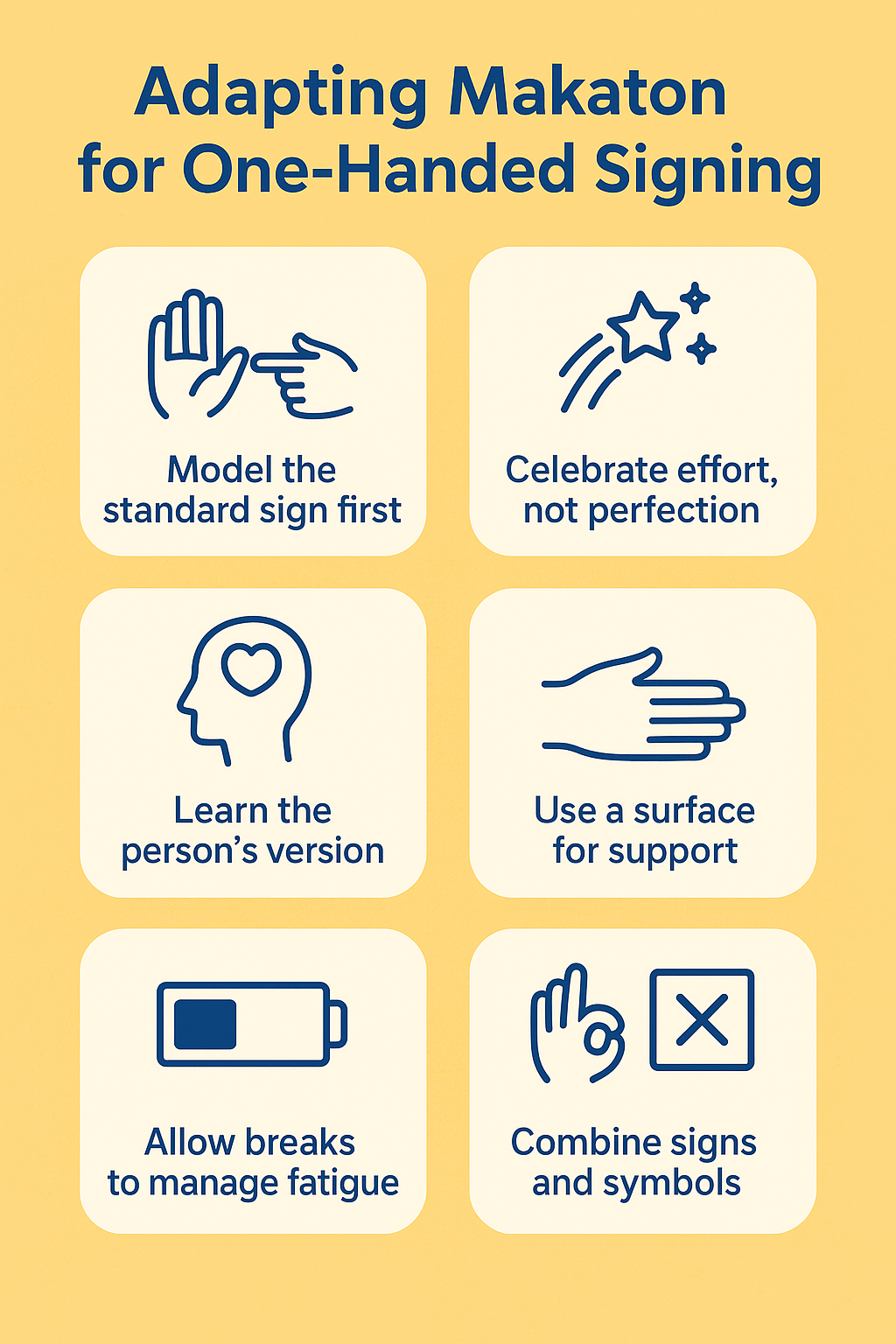
Model the standard sign first
Always introduce the standardised Makaton sign (so the learner sees the “official” version). From there, encourage approximations or adapted versions. -
Encourage effort, not perfection
Any attempt at a sign is communication. Celebrate it, even if it looks different. -
Recognise the person’s version
If someone creates their own one-handed adaptation, communication partners should learn to recognise and respond to it. However, when they sign back, they should continue to model the standardised version so consistency of the programme is maintained. -
Comfort is key
Good seating, positioning, and pacing can make signing easier and reduce fatigue. Physiotherapists or occupational therapists may be able to advise. -
Multimodal is valid
Sometimes one-handed signing is tiring or not fully understood. It’s absolutely valid to use Makaton symbols, facial expression, gesture, or a communication device alongside signing — whatever supports communication best. -
Key Principles
-
Model the standard sign first
Always introduce the standardised Makaton sign (so the learner sees the “official” version). From there, encourage approximations or adapted versions. -
Encourage effort, not perfection
Any attempt at a sign is communication. Celebrate it, even if it looks different. -
Recognise the person’s version
If someone creates their own one-handed adaptation, communication partners should learn to recognise and respond to it. However, when they sign back, they should continue to model the standardised version so consistency of the programme is maintained. -
Comfort is key
Good seating, positioning, and pacing can make signing easier and reduce fatigue. Physiotherapists or occupational therapists may be able to advise. -
Multimodal is valid
Sometimes one-handed signing is tiring or not fully understood. It’s absolutely valid to use Makaton symbols, facial expression, gesture, or a communication device alongside signing — whatever supports communication best.When to Consider Symbols
If a person’s one-handed signing is very difficult to understand, Makaton symbols (or another AAC system) may be more effective as their main form of communication. This isn’t a “step down” — symbols are an equally valid and respected way to communicate. Many people use a blend of signs, symbols, and speech.
Closing Thought
Adapting Makaton for one-handed use is about flexibility, creativity, and respect. Communication isn’t about producing perfect signs — it’s about being understood, included, and connected.
So if you’re supporting someone who signs one-handed, celebrate their version, respond to it, and keep modelling the standardised version. The best sign is the one that works.
-
-
Tags: