
Why Mr Tumble Matters
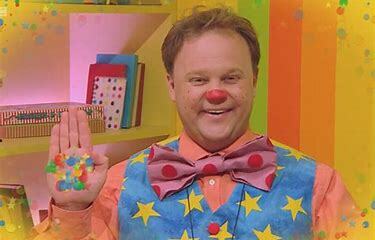
If you’ve ever had a toddler in the house, chances are you’ve crossed paths with Mr Tumble. Bright waistcoat, spotty bow tie, a bottomless spotty bag – and that famous cheek wobble. Mr Tumble has become a familiar figure in living rooms up and down the country since he first appeared in 2002.
But behind the slapstick humour and silly voices is something truly special. For many children – especially those with additional needs – Mr Tumble isn’t just a TV character. He’s a friend, a teacher, and sometimes the very first step into communication.
A Gentle Introduction to Signs and Symbols
What makes Mr Tumble stand out is his use of Makaton signing. As he sings, chats, and plays, he also signs key words. For children who struggle with speech or are just finding their voice, this can be a lifeline. Parents often share stories of their child’s very first sign – “more,” “drink,” “Mummy” – copied straight from Mr Tumble. Those little handshapes often open big doors, giving children confidence and families a way to connect.
Belonging on Screen
There’s something wonderfully affirming about seeing signing on mainstream TV. Children who use Makaton get to see themselves represented, and their siblings and friends learn alongside them. It’s inclusion without fuss or fanfare – just woven naturally into the fun. For many families, that sense of belonging is priceless.
Why Parents Appreciate Him
Mr Tumble’s clownish style is full of colour, music, and fun – the kind of energy that children can’t resist. But what parents quickly come to appreciate is that he’s not just filling airtime; he’s teaching children to communicate, showing kindness, and making learning joyful. And, importantly, he gives parents a way to join in too – many mums, dads, and grandparents pick up their first Makaton signs thanks to him.
A Lasting Legacy
It’s hard to believe Mr Tumble has been on our screens for over 20 years. Generations of children have laughed, signed, and sung along with him. And while TV characters come and go, his impact has been lasting. He’s helped thousands of families find their first steps into communication – and that’s something truly special.
Tags:
Is It a Symbol, or Is It PECS? Clearing Up the Confusion
If you’ve spent any time around schools, therapists, or parent groups, you’ve probably heard people say things like: “He uses PECs” or “Can I have a PEC for snack?” The word PECS has become shorthand for any picture, symbol, or visual support. But that’s not quite right.
Symbols are not the same as PECS
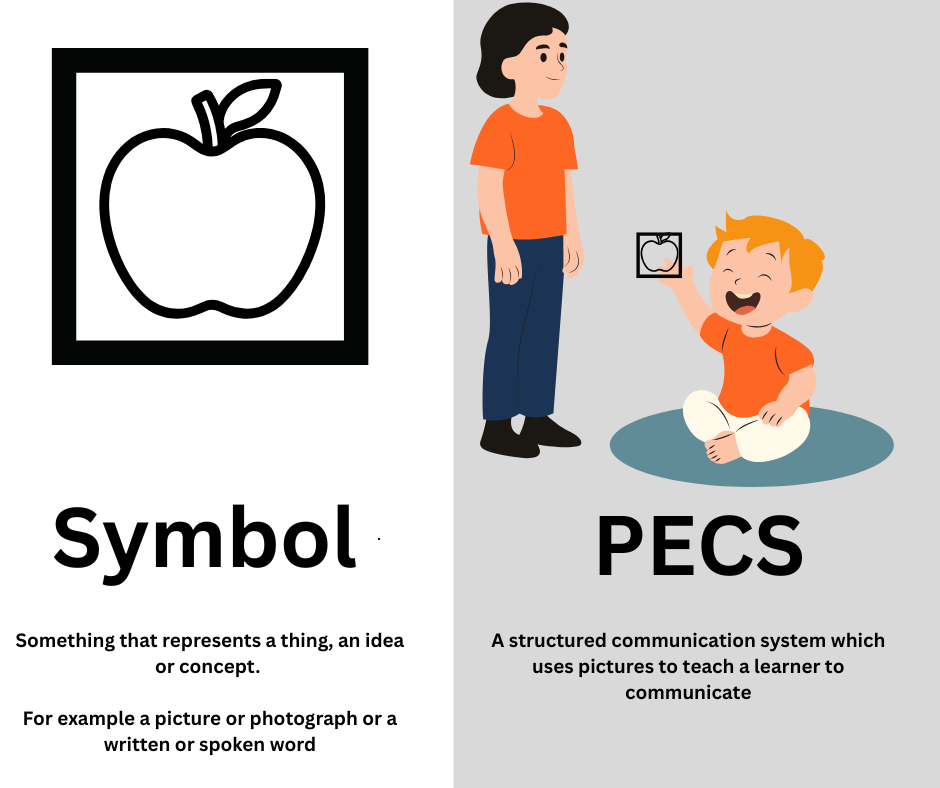
A symbol is anything that represents a concept — this is often thought of in picture form but a symbol could be an object, a written word, a spoken word, or a picture. In this context, when we talk about symbols, we usually mean pictorial representations: a simple image or drawing that helps to represent meaning.
The PECS system is different. It’s a structured programme that uses pictures as part of its teaching method. Any symbol set can be used within PECS (although the programme has its own “Pics for PECS” images). But that doesn’t mean a symbol is a PEC. A visual of any type is not PECS — it’s just a symbol being used to support communication.
Why this matters
When we mix up “symbols” with “PECS,” we risk narrowing how we think about communication. PECS is focused on exchanging a picture to make a request. But communication is so much richer than that. It’s about sharing ideas, telling jokes, showing feelings, saying “no,” asking questions, or just enjoying connection.
A better way: total communication in action
More enlightened approaches to communication have moved away from a strict PECS or ABA-style framework. Instead, they focus on modelling communication without pressure or expectation, within a total communication approach.
What is Total Communication?
Total communication does not mean using every method all at once. Instead, it’s an approach that supports all forms of communication, not just spoken words.
This might include:
-
Gestures, facial expression, and body language
-
Signing or Makaton
-
Touch, movement, and sensory cues
-
Sounds, vocalisations, or music
-
Symbols, pictures, or AAC devices
-
Creative expression such as art or dance
The aim is to find the right combination of methods for each individual — the mix that helps them connect, share, and be understood. One method often strengthens the meaning of another. For example, if someone’s signing isn’t very clear, a symbol alongside it can help clarify what they’re trying to communicate.
Total communication is also about creating a positive environment where communication can flourish, ensuring successful interactions and supporting real connection.
-
Music and rhythm – a tidy-up song, or clapping a rhythm to get attention.
-
Environmental cues – turning off lights to mean “finished,” or opening a lunchbox to show “time to eat.”
The key is that we model these naturally in daily life, without demanding that the child copies us or “performs” communication.
Building relationships through communication
When we stop thinking of communication as something to be trained, and instead see it as a way to connect, something changes. We notice the little things our children are already doing. We join in. We model back. We respond.
That’s when relationships deepen. That’s when children learn that their voice – however it comes out – matters. And that’s what helps them grow into strong self-advocates, able to express not just what they want, but who they are.
Final thought:
Communication isn’t about programmes, systems, or perfect methods — it’s about connection. When we meet children where they are, model different ways of communicating, and respond with respect, we show them that their voice truly matters. That’s the foundation for confidence, relationships, and lifelong self -advocacy.
Tags:
One of the questions I’m often asked is: “How do you adapt Makaton signs if someone can only use one hand?”
The good news is that Makaton is flexible — it’s designed to support communication in ways that work for the individual. While we always start by modelling the standardised signs, adaptations are not only possible but encouraged where needed.
Why Adapt?
Not everyone can use two hands to sign. Someone may have hemiplegia, cerebral palsy, limb difference, arthritis, an injury, or fatigue that makes two-handed signing difficult. That shouldn’t stop them from using Makaton.
Adapting signs for one-handed use means:
-
Everyone has access to communication.
-
People can sign in ways that feel comfortable and natural.
-
Families, friends, and professionals can understand their individual adaptations.
Key Principles
-
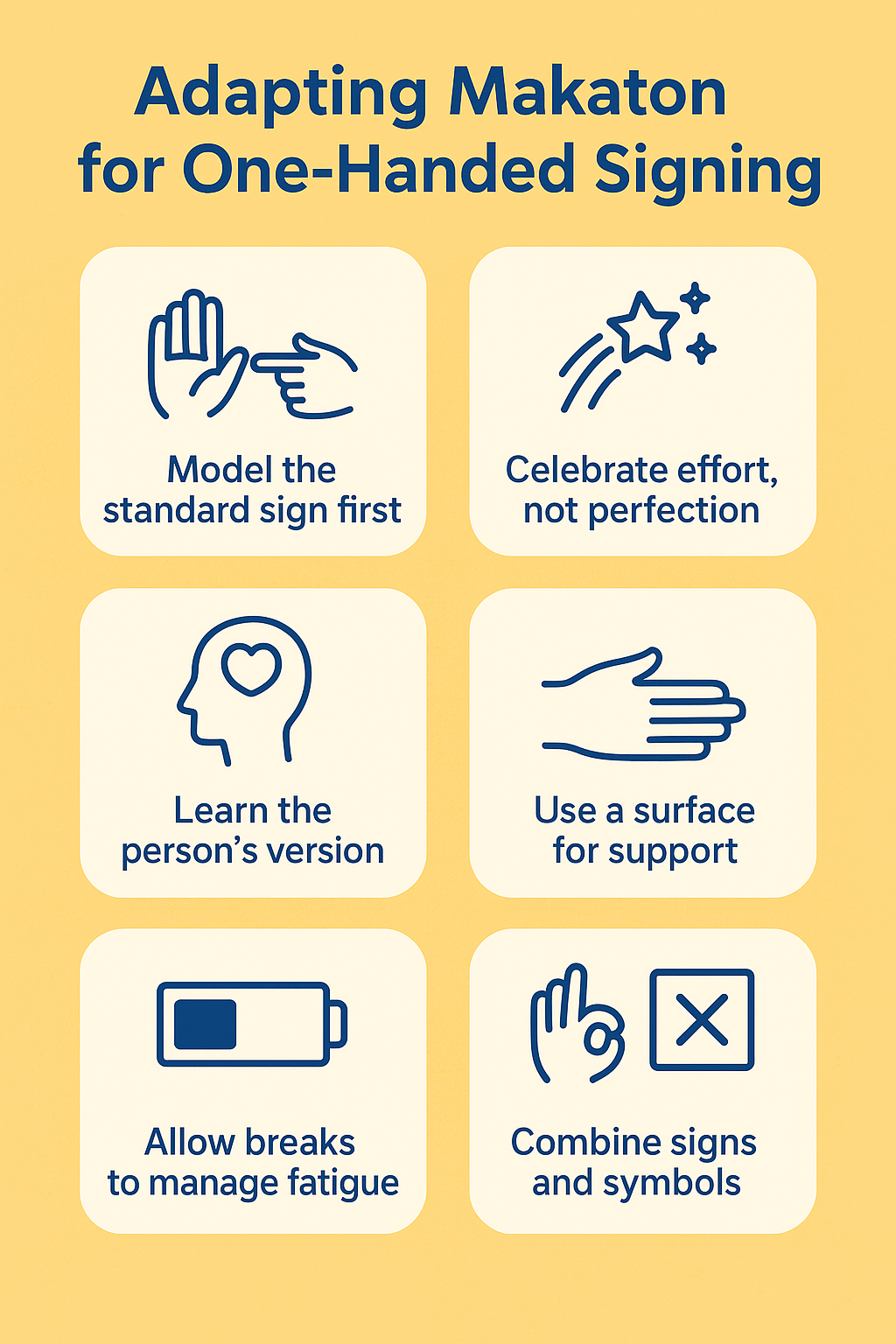
Model the standard sign first
Always introduce the standardised Makaton sign (so the learner sees the “official” version). From there, encourage approximations or adapted versions. -
Encourage effort, not perfection
Any attempt at a sign is communication. Celebrate it, even if it looks different. -
Recognise the person’s version
If someone creates their own one-handed adaptation, communication partners should learn to recognise and respond to it. However, when they sign back, they should continue to model the standardised version so consistency of the programme is maintained. -
Comfort is key
Good seating, positioning, and pacing can make signing easier and reduce fatigue. Physiotherapists or occupational therapists may be able to advise. -
Multimodal is valid
Sometimes one-handed signing is tiring or not fully understood. It’s absolutely valid to use Makaton symbols, facial expression, gesture, or a communication device alongside signing — whatever supports communication best. -
Key Principles
-
Model the standard sign first
Always introduce the standardised Makaton sign (so the learner sees the “official” version). From there, encourage approximations or adapted versions. -
Encourage effort, not perfection
Any attempt at a sign is communication. Celebrate it, even if it looks different. -
Recognise the person’s version
If someone creates their own one-handed adaptation, communication partners should learn to recognise and respond to it. However, when they sign back, they should continue to model the standardised version so consistency of the programme is maintained. -
Comfort is key
Good seating, positioning, and pacing can make signing easier and reduce fatigue. Physiotherapists or occupational therapists may be able to advise. -
Multimodal is valid
Sometimes one-handed signing is tiring or not fully understood. It’s absolutely valid to use Makaton symbols, facial expression, gesture, or a communication device alongside signing — whatever supports communication best.When to Consider Symbols
If a person’s one-handed signing is very difficult to understand, Makaton symbols (or another AAC system) may be more effective as their main form of communication. This isn’t a “step down” — symbols are an equally valid and respected way to communicate. Many people use a blend of signs, symbols, and speech.
Closing Thought
Adapting Makaton for one-handed use is about flexibility, creativity, and respect. Communication isn’t about producing perfect signs — it’s about being understood, included, and connected.
So if you’re supporting someone who signs one-handed, celebrate their version, respond to it, and keep modelling the standardised version. The best sign is the one that works.
-
-
Tags: