
One of the questions I’m often asked is: “How do you adapt Makaton signs if someone can only use one hand?”
The good news is that Makaton is flexible — it’s designed to support communication in ways that work for the individual. While we always start by modelling the standardised signs, adaptations are not only possible but encouraged where needed.
Why Adapt?
Not everyone can use two hands to sign. Someone may have hemiplegia, cerebral palsy, limb difference, arthritis, an injury, or fatigue that makes two-handed signing difficult. That shouldn’t stop them from using Makaton.
Adapting signs for one-handed use means:
-
Everyone has access to communication.
-
People can sign in ways that feel comfortable and natural.
-
Families, friends, and professionals can understand their individual adaptations.
Key Principles
-
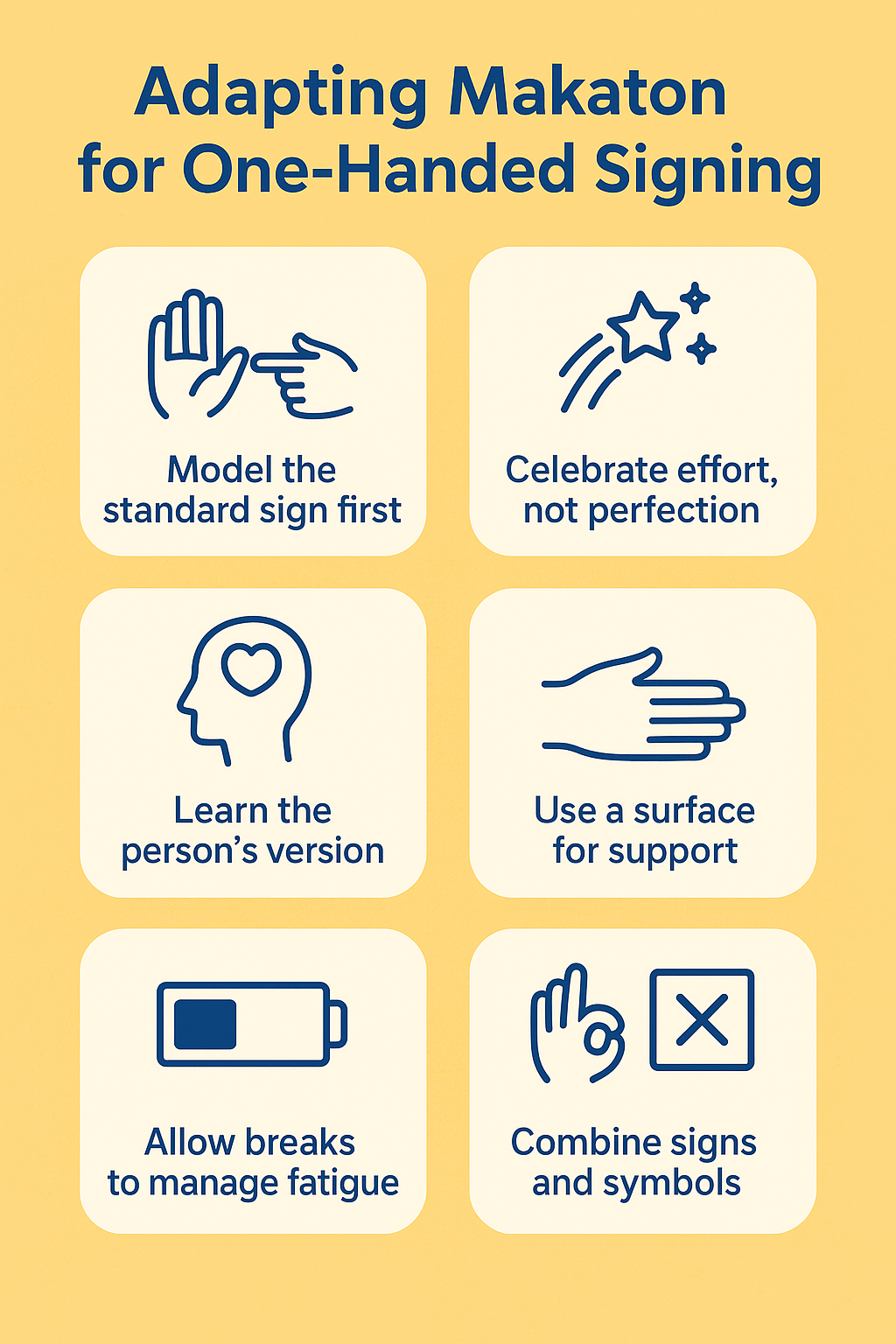
Model the standard sign first
Always introduce the standardised Makaton sign (so the learner sees the “official” version). From there, encourage approximations or adapted versions. -
Encourage effort, not perfection
Any attempt at a sign is communication. Celebrate it, even if it looks different. -
Recognise the person’s version
If someone creates their own one-handed adaptation, communication partners should learn to recognise and respond to it. However, when they sign back, they should continue to model the standardised version so consistency of the programme is maintained. -
Comfort is key
Good seating, positioning, and pacing can make signing easier and reduce fatigue. Physiotherapists or occupational therapists may be able to advise. -
Multimodal is valid
Sometimes one-handed signing is tiring or not fully understood. It’s absolutely valid to use Makaton symbols, facial expression, gesture, or a communication device alongside signing — whatever supports communication best. -
Key Principles
-
Model the standard sign first
Always introduce the standardised Makaton sign (so the learner sees the “official” version). From there, encourage approximations or adapted versions. -
Encourage effort, not perfection
Any attempt at a sign is communication. Celebrate it, even if it looks different. -
Recognise the person’s version
If someone creates their own one-handed adaptation, communication partners should learn to recognise and respond to it. However, when they sign back, they should continue to model the standardised version so consistency of the programme is maintained. -
Comfort is key
Good seating, positioning, and pacing can make signing easier and reduce fatigue. Physiotherapists or occupational therapists may be able to advise. -
Multimodal is valid
Sometimes one-handed signing is tiring or not fully understood. It’s absolutely valid to use Makaton symbols, facial expression, gesture, or a communication device alongside signing — whatever supports communication best.When to Consider Symbols
If a person’s one-handed signing is very difficult to understand, Makaton symbols (or another AAC system) may be more effective as their main form of communication. This isn’t a “step down” — symbols are an equally valid and respected way to communicate. Many people use a blend of signs, symbols, and speech.
Closing Thought
Adapting Makaton for one-handed use is about flexibility, creativity, and respect. Communication isn’t about producing perfect signs — it’s about being understood, included, and connected.
So if you’re supporting someone who signs one-handed, celebrate their version, respond to it, and keep modelling the standardised version. The best sign is the one that works.
-
-
Tags: