

Makaton and Saying Sorry
Nurturing empathy, not just expression — finding the right time to introduce sorry.
I’m sometimes asked: “Why is sorry in Stage 3 of the Makaton Core Vocabulary?”
It’s a great question — and one that often comes from people who feel it should appear earlier. After all, sorry seems like such a simple, everyday word — one we use often with young children. But understanding what sorry really means is far from simple, and that’s exactly why it’s placed where it is.
What Does Sorry Really Mean?
The sign for sorry might look simple, but the concept behind it is anything but.
To truly understand sorry, we need to understand that:
Our actions have consequences for others.
Those consequences might make someone else feel sad, hurt, or cross.
We can help repair that by expressing remorse.
That’s a lot of abstract thinking — and it takes time to develop.
How the Understanding of Sorry Develops
Research shows that understanding regret and remorse grows gradually through childhood:
Around age 4–5: Children start to grasp that apologies express emotions like guilt or remorse, and they may respond positively when someone says sorry.
Around age 5: They begin to feel their own sense of regret — for example, feeling sad when a choice doesn’t work out.
Between ages 5 and 7: This self-awareness becomes stronger; children can reflect on their own actions and feel genuine regret.
Around age 6: Many begin to show a clearer sense of remorse.
By around age 7: They can experience relief and remorse for themselves — though understanding those emotions in others may not be solid until closer to age 9.
A big part of this process is developing what psychologists call theory of mind — realising that other people have thoughts and feelings different from your own. This skill usually starts to emerge around 4 to 5 years old and continues to mature well into later childhood.
So, while “sorry” appears early in the Makaton Core Vocabulary, that doesn’t mean it’s ready to be understood or used meaningfully by every learner at that stage.
Why We Need to Be Cautious with Sorry
It’s easy to fall into the habit of prompting someone to say sorry after an incident.
But if the concept isn’t yet understood, the sign or word can lose its meaning and simply become something to copy.
Sometimes, if sorry is prompted too soon, it can also feel uncomfortable or confusing for the person using it.
Instead of helping them learn how to make things right, it might start to feel like something they have to do when they’re “in trouble.”
When (and How) to Introduce Sorry
It can help to pause and notice what the person already understands before bringing in the sign or symbol for sorry.
Are they beginning to recognise emotions like happy, sad, cross and hurt?
Can they see that other people have feelings too?
Do they understand simple cause and effect — like “You knocked the tower, it fell down”?
If those early emotional foundations are in place, the idea of sorry will start to make more sense.
You can weave it in gently and naturally, through everyday moments that have real meaning. For example:
“Oops, I spilt the juice — sorry!”
“Oh no, I bumped you. Are you okay? Sorry.”
Personally, I never insisted that my own children used the word or sign for sorry. Instead, I modelled it myself when it felt natural and genuine. Over time, I watched for those small but important signs that they were beginning to understand — moments of empathy, awareness, or care — and that’s when I began to introduce the concept more deliberately.
By seeing and hearing sorry used with real feeling, learners begin to associate it with care and connection, rather than correction.
A Better Approach
Rather than focusing on getting someone to say sorry, it can be more meaningful to guide them towards repairing the moment.
That might look like noticing what’s happened and finding a way to make it better together:
“You knocked his bricks. Let’s help rebuild.”
“She’s sad. Let’s check she’s okay.”
This gentle, supported approach models empathy and responsibility in a way that feels safe and real — and when the time is right, the sign for sorry will grow naturally from that understanding.
Final Thoughts
The sign for sorry sits in Stage 3 because it’s a social word — but it needs emotional understanding behind it.
So before you teach it, build those early experiences of emotions, empathy, and awareness of others.
That’s how sorry becomes more than a sign — it becomes a genuine act of connection.
Tags:
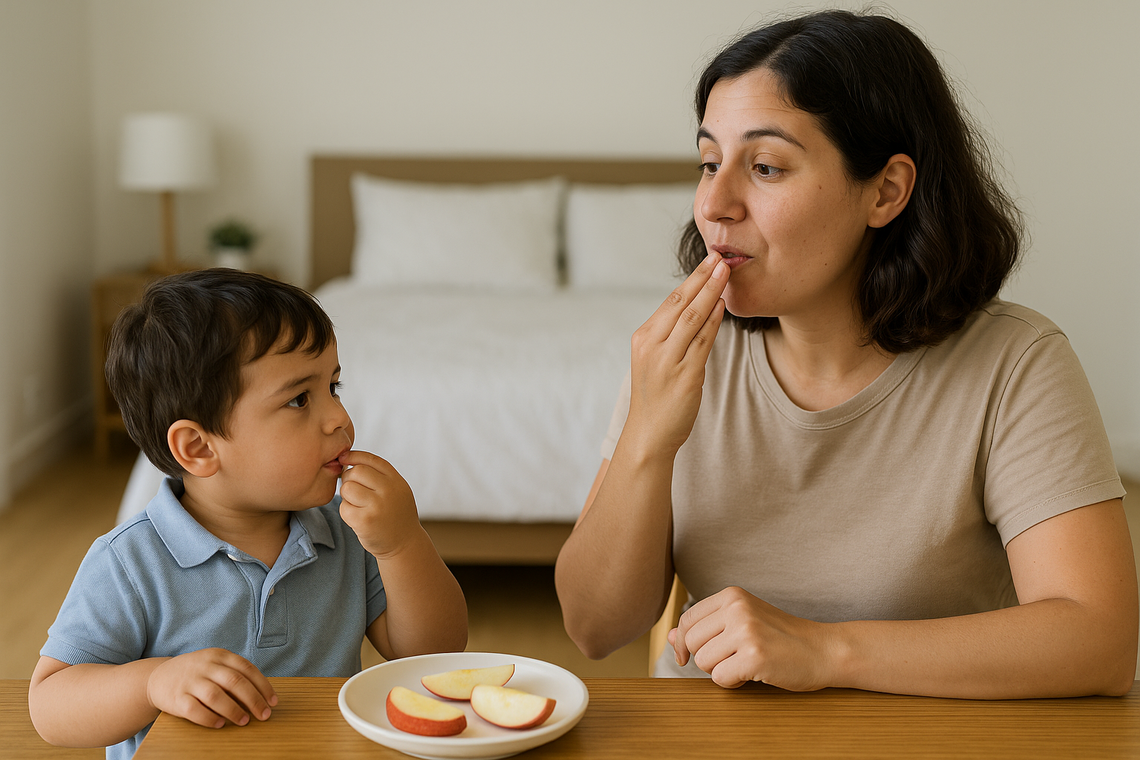
When my son was younger, we were advised by his Speech and Language Therapist to use hand-over-hand signing — physically guiding his hands to make the signs. That was common practice at the time. The advice came from a good place: he found it hard to coordinate his movements, and we wanted to help him experience what each sign felt like.
There are reasons why this approach was once recommended. Some Makaton users benefit from additional sensory feedback because of differences in proprioception — the body’s internal sense of position and movement. Proprioception helps us know where our hands are, how our fingers are shaped, and how to control them without constantly looking. If someone struggles with this, they might not instinctively know how to form a sign, even if they can see it clearly.
In this context, haptic feedback — the sensory information we get through touch and movement — can play a role in learning. Feeling the motion of a sign can help the brain make connections between what’s seen, felt, and meant. For example, feeling the gentle placement of hand on fist for more can give additional sensory input alongside the visual model.
From Hand-Over-Hand to Hand-Under-Hand
Over time, our understanding — and practice — changed. We moved from hand-over-hand to hand-under-hand.
This might sound like a small shift, but it represented a much bigger change in thinking. With hand-under-hand, the adult’s hands sit underneath, providing support if wanted — but the Makaton user remains in control. They can rest their hands on yours, feel the movement if they wish, or move away entirely.
This subtle difference communicates something powerful: “You’re in charge of your own body.” It gives the person choice and control. It turns touch into an invitation, not an instruction.
But even with this gentler approach, there’s still physical contact — and that means we must think carefully about body autonomy.
What is Body Autonomy — and Why Does it Matter?
Body autonomy means having the right and freedom to make choices about your own body — including who touches you, when, and how.
For many Makaton users, this principle is especially important. They often experience more hands-on help than their peers — for example, with dressing, feeding, mobility, or therapy activities. Over time, if people touch or move them without asking or explaining, they may learn that they don’t have a say over what happens to their body.
Respecting body autonomy means:
-
Always asking permission before touching or guiding someone
-
Watching for non-verbal cues of comfort or discomfort
-
Offering choice (“Would you like to hold my hands while we sign?”) rather than assuming consent
-
Teaching that “no” or pulling away is always respected
The Story Massage approach beautifully demonstrates this principle. Before beginning any story or massage movement, practitioners always ask permission — even if the person can’t respond verbally. A pause is given to watch for signs of agreement or refusal. This moment of asking isn’t just polite; it reinforces that every individual has ownership over their body. The same principle applies to signing and communication support: touch should never be automatic. It should always be offered, never assumed.
When we apply these principles to signing or communication teaching, it helps Makaton users understand that their body belongs to them. It builds trust, safety, and mutual respect — the foundations for real communication.
Supporting body autonomy doesn’t mean avoiding help altogether; it means making sure that any support is done with the person, not to them.
Why We Now Focus on Modelling
Today, we rarely use physical support at all. Instead, we focus on modelling — signing ourselves clearly, consistently, and meaningfully in everyday interactions.
Modelling means showing. It’s about using signs naturally while talking, so the Makaton user sees them in real communication — not just in practice. For example:
-
Signing more while offering another biscuit or turn on the swing
-
Signing finished when tidying up or putting something away
-
Signing drink, or book as those things are happening
-
Signing food whenever it’s meaningful — when preparing, offering, eating — so the sign is always linked to real experiences.
This approach allows the Makaton user to see the signs being used for genuine reasons, with clear links between the sign, the word, the action, and the emotion.
Over time, consistent modelling helps to:
Build understanding (receptive communication) long before expressive signing develops
Develop confidence, because there’s no pressure or correction
Notice patterns, repetition, and meaningful contexts — the building blocks of real language
Build motivation to communicate, because attempts are understood and valued.
Physical prompting, by contrast, can unintentionally create dependency. If someone learns that another person will move their hands, they may wait for that prompt instead of initiating communication themselves. It can also blur the boundaries of consent and touch — especially for people who already find personal space or body awareness difficult.
That’s why any physical prompting should only ever be used with great caution. Even if done kindly, it can undermine a person’s sense of control and ownership of their body — and ultimately slow down the journey toward spontaneous, autonomous communication.
Most Makaton users develop their signing skills through exposure, repetition, and real interaction. If we respond positivel to every attempt — even unclear or partial signs — they learn that communication works. From there, accuracy and fluency grow naturally.
(And if a Makaton user indicates “Help my hands do it,” that’s a completely different situation. When the request comes from them, it becomes part of their communication. My own son often does this — he’ll guide my hands to show what he means or to make his message clearer when his own hands can’t. In those moments, the touch is purposeful and led by him. It’s not about teaching or prompting; it’s about connection, collaboration, and helping him be understood.)
A Better Approach
Model signs often and in real situations – show rather than tell.
Use hand-under-hand only if needed, and only with consent or clear comfort.
Trust the process – people learn by watching, feeling safe, and being understood.
Prioritise body autonomy – every Makaton user deserves control over their own body.
Real communication isn’t about perfect signing; it’s about connection, understanding, and respect.
Tags: