
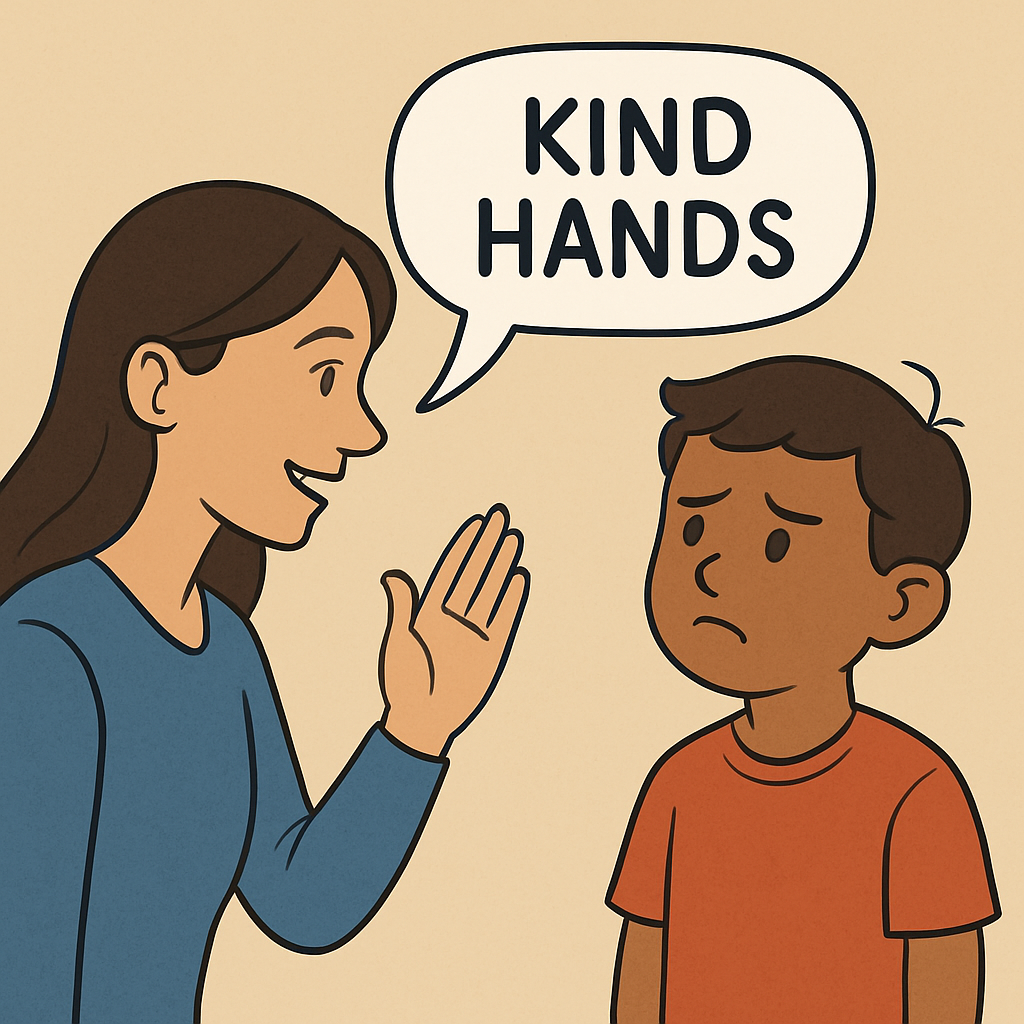
Kind Hands, Kind Feet – and Why Clearer Language Helps
Helping Everyone Understand Behaviour Expectations
Many people really like the phrase “kind hands, kind feet.” It feels warm and positive, and it’s often used in schools, clubs, and care settings as a way of encouraging caring behaviour. The message behind it comes from a good place – wanting to remind children and adults to act with kindness.
But for some, especially children or adults with learning disabilities, autism, or communication differences, the phrase isn’t always as helpful as we’d hope. What sounds encouraging on the surface can actually be confusing in practice.
Why phrases like “kind hands, kind feet” are confusing
They’re abstract
Hands and feet can’t literally be “kind.” The phrase could mean many different things – still hands, a gentle touch, not kicking, or even waving nicely. Because the meaning isn’t obvious, it relies on the person to guess what’s expected.
They’re unclear
Saying “kind hands” leaves the person to work out what action you expect. Some will guess right, but for others the message won’t be obvious.
They can be inconsistent
Different adults may use the phrase differently. One teacher might mean “hands to yourself,” another might mean “gentle touch.” That inconsistency makes learning harder.
Why “Don’t” and “No” can be hard to process
It’s not just abstract words that cause problems. Negative instructions like “Don’t run” or “No shouting” can also be tricky.
The brain often latches onto the action word. If you say “Don’t run,” the word “run” is what gets remembered.
Negatives are abstract. You can’t physically do “don’t.” Our brains – especially when we’re learning or under stress – find it easier to process clear, positive actions.
It leaves a gap. Telling someone what not to do doesn’t tell them what to do instead.
Say what you do want to see
That’s why it’s more effective to give positive, concrete instructions.
Instead of “Don’t run” try “Walking feet.”
Instead of “No shouting” try “Quiet voice.”
Instead of “Don’t hit” try “Gentle hands.”
This way:
The instruction is clear – they know exactly what to do.
It’s doable – it’s an action they can follow straight away.
It’s supportive – it sets them up for success.
Teaching what “gentle hands” means
Even when we use clear, positive phrases, we often need to teach what they mean in practice. For “gentle hands,” here are a few approaches that I use:
Model it – Show what gentle touch looks like. For example, stroke your own arm softly while saying “gentle hands.”
Use visuals – Pair the words with a symbol, picture, or Makaton sign so there’s a consistent reminder.
Practice with safe objects – Let the person practice stroking a soft toy, patting a cushion, or holding your hand gently. Praise and name it: “That’s gentle hands.”
Contrast learning – If appropriate, demonstrate “too rough” versus “gentle” with something safe (like patting a teddy hard vs. softly). This helps make the difference concrete.
Reinforce consistently – Always pair the phrase with the action, so over time the person links the words to the behaviour you want.
Why this matters
When we use clear, positive, concrete language, we make expectations easier to understand. That reduces frustration, supports emotional regulation, and helps children and adults succeed in social situations. In the end, that’s far more effective – and far kinder – than simply saying “kind hands, kind feet.”
Final thoughts
At the heart of all behaviour support is communication. When we use language that is clear, concrete, and positive, we reduce confusion and give children and adults the best chance to succeed.
Phrases like “kind hands, kind feet” are well-intentioned, but they put the responsibility on the learner to work out what we mean. By shifting to action-based instructions – “gentle hands,” “walking feet,” “quiet voice” – we make expectations easy to understand and achievable in the moment.
It’s not about being stricter; it’s about being clearer. Clear communication isn’t just good practice – it’s an act of kindness in itself.
Tags: