
Is It a Symbol, or Is It PECS? Clearing Up the Confusion
If you’ve spent any time around schools, therapists, or parent groups, you’ve probably heard people say things like: “He uses PECs” or “Can I have a PEC for snack?” The word PECS has become shorthand for any picture, symbol, or visual support. But that’s not quite right.
Symbols are not the same as PECS
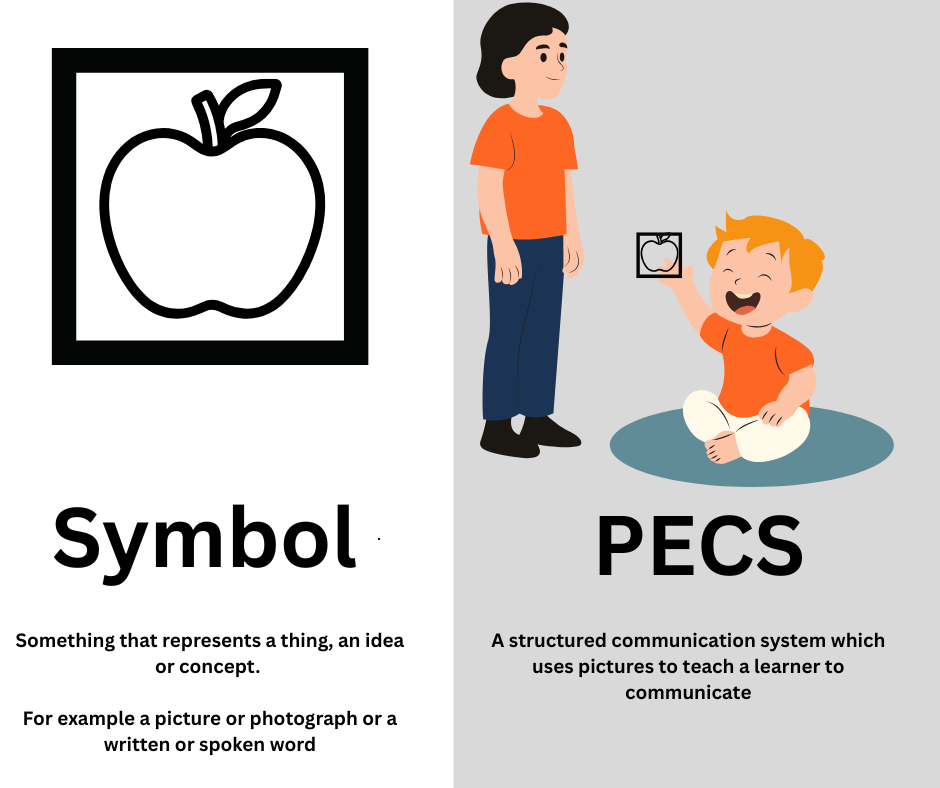
A symbol is anything that represents a concept — this is often thought of in picture form but a symbol could be an object, a written word, a spoken word, or a picture. In this context, when we talk about symbols, we usually mean pictorial representations: a simple image or drawing that helps to represent meaning.
The PECS system is different. It’s a structured programme that uses pictures as part of its teaching method. Any symbol set can be used within PECS (although the programme has its own “Pics for PECS” images). But that doesn’t mean a symbol is a PEC. A visual of any type is not PECS — it’s just a symbol being used to support communication.
Why this matters
When we mix up “symbols” with “PECS,” we risk narrowing how we think about communication. PECS is focused on exchanging a picture to make a request. But communication is so much richer than that. It’s about sharing ideas, telling jokes, showing feelings, saying “no,” asking questions, or just enjoying connection.
A better way: total communication in action
More enlightened approaches to communication have moved away from a strict PECS or ABA-style framework. Instead, they focus on modelling communication without pressure or expectation, within a total communication approach.
What is Total Communication?
Total communication does not mean using every method all at once. Instead, it’s an approach that supports all forms of communication, not just spoken words.
This might include:
-
Gestures, facial expression, and body language
-
Signing or Makaton
-
Touch, movement, and sensory cues
-
Sounds, vocalisations, or music
-
Symbols, pictures, or AAC devices
-
Creative expression such as art or dance
The aim is to find the right combination of methods for each individual — the mix that helps them connect, share, and be understood. One method often strengthens the meaning of another. For example, if someone’s signing isn’t very clear, a symbol alongside it can help clarify what they’re trying to communicate.
Total communication is also about creating a positive environment where communication can flourish, ensuring successful interactions and supporting real connection.
-
Music and rhythm – a tidy-up song, or clapping a rhythm to get attention.
-
Environmental cues – turning off lights to mean “finished,” or opening a lunchbox to show “time to eat.”
The key is that we model these naturally in daily life, without demanding that the child copies us or “performs” communication.
Building relationships through communication
When we stop thinking of communication as something to be trained, and instead see it as a way to connect, something changes. We notice the little things our children are already doing. We join in. We model back. We respond.
That’s when relationships deepen. That’s when children learn that their voice – however it comes out – matters. And that’s what helps them grow into strong self-advocates, able to express not just what they want, but who they are.
Final thought:
Communication isn’t about programmes, systems, or perfect methods — it’s about connection. When we meet children where they are, model different ways of communicating, and respond with respect, we show them that their voice truly matters. That’s the foundation for confidence, relationships, and lifelong self -advocacy.
Tags: