MAIN STREETS
A visit to Bradford about 1800, reveals that the former Forster Square which some of you may remember, was the busiest part of town.The main road from Leeds came down Church Bank to Wells street through Forster Sq to the bottom of Kirkgate and up to Ivegate and Westgate, the three main streets of bradford.
SCHOOL
At the foot of Church Bank was the Grammar School, which stood near the old Post Office. According to a 17th century charter the school was called “The Free Grammar School of King Charles ll The foundation is much older since in 1563 a vicar left 20 shillings to Robert Hall to be school master. Wells street was named after the school well, which moved to Manningham Lane in 1820.
POST OFFICE The Church Steps Inn which was the inn frequented by the church bell ringers was demolished to make way for the Post Office. Some church steps can still be seen.
THE CANAL BASIN was fed from the East Brook (stream) near a bridge called Hoppy Bridge, named after a a famous usher of the school. The canal wharfe was at the end of Canal Rd. The Wool Pack Inn and The Ship Inn bounded the basin and werefrequent by canal workers, The area was referred to as the Isle of Man.
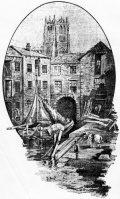
BROADSTONES Leading from this area to the bottom of Kirkgate was Broadstones, one of the main shopping streets and home of Bradfords first bank. Ship Alley was another thorughfare demolished when Broadway was built which lead to the current Hall Ings.
HALL INGS An Ing is an old word of Norse origin referring to water meadows and marshes. Hall Ings was an area of waste ground that was allowed to flood when the beck overflowed during winter and stormy weather. Modern engineering methods ensure that the beck now flows freely underground.
BRADFORD BECK is fed from streams situated to the west of Bradford, streams like Pitty Beck
Clayton Beck Pinch Beck and Middle Brook. It entered Bradford running on the same line as pre Thornton Rd and can be seen behind Holme Mill. It then runs parallel to Aldermanbury and to the bottom of Ivegate. DUNGEON ?
COCKPIT The Cockpit was situated on Aldermanbury and was a place where cockfighting may have Taken place. Later it was converted into the Cockpit meeting hall. John Wesley preached to a large crowds here on one of his visits to Bradford.
At the bottom of Sunbridge Rd and Ivegate you would find the Ive Bridge later to be renamed as the Sun Bridge after the old Sun Inn .
Market Street in 1800 was called New Street and at the Bridge Street end of New Street, the beck was crossed by the New Bridge.
The Bowling Beck joined the Bradford Beck near to The New Bridge and was crossed by by the Cuckoo Bridge that was situated neartodays St Georges Hall
KIRKGATE was a main road through the city leading up to Westgate and Ivegate. It was largely a residential area on which you would see The Bradford Manor House which was situated where the old Kirkgate Market once stood. There were private allottment areas for growing vegitables.
Opposite the Piccadilly – Kirkgate junction was the Bradford Piece Hall, no where near as ornate as the Halifax Piece Hall but achieving the same purpose. Peice Hall yard still exists.
MARKET CROSS At the junction of Ivegate Westgate and Kirkgate was the Market Cross, now situated at the Westgate entrance to Kirkgate Market. Here also was the towns dungeon, the original door can be seen in Bolling Hall. The house of Pleas was situated over the dungeon, this is where you could try to PLEAD your innocence if you had been arrested.
MARKET PLACE The market place and hall was in the position of the old Brown Muff store, adjacent to the wool exchange.
THE TYRRLS was a major thoroughfare better known to us as Tyrrell St. The Bradford brewery stood on the site of the Gaumont/ Odeon cinema.
The Bowling Green Hotel, Bradfords main coaching house was situated on Bridge street
just oposite Carters and Rimingtons.