
This is where you will get updates on Ellesmere Bowling Club's investigation into what lies below the surface of the top green. Will we get a better understanding of the castles foundation and what secrets from the past can we unearth?
Exploring Ellesmere’s Castle - Update 28th May 2026
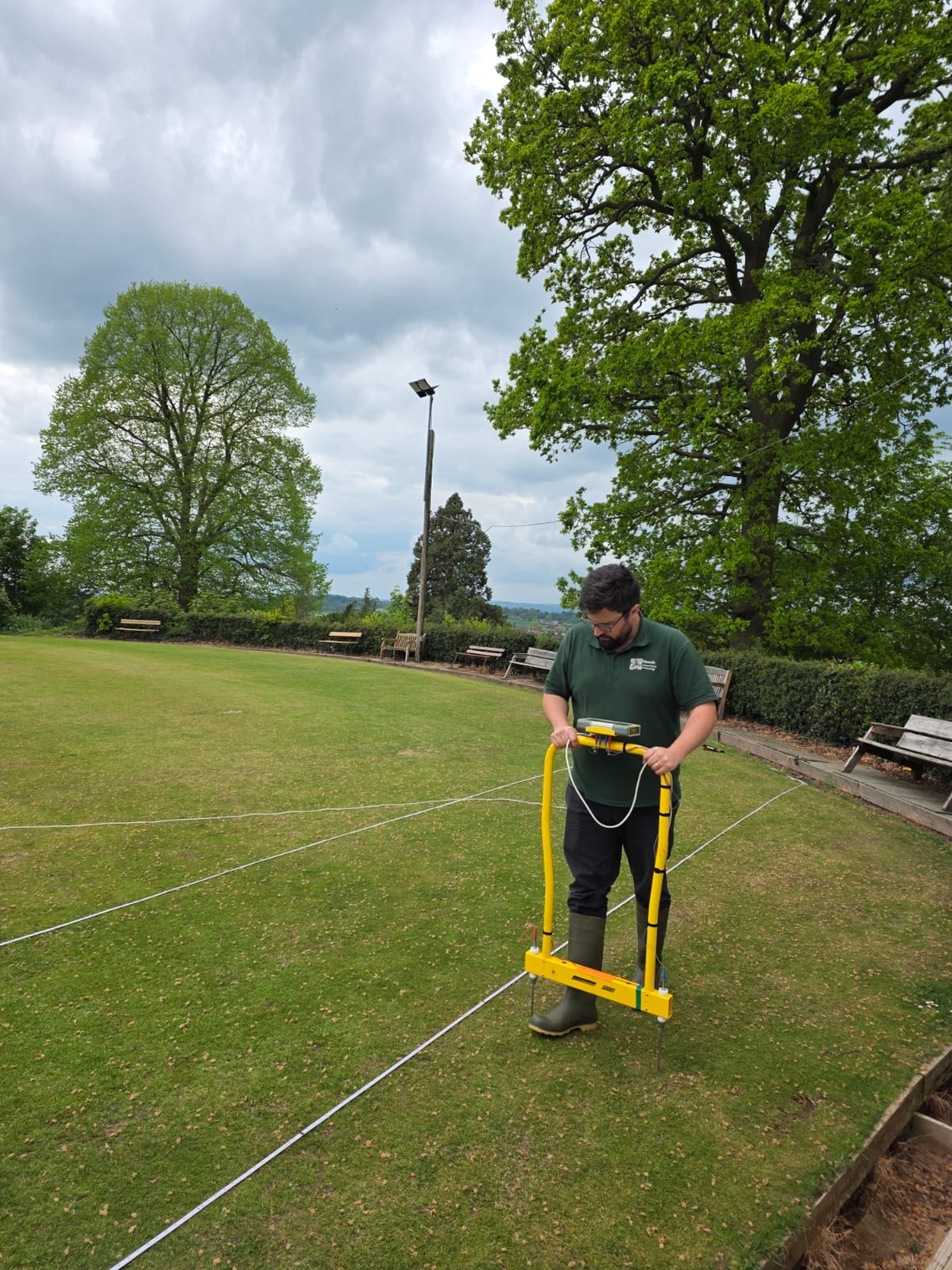
The work has been made possible through a grant from the Castle Studies Trust, awarded to the Ellesmere Bowling Club to investigate Ellesmere Castle (owned by the club) and the adjacent Castlefields, which are owned by Shropshire Council. The project is being led by Nick Cull and Gary Bick of the bowling club, and all surveys are being undertaken with the consent of Historic England.
Investigations to date have included a Ground Penetrating Radar survey of the motte, carried out by Adam Cook of SMT, followed by LiDAR analysis and additional geophysical surveys (magnetometry and electrical resistivity) undertaken by Heneb. Together, these non‑intrusive techniques will allow us to build a picture of what likely lies below the surface, without disturbing the ground or the archaeology beneath.
The survey results to date are highly encouraging. As with many marcher castles, Ellesmere now appears to be far more complex than previously understood. The combined evidence points to a strong likelihood that substantial masonry remains survive below ground, indicating that the site once included significant stone buildings rather than being solely a timber motte‑and‑bailey. Although much of this stone was probably systematically robbed out during the later medieval period, there is a high potential for important buried remains to survive, sealed beneath the Georgian bowling green.
Ellesmere Castle – Revealing the Secrets of a Major Castle of the Welsh Marches
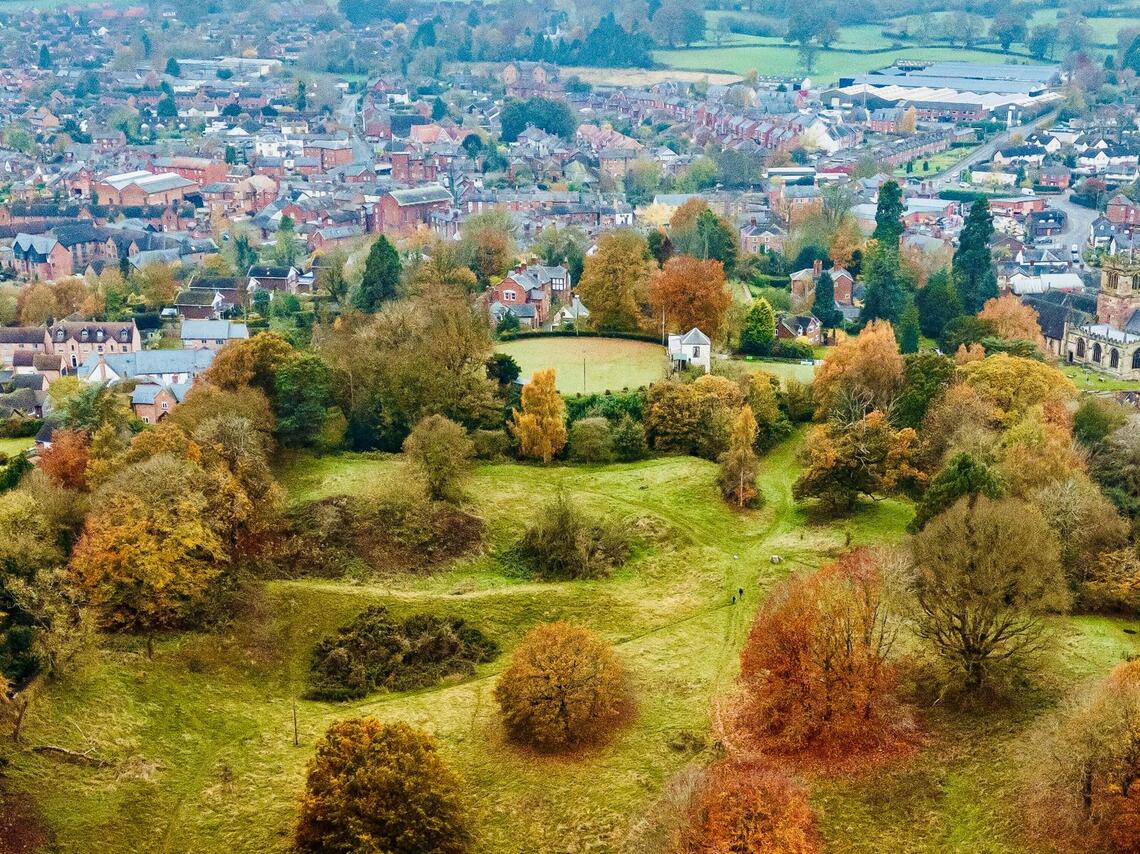
Starting on Monday 23 March, on behalf of the owners of the motte, Ellesmere Bowling Club, and with the support of owners of the rest of the castle Shropshire Council and funded by the Castle Studies Trust, archaeologists from the heritage organisation Heneb will be undertaking a programme of geophysical survey at the castle to assess the potential for surviving sub‑surface archaeological remains. The methods being used include magnetic gradiometry and electrical resistivity survey.
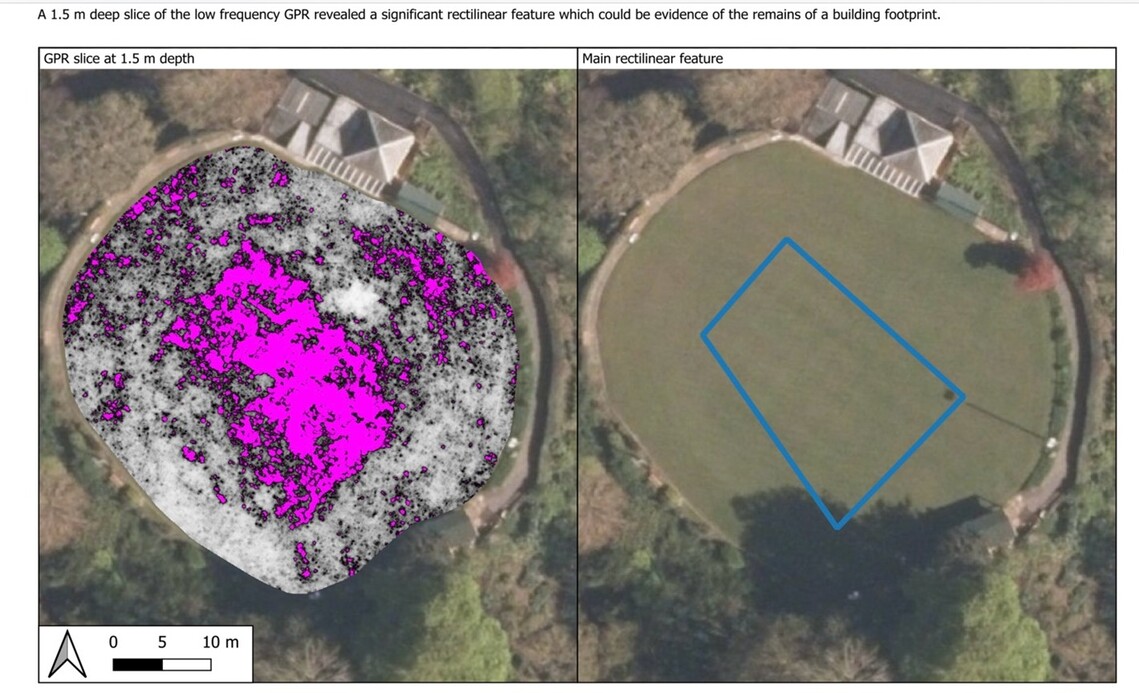
Ellesmere motte top, showing size as an shape of possible structure shown by GPR survey
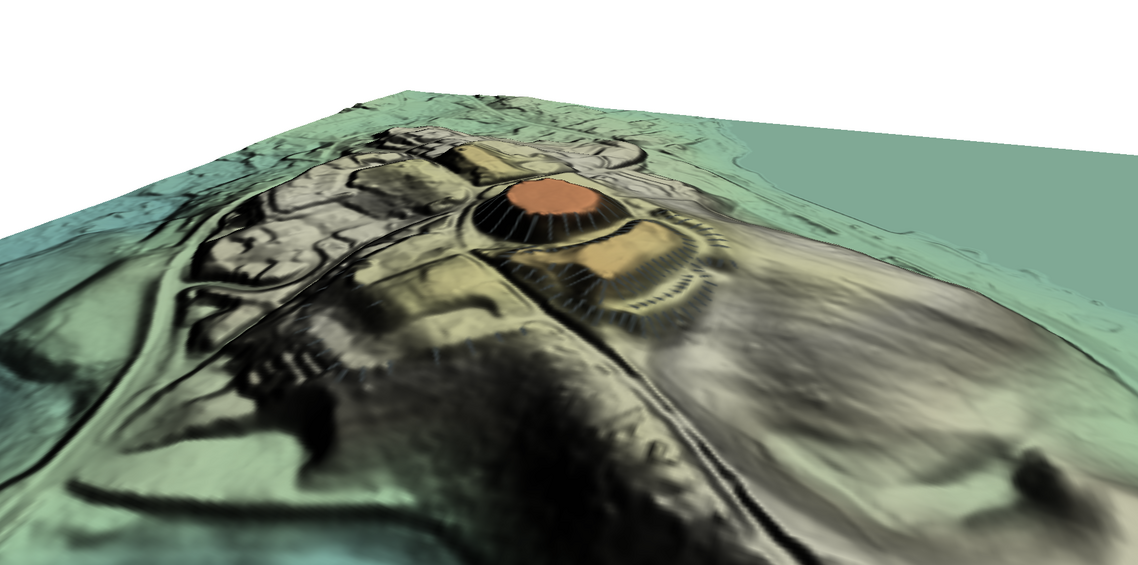
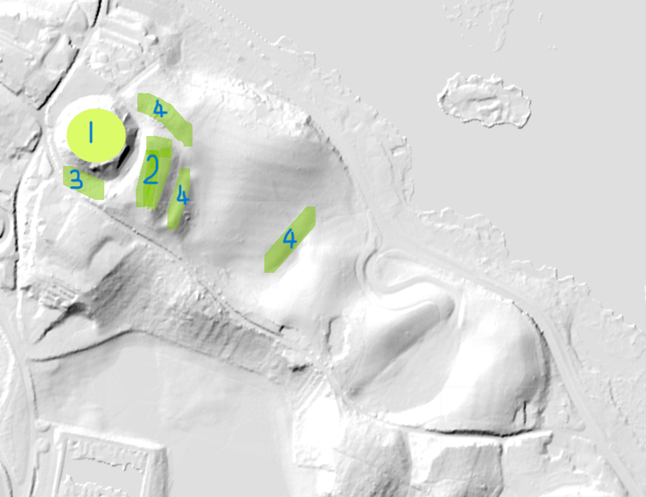
Lidar image of Ellesmere Castle including areas of geophysical survey
This current survey builds on the work carried out in 2024. It will be covering four areas of this very large castle site. The LiDAR image below shows the four targeted areas for geophysical survey:
- Motte: to pinpoint the position of the curtain wall along with any other buildings within.
- Bailey: to determine the location and size of the buildings.
- Area three, to establish where the outer defensive wall once stood that came down from the top of the motte, and to understand the width and depth of the defensive ditch, along with deciphering the extent of the bailey (No2), part of which had been quarried away sometime in the past.
- Earthworks which are believed to be the outer defensive walls, showing what appears to be an entrance in the north east section, and to investigate the furthest easterly earthworks to determine whether there was both an inner and outer bailey.
The date of construction is unknown: it could have been built as early as the late eleventh century, by marcher lord Roger de Montgomery. The lands were confiscated by the crown following his son Robert de Bellesme’s rebellion. The castle was certainly in existence by 1138. In 1174 Henry II confirmed the manor to Dafydd ab Owain, a north Welsh prince, when he married Henry’s sister Emma in 1174. During the early to middle part of the 13th century the manor of Ellesmere passed in and out of royal control and throughout much of that century there are numerous accounts of building or repair works especially during the reign of Henry III.
In 1241 John le Strange was paid forty pounds to build a castle also in the same year twenty one pounds was spent on building two bretasches. In 1256, the King’s house within castle was repaired at a cost of five pounds ten shillings and nine with a further one hundred and sixteen pounds being spent on castle repairs further emphasising the castle’s significance.
In historical terms, perhaps its most well-known claim to fame is that Joan, daughter of King John and wife of Llywelyn ap Iorwerth, was confined to the castle for about a year following her infidelity.
While the survey will not answer questions on its history, it will hopefully supply more details on the castle’s form, and potential targets for future excavation so we can learn more about its history.
PRESS RELEASE
“Will Ellesmere Castle reveal its secrets?”

A grant from the Castle Studies Trust has been awarded to the Ellesmere Bowling Club and will hopefully unlock some of the mystery surrounding Ellesmere Castle.
The Castle, built in the early part of the 12th Century, had a rich and varied history, at one time given by King John to Llewellyn the Great when he married his daughter Joan. But sadly nothing physical remains of the Castle today other than the mound itself which is now home to the Bowling Club and earthworks which cover the top part of Castlefields which is in the ownership of Shropshire Council..
The grant will pay for surveys to identify any buildings on or near the Castle - their size, shape and construction material. They will start to link the Castle’s written history with its actual appearance. Heneb Clwyd and Powys Archaeology - the Trust for Welsh Archaeology -will carry out the survey work during March.
A spokesperson, on behalf of Ellesmere Bowling Club, said, “It’s very exciting to have been awarded a grant from the Castle Studies Trust as there is fierce competition for them each year. The surveys will start to build a picture of what the Castle site looked like over seven hundred years ago. The surveys are non-intrusive so will not impact on the bowling season which starts in April”.
Jeremy Cunnington, Chair of Trustees for the Castle Studies Trust says: “We are delighted to support the local Bowling Club and community to learn more about their castle. Ellesmere was an important and historically significant castle of the Welsh March of which we know next to nothing of what it looked like. Carrying out this survey will hopefully help us learn more.”
Contribution by Gary Bick
Data Protection: When you registered for an EBC account on e-voice.org.uk (Voice), you agreed to UK GDPR and Data Protection legislation. You have the right to request (via Webmaster) access to your information or ask for your account and data to be permanently deleted.