Industry
Farming was the greatest industry in the village. however due to the amount of trade and transport links at one time the village was nicknamed ‘Little London’. In Domesday the village is noted to have grown reeds for rush bearling (placing them on floors in the chapels and other buildings to act as floor coverings). It also grew them for tallow or candlewax. the term 'On the wagon' originated with rush bearing. One fellow had to sit atop the rushes as they were carted to ensure that they did not fall, he had to be sober; hence on the wagon.
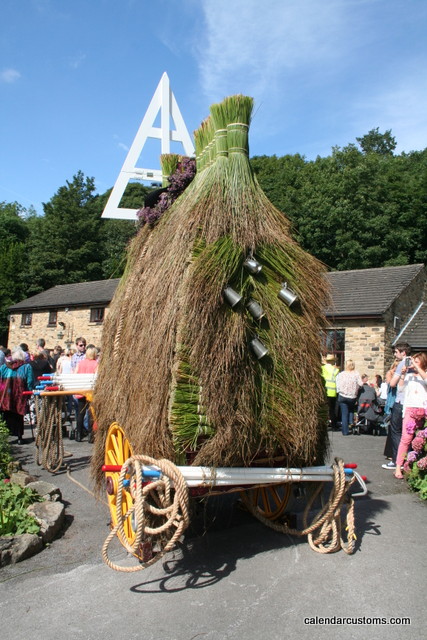
This industry having started in the 11the Century was still evident in the village until 1830. The rushes were conveyed around the village and nearbouring villages via the rushcart. This would have been a slendid form of transport with the rushes piled on ion is a type of dome shape. The shape was reminiscent of a Cathdral window and sitting on the top holding the whole thing together a sober young man. It is written that the rushcart was present at the late season fairs in the village then its harvest was carried to each churrch, hall and other buildings.
The rushes were stored in buildings to be used as floor coverings in the winter. They were spread on the floors, down the aisles, among the pews, in the pulpit as a farmer spreads bracken for bedding in a cow boose. The rushes were also used in the large halls in the area and at one time would have been the inly form of floor covering. In 1800 it was noted that St Anns church at Copp had no pewsonly benches with open backs and rushes on the floor. When the Bishop visted the church in the early 1800s he wrote that the church looked like a stable and then he gave the church warderns a good telling off. The last time rushes were used for this purpose was in 1821 although the rushcart was still used for another 9 years in the village.
Ancient tradition ( and superstition) stated that a horse could not pull the rush cart and it had to be hauled by young strong men in the village. During the Harvest Fair the young men would wheel the cart into the Square then down many pints in the three public houses, cause havoc among the young lasses. Then the 'swippers' would in this state pull the cart to the church and other large buildings. Only one was sober and he sat at the top of the pile of rushes.
The builders of the cart could build a strong sturdy pile of rushes. It would have to survive long miles on uneven, rutted roads (like today then) without losing any of its cargo. Many carts could be a thing of beauty. Now the 'swippers' were a roudy crew; usually drunk. However they were above the law and the magistrates looked favourably on them, with none reported as being in trouble with the law whilst plying their trade.