Electic vehicles (EVs), as well as being good for the planet, are also becoming good for the wallet!
Although many EVs are still 10-15% more expensive then their petrol equivalents, there are government grants available and running costs can make the EVs cheaper over 2 - 3 years (depending on mileage). Economy and convienience, today, are still dependent on your charging arrangements.
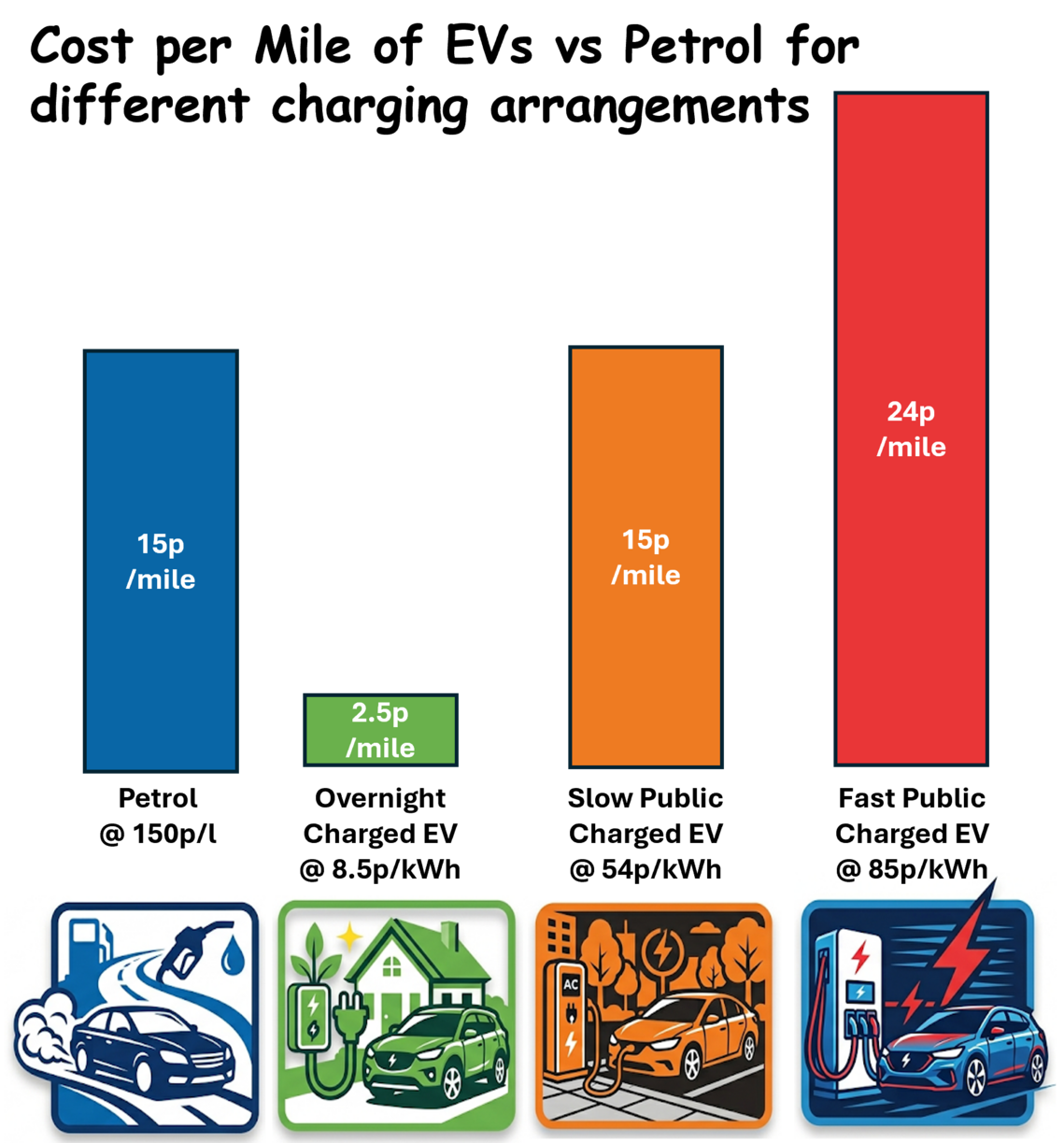
This graph compares the energy price per mile for various charging option.
Some raise the issue of battery manufacturing pollution and emissions. The extra emissions created during battery manufacturing mean that, currently, an EV only becomes lower emission than a petrol car after about 11,000 to 30,000 miles. Battery technology is improving with newer batteries becoming less dependent upon rare-earth-elements with their harmful extraction practices.
EV Charging
Public chargers, while helpful if you need to charge away ccfrom home, are expensive. The BP Pulse chargers in Cricklade currently charge 65p/kWh making them above average for a slow charger (7kW).
Charging at home saves significantly. With electricity at 30p/kWh, the cost is about 8p/mile, approximately half the price of a petrol car. Where overnight tariffs are used, this can come down to about 2.5p/mile, potentially saving £1,000 for every 8,000 miles driven.
For those lucky enough to have off-road parking, the cost of a home charger is easily recouped. (Low mileage drivers might not need a dedicated charger. A standard 13amp socket can provide 100 miles worth of charge in about 10 hours.)
Solutions for those who have to charge on the street are coming. Wiltshire Council is assessing the safety and economics of installing covered gullys across pavements to enable cables to pass over without creating trip hazzards for pavement users. Trials are being rolled out this year and, it is hoped that, solutions will become available in 2027. For more information and to apply to take part in the trials, click here.