
Many visitors walk or cycle along the former Killingworth Waggonway without realising they are following a route that played an important role in the development of the modern railway. Originally built to transport coal from Killingworth Colliery to the River Tyne, it later became associated with the pioneering work of George Stephenson, whose locomotives and engineering innovations helped transform transport in Britain and around the world.
A substantial section of the historic Killingworth Waggonway survives within Rising Sun Country Park. From the Imago butterfly gates on Whitley Road, walkers and cyclists can follow part of the original route as it passes Swallow Pond and continues through the park.
In the early nineteenth century, the route became a testing ground for some of the most important developments in railway history. Stephenson tested Blücher, his first locomotive, on the line in 1814. Fifteen years later, Rocket, which would go on to win the famous Rainhill Trials, also underwent testing on the Killingworth Waggonway.
While the wagons, rails and industrial activity have long disappeared, the course of the route remains visible in today's landscape, allowing visitors to follow the same corridor once used by some of the earliest steam locomotives.
Today, the former waggonway serves a very different purpose. As well as providing opportunities for walking, cycling and exploring local history, it forms an important green corridor for wildlife, helping to connect habitats across the park and beyond.
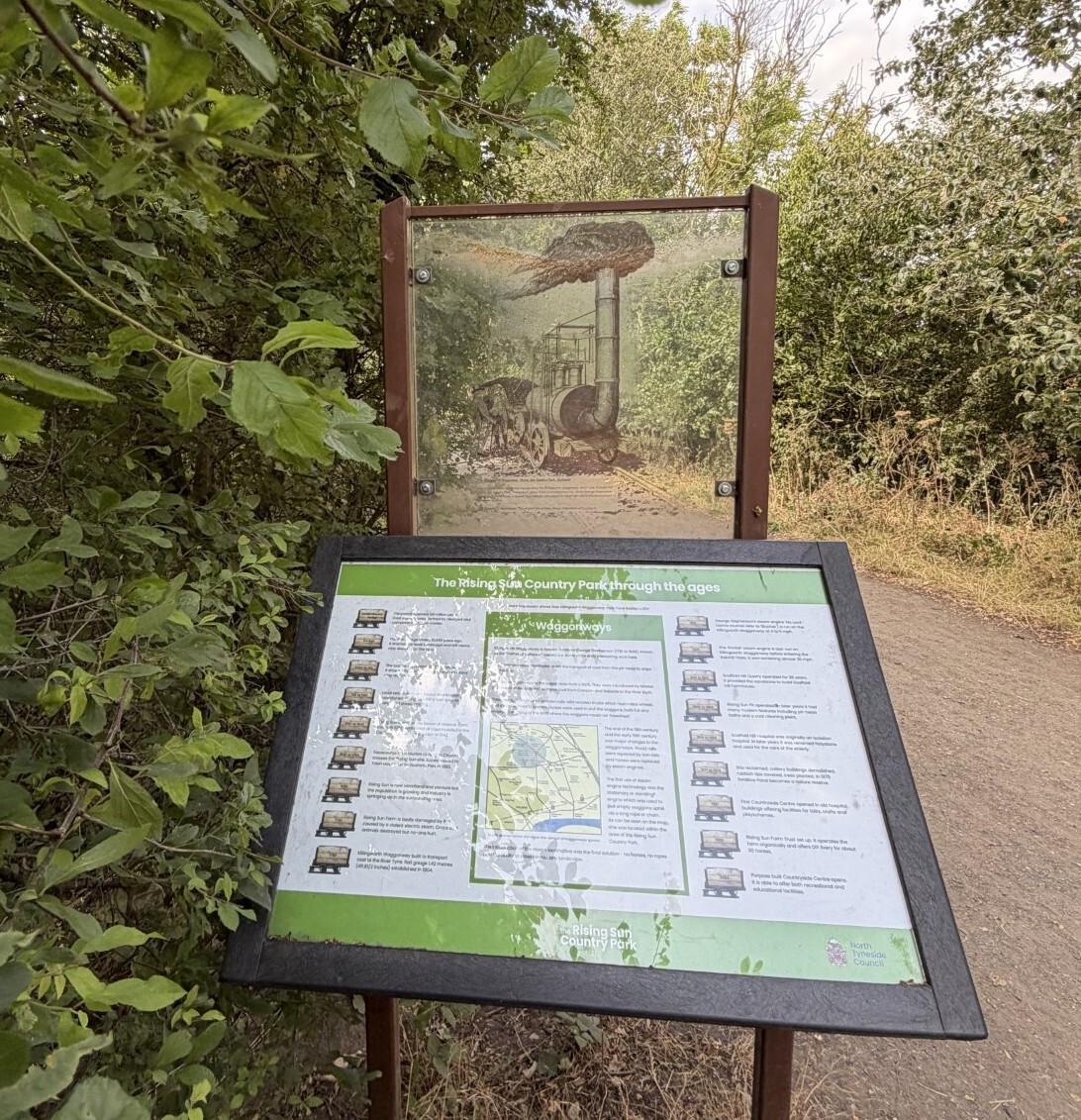
Along this section of the route, the park's heritage interpretation panel charts the history of the Rising Sun site, from the Carboniferous Period through farming, quarrying, mining and its years as a hospital, to the opening of the purpose-built Countryside Centre in 2003. A see-through artwork panel above it allows visitors to imagine Blücher travelling along the waggonway, superimposing an image of Stephenson's pioneering locomotive onto the present-day landscape.
Explore the links below to learn more about the history of the Killingworth Waggonway, George Stephenson's work at Killingworth, the development of Blücher and Rocket, and the wildlife that now thrives along this historic route.