
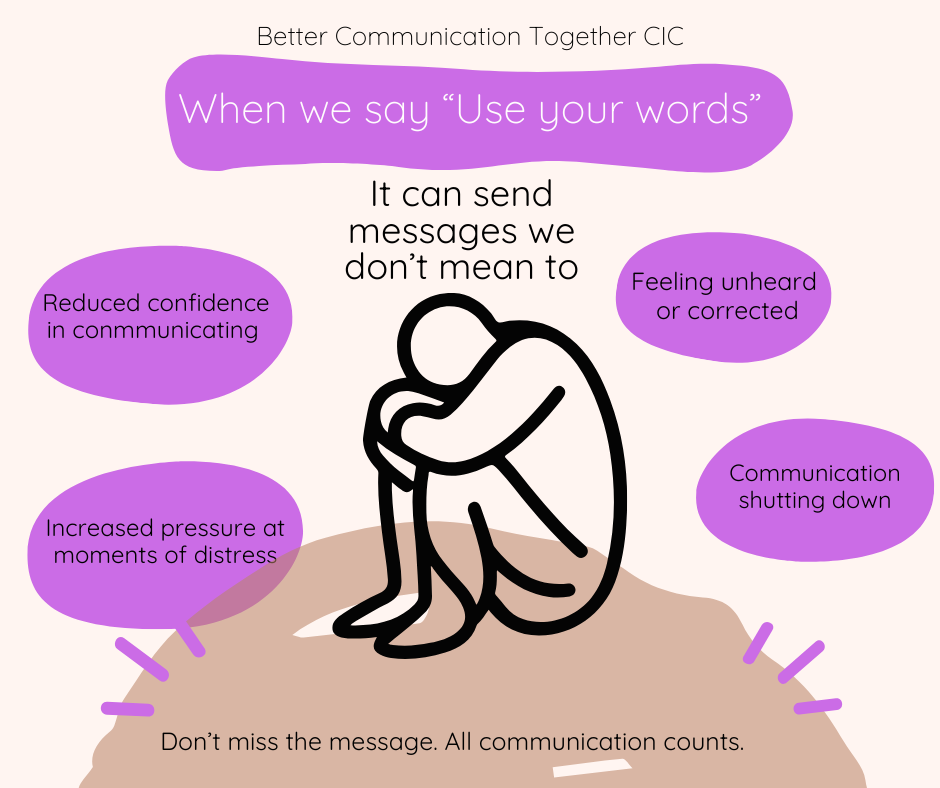
During a recent communication training session, a conversation arose about a young person who is sometimes prompted to “use your words.”
This approach was part of an agreed strategy and written into the young person’s EHCP.
One member of staff shared that this didn’t sit comfortably with them.
That feeling was valid.
Phrases like “use your words” are often well-intentioned. They are usually meant to support communication and reduce frustration.
However, this is a phrase I would encourage us to move away from.
Not because staff are uncaring.
Not because support plans are written without thought.
But because this phrase places the responsibility for communication entirely on the individual — and doesn’t reflect how communication access really works.
When communication is already happening
When we say “use your words”, or even “use your signs / symbols / device”, we are often responding to a moment where communication is already taking place — just not in the way we expected.
This isn’t a theoretical concern for me. These are real moments I’ve witnessed — and they’ve stayed with me.
I remember being in a situation where a young person who uses a voice output communication aid answered a question using signs.
Their response was clear, correct, and intentional and I understood them immediately. But it wasn’t accepted and they were told to “use your device.”
I remember how uncomfortable that moment felt - a successful piece of communication had just happened — and yet it was treated as if it didn’t count.
I’ve also witnessed someone who communicates with speech express their needs clearly through movement, gesture, and facial expression.
To me, their message was there if you were willing to look. It wasn’t responded to and later, I heard them described as “lazy.”
That stayed with me too because what I saw wasn’t laziness — it was effort that went unrecognised.
Why “use your words” doesn’t sit well
This phrase assumes that communication is always available on demand or that the person is choosing not to use it. It assumes that there is a correct method that must be used.
It doesn’t take into account emotional regulation, sensory overload, fatigue, confidence or accessibility of tools in that moment
For many people, especially in times of stress, access to communication fluctuates and being told to “use” a method can add pressure at the very moment when support is most needed.
The unintended messages we send
Even when spoken calmly, phrases like this can communicate:
“This way doesn’t count.”
“You’re not trying hard enough.”
“I value the system more than your message.”