
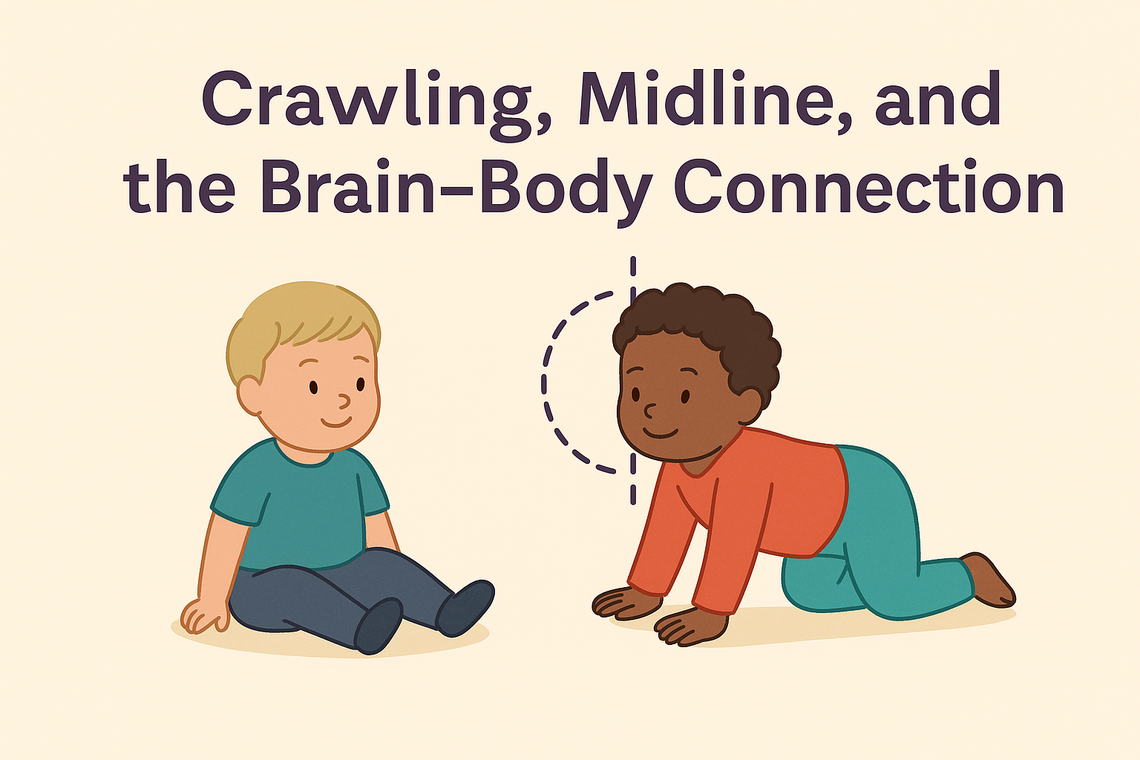
When my son was a youngster, he didn’t crawl. He shuffled around on his bottom instead — not fast, but slowly and determinedly, finding his own way to explore the world.
He couldn’t sit up independently until he was nearly two, and his low muscle tone made physical tasks more of a challenge. At the time, I thought nothing of it. It was just how he moved — his own unique way of getting from A to B.
What I didn’t realise back then, until an Occupational Therapist explained it to me, was how much crawling contributes to speech and language development. That conversation changed how I thought about movement, communication, and the brain–body connection.
Crawling and the Brain–Body Connection
Crawling isn’t just about mobility — it’s a vital part of how the brain organises itself. When babies crawl, they move their opposite arm and leg together: right arm with left leg, left arm with right leg. This “cross-lateral” movement helps both sides of the brain communicate through the corpus callosum — the bundle of nerve fibres that links the two hemispheres.
This early integration supports so many later skills, including:
Balance and posture
Hand dominance
Visual tracking and focus
Sequencing, timing, and rhythm
Speech and language
In other words, crawling helps the body and brain learn to work together — a foundation for everything that follows, from walking to writing to talking.
When Crawling Is Missed or Limited
Not every child crawls in the typical way, and that’s okay. Some shuffle, roll, or find other ways to get around. But when crawling doesn’t happen, the brain–body pathways that connect left and right may need extra support later on.
Children who skip crawling sometimes show:
Difficulty crossing the midline (moving one hand across the body)
Switching hands during a task
Challenges with rhythm, sequencing, or motor planning
Lower core strength and stability
Speech and language delays linked to coordination and timing
For my son, low muscle tone made many of these things harder. Once I understood the link, I saw how physical development and communication were beautifully intertwined.
Why It Matters for Signing and Communication
As a Makaton tutor, I see this connection play out every day. Signing isn’t just a hand skill — it’s a whole-body skill. It relies on coordination, rhythm, and timing. Many signs naturally cross the midline or use both hands together.
If crossing the midline is tricky, people might:
Keep signs on one side of their body
Swap hands mid-sign
Modify the sign — creating their own version that feels easier or more natural
And that’s perfectly fine. Signing is about communication, not precision. If the sign gets the message across, it’s a success.
Communication partners can:
Acknowledge and value each person’s way of communicating.
Pair signs with other visual indicators such as symbols, pictures, or objects of reference to support understanding.
Model the sign back correctly — correction isn’t necessary. Modelling is best practice.
Every attempt to connect deserves recognition. What matters most is that meaning is shared, not that movements are identical.
“Signing is about communication, not precision.”
My Own Experience of Dyspraxia
I also bring my own experience to this understanding. I have dyspraxia, and I often twist my body when I write so I don’t have to cross my midline. It’s not something I think about — it’s just what feels easier.
Using a laptop is far more comfortable for me than writing by hand, and I’ve learned that this isn’t avoidance — it’s adaptation. My brain and body are finding the most efficient route to success, just as my son did when he shuffled instead of crawled.
Recognising this helps me see others’ adaptations not as “incorrect,” but as clever, creative solutions.
Supporting Midline Development Through Movement
If someone has missed the crawling stage or finds coordination difficult, we can gently strengthen those brain–body connections through play and rhythm. Professionals reccommend activites such as:
Cross-crawl games (touching opposite hand and knee)
Rolling or reaching activities on the floor
Dancing with scarves or ribbons to encourage side-to-side movement
Action songs that involve both sides of the body
Movement and communication are deeply linked — when the body feels connected, the brain is freer to focus on interaction, understanding, and expression.
A Better Approach
Understanding how movement underpins communication helps us see the whole person, not just the surface skill. It reminds us that everyone develops in their own way, and every movement — whether crawling, shuffling, or twisting — tells part of their story.
Instead of correcting difference, we can celebrate adaptation.
Every child, every learner, every communicator finds their own way to connect. And when we create space for those individual routes, we build true inclusion.