
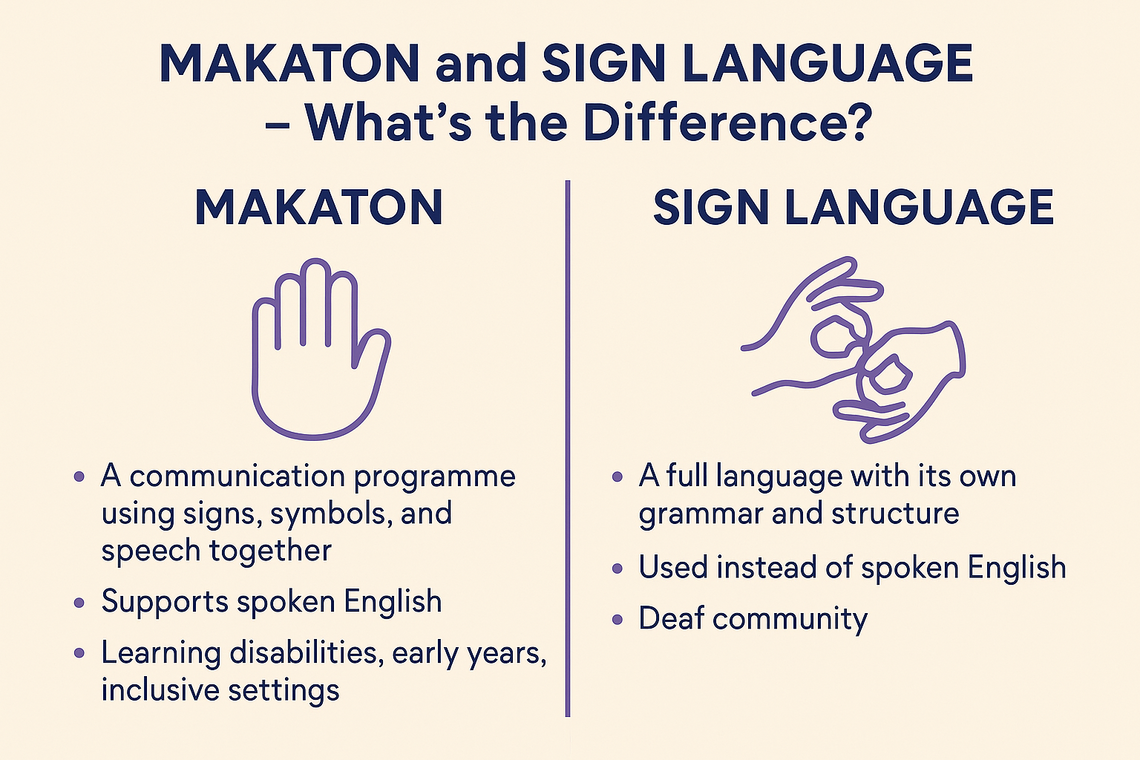
Makaton and Sign Language – What’s the Difference?
One of the questions I’m asked most often is: “Is Makaton the same as British Sign Language (BSL)?” The short answer is no — but both are powerful, meaningful, and deeply valuable in their own ways.
It’s important to talk about this carefully and respectfully, especially when speaking about the Deaf community and BSL, which have a long and rich history.
What is Makaton?
Makaton is a communication programme that uses signs, symbols, and speech together. It was originally developed in the 1970s to support people with learning and communication difficulties.
The key idea is that Makaton supports spoken language. Signs (usually drawn from BSL) are used alongside speech, while symbols give a visual reminder. This means it can help with both understanding and expression. Signs are standardised across the UK.
Makaton is used widely in:
- Early years education
- Families supporting children with additional needs
- Adults with learning disabilities
- Inclusive settings such as schools, libraries, and community groups
What is British Sign Language (BSL)?
BSL is a complete, natural language with its own grammar, sentence structure, and cultural identity. Unlike Makaton, BSL does not rely on spoken language — it stands alone. It is not a visual representation of spoken language.
Instead, BSL is an independent language in its own right — the language of the Deaf community in the UK. Like any language, it has regional variations and dialects, so signs may differ depending on where in the UK you are.
For many Deaf people, BSL is their first language. It carries not only communication but also identity, culture, and community.
A Little History
- Records of sign language use in Britain date back to the 16th century, although Deaf people have always needed a way to communicate, and signs have existed as long as there have been civilisations.
- In 1760, Thomas Braidwood founded the first school for Deaf children in Edinburgh, where sign language began to flourish.
- However, it’s important to note that Deaf history is not only about growth but also about struggle. For centuries, Deaf people were often denied the right to use their own language. The 1880 Milan Conference — an international meeting on Deaf education — declared that spoken language should be used instead of sign language. This decision led to the widespread banning of sign language in schools, forcing generations of Deaf children to learn through oral methods alone. Many experienced isolation, punishment, and discrimination simply for using their natural language.
- Despite these barriers, the Deaf community fought tirelessly to keep BSL alive — passing it down within families, clubs, and communities.
- It was only officially recognised as a minority language in the UK in 2003, and the BSL Act 2022 now gives it legal status in England, Scotland, and Wales.
- BSL is central to Deaf culture, identity, and community. The resilience and activism of the Deaf community have ensured that BSL continues to thrive, despite a long history of challenges. Today, BSL remains central to Deaf culture, identity, and community — a living language carried forward with resilience, creativity, and pride.
To learn more, you can explore:
- British Deaf Association (BDA)
- SignHealth
- Deaf History Scotland
Key Differences Between Makaton and BSL
- Purpose: Makaton is designed to support spoken English. BSL is a full, independent language.
- Grammar: Makaton follows English word order. BSL has its own grammar and syntax.
- Community: Makaton is widely used with children, people with learning disabilities, and in inclusive settings. BSL belongs to and is led by the Deaf community.
- Symbols: Makaton uses visual symbols alongside signs. BSL does not.
Why Both Matter
It’s not about which is “better.” Both Makaton and BSL are valuable, and both create bridges to understanding and connection.
For a child with learning difficulties, Makaton might unlock their first words. For a Deaf person, BSL may be their identity, their culture, and their language.
Both deserve respect, celebration, and support.
Closing Thought
Think of Makaton as a stepping stone that makes communication more accessible for many people. And think of BSL as a thriving, complete language that belongs to a proud and resilient community.
The more we understand both, the more inclusive and respectful our society becomes.