The idea of establishing a Joint Hospital Scheme for the districts of Tynemouth (Rural), Earsdon, and Whitley & Monkseaton first emerged in January 1902. Across the country, local authorities were under increasing pressure to improve public health provision in response to outbreaks of infectious diseases such as scarlet fever, diphtheria and smallpox. Isolation hospitals were becoming an important part of disease control, with the Local Government Board encouraging neighbouring districts to work together and share costs.
Earsdon Urban District Council initially rejected the proposal, but six months later Tynemouth Town Council's Sanitary Committee revived the idea. It recommended applying to the Local Government Board to establish a Joint Hospital Board, bringing together Tynemouth Town Council, Tynemouth Rural District Council and Whitley & Monkseaton Urban District Council, while inviting Seghill and Earsdon Urban District Councils to participate.
Progress stalled during 1902 when disagreements arose over representation on the proposed board. Tynemouth Town Council sought seven representatives, leaving the remaining districts with only six between them. The other authorities rejected this arrangement, arguing that no single district should hold a majority. Negotiations eventually shifted towards a scheme involving the urban districts of Seghill, Earsdon, Whitley and Monkseaton, together with Tynemouth Rural District.
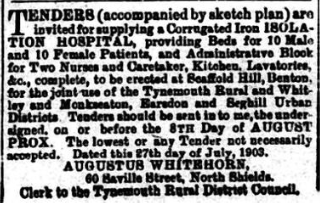
On 27 July 1903, an advertisement appeared in the Shields Daily News inviting tenders for the construction of a corrugated iron hospital at Scaffold Hill. Prefabricated hospitals of this type were widely used at the time because they could be erected quickly and at relatively low cost, providing much-needed isolation facilities during outbreaks of infectious disease.
The Earsdon Joint Hospital Board (EJHB) was formally inaugurated at a meeting held at Guardian Hall, North Shields, on 3 September 1903. It was constituted under a provisional order on 7 October 1903, later confirmed by Parliament in May 1904. The Board held its first official meeting on 11 October 1904, marking the start of coordinated infectious disease provision across the member districts.
The creation of the EJHB represented a significant step forward in local public health. By pooling resources, neighbouring authorities were able to provide facilities that would have been difficult for individual districts to fund and maintain alone. The isolation hospital at Scaffold Hill became part of a wider effort to protect local communities from infectious disease during a period when epidemics remained a constant concern.
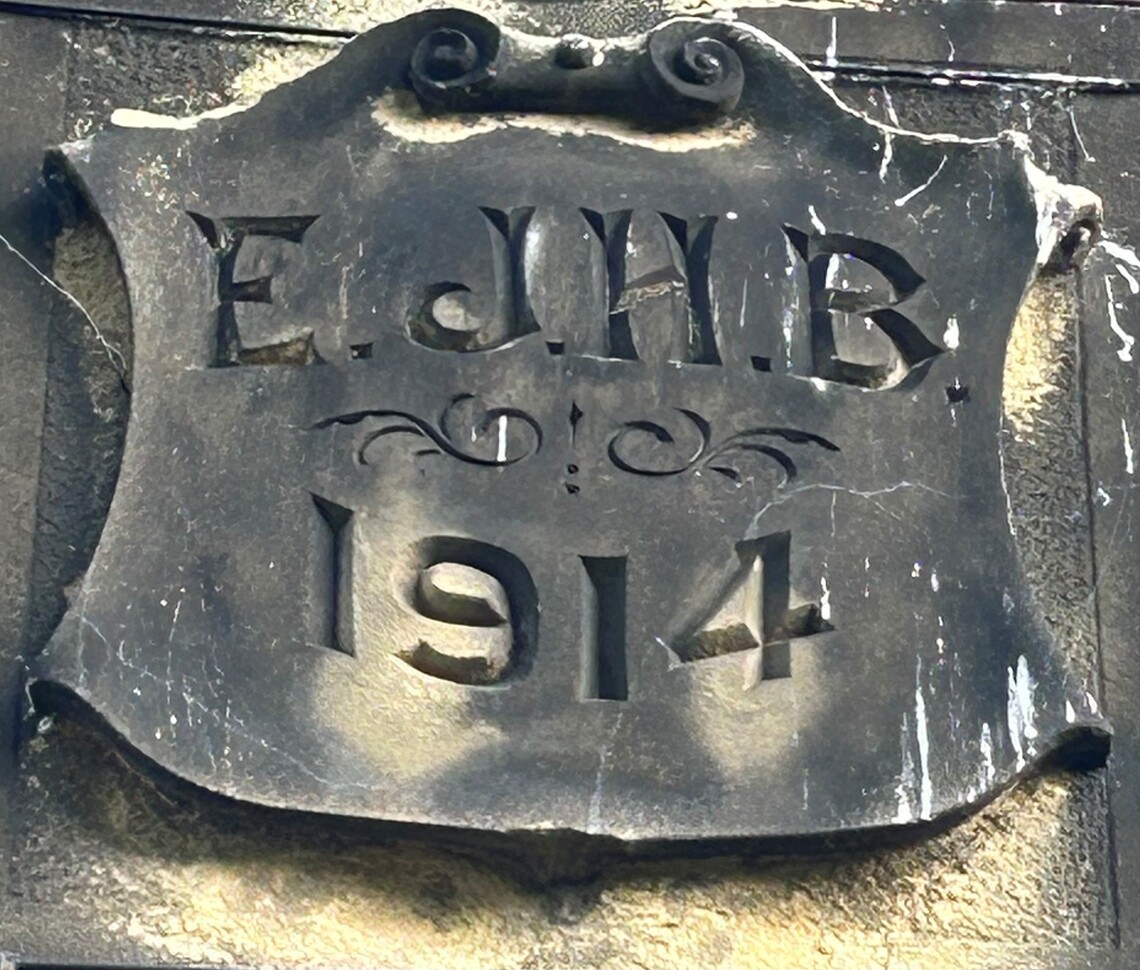
Many of the former hospital buildings remain today. Each still displays the crest of the Earsdon Joint Hospital Board together with its date of construction, providing a visible reminder of the site's role in protecting local communities from infectious disease during the hospital's early years.