
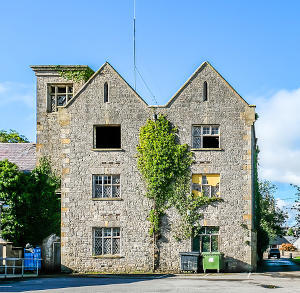
The Victorian workhouse
Wednesday 08 January 2025
19:45 to 21:30
Report by Shirley Deering
On the evening of 8th January members were delighted to welcome back speaker Richard Pusey. On this occasion Richard’s subject was “The Victorian Workhouse”.
Under an 1834 amendment of the Poor Law, local authorities were required to provide support and accommodation for those in their community who were destitute and unable to find paid employment. Those who met the criteria for admission were first given a bath and a set of clean clothes. Their living conditions were spartan, but at least each individual had his/her own bed. Men were put to work breaking stones for road repairs, women helped with domestic work, mostly in the workhouse laundry.
The thing most dreaded by those facing life in the workhouse was the break-up of families. Husband and wives were separated and only babies and children under five were allowed to stay with their mothers.
The workhouses themselves were solidly constructed, many designed by well-known architects of the day and visually attractive. Many survive to this day, in the form of hospitals, hospices or residential care homes. Some have been converted into luxury apartments, where the owners or tenants enjoy a life style undreamed of by the original residents.
>
Workhouse visits to Hatfield Forest
Postscript by David Simmonds
At our January meeting, Richard Pusey, gave us a fascinating and well researched talk about the Victorian Workhouse. Life in workhouses was generally grim and arduous and so I was pleased to tell Richard before the meeting of the annual outings of inmates from Bishop’s Stortford workhouse to Hatfield Forest. I know about these because they are recorded in the Forest’s Visitors’ Book.
Three visits took place:
28 August 1896 - H Traill (Master), Robert Gilham, Charlie Speller with inmates of Bishop Stortford Guardian Union Workhouse
24 September 1898 - H Traill & family and 121 inmates of Bishop Stortford Workhouse
8 September 1899 - Bp Stortford Union Inmates Outing (the word Guardian has been crossed out!)
My feeling is that these were genuine outings, rather than work parties. I think they may well have walked the two or so miles from Haymeads Lane in Bishop’s Stortford to the Forest. The Workhouse records are in the Hertfordshire Record Office and one day I hope to go over to Hertford to see if more information is available.
The Master at the time was Harry Traill. In the Cambridge Daily News of 24 August 1899 (on Findmypast) there is a reference The Master (Mr H Traill) asked for permission to give the inmates in the House their annual outing. He said last year the inmates were taken to Hatfeld Forest and in all probability he might get permission to take them again this year. The Board acceded to his request.
I am always pleased to show these entries to present day visitors as they show workhouses in a different light. They make a wonderful contrast to the visit on 1 April 1893 of Albert Edward, later King Edward VII. It is also gratifying to know that some 25 years before Hatfield Forest was presented to the National Trust, the Workhouse was giving inmates access to nature, which is in line with one of the Trust’s new strategic goals for 2025 to 2035.
Please contact me for further information about the Visitors’ Book.
| Location |
Trinity Methodist Church, Rainsford Road Chelmsford Essex CM1 2XB (view map) |
|---|---|
| Cost | £3.00 Members / £5.00 Non-Members |