Lincolnshire Heritage Explorer - MLI13123 - Wolmersty Deserted Medieval Village.
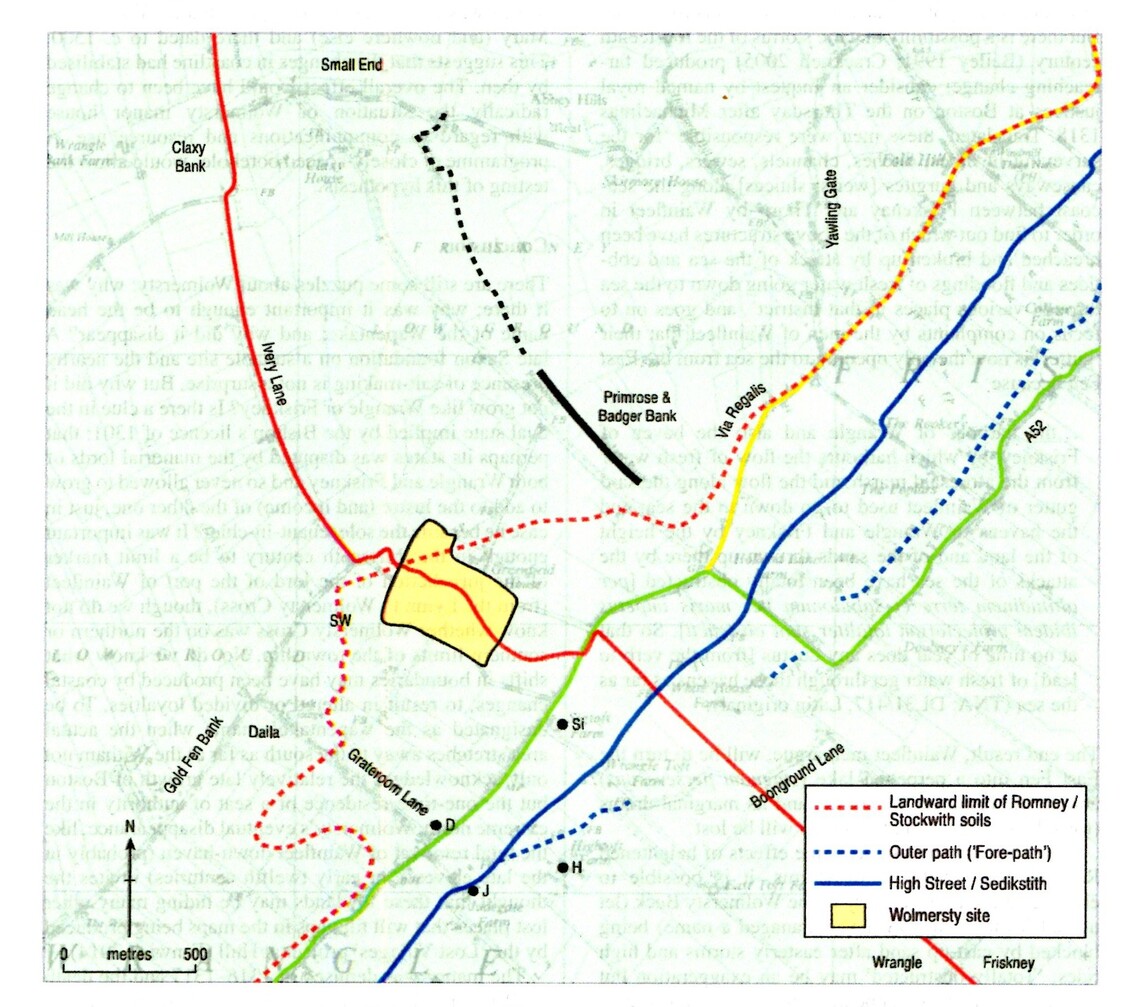
As sea levels slowly dropped from their raised levels at the end of the Roman period more land became available for settlement. From available information, the first of these areas to appear would have been the Stickney Ridge closely followed by a large land mass stretching from Leake, in the North-east, to Spalding and the River Welland, in the south-west. The areas between this land-mass and the mainland would still be below sea level and were, at best, salt-marsh. As levels continued to fall other hillocks of dry land appeared and, situated on the North-west boundary of the parish of Wrangle, one of these became the site of Wolmersty, Vlmerstig in the Domesday Book.
It is believed the name is derived from a combination of Wulf, (Ulf), spelled Vl in Old Danish, stig, a narrow road or path, and mer, the sea. When assembled this could become "Wulf's path to the sea." which could be linked to the references to a "Sea-bank Path." documented in both Wrangle and Wainfleet.
From the dating of items recovered during investigation it can be shown that Wolmersty existed from the late Anglo-saxon period (AD900 - 1066).
A short distance north (3km) lie Dickon Hills, another raised area where late Anglo-saxon items have been recovered and, if the havens of Wrangle and Friskney still merged at this point, the name Vlmerstig could have indicated an Anglo-saxon path to the sea.
As the sea-level fell still further, more land became available Wolmersty gained in importance and records indicate that the villages of Wolmersty, Leake and Butterwick became part of the Wapentake of Bolinbroke. At an unknown date the the area became sufficiently important that the Wapentake of Wolmersty was created taking in the villages of Wolmersty, Wrangle, Leake, Leverton, Butterwick, Freiston, Fishtoft and Skirbeck and this was the situation at the time of the Domesday Book.
NOTE. Skirbeck was a village and Boston did not exist.
Over the following years Wolmersty was mentioned in a number of documents, usually to do with the boundaries, useage and ownership of other tracts of land and it is known that there were salterns being worked on the site. However, the importance of Wolmersty waned, possibly because of its position on the boundary of two Wapentakes, and, eventually, the Wapentake was renamed as that of Skirbeck which included the developing harbour and town of Boston.
The manor of Wolmersty was demised in 1316 - 1317 and in 1369 a transfer of land named both Wrangle and Friskney but not Wolmersty. The name of the manor was still on record until 1529.
The Wapentake of Skirbeck is still recognised and includes all of the named villages and towns.
-----------------------------------------
The following item is a copy of an article printed in the Sixth Annual Report of The Trust for Lincolnshire Archeology October 1990.
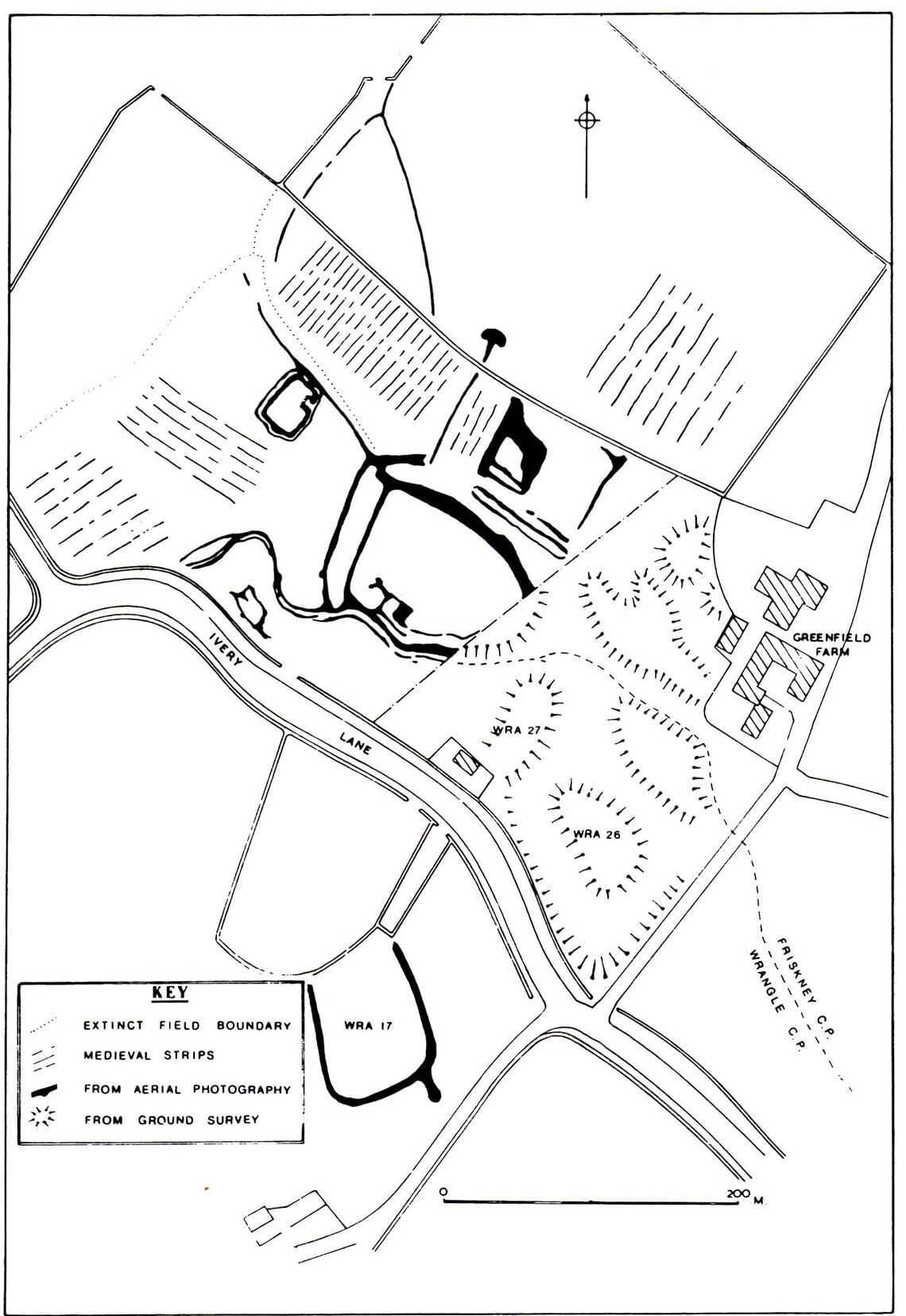
Wolmersty in Friskney/Wrangle.
A plan of the Earthworks and crop/soil markings.
(Drawing by P.Sidebottom)
The site of one of the few deserted Medieval settlements in the Lincolnshire Fens was located in 1988 during the Fenland Survey. The site, which straddles the Wrangle-Friskney boundary, is thought to be that of Wolmersty.
Finds of pottery sherds made during field survey suggest the village was founded in the Late Saxon period. At that time Wolmersty was a significant place for it provided an early, if short-lived, name for the wapentake later called Skirbeck. (Fellows Jensen 1978, 344; Foster & Longley 1976, 68).
A seaward location for Wolmersty, on the borders of Wrangle & Friskney, is suggested by historical sources; sometime before 1186, Simon le Bret gave Waltham Abbey four acres of meadow in Wrangelcornfen next to Wilmersti abutting on the boundary with Friskney (Hallam 1965, 17); in 1274, the Abbot of Waltham claimed in Wrangle 'wrecks and wayffs and the goods from felons from Leake Bank (on the western parish boundary) to Wolmersty (Thompson 1856, 594), presumably tying in the latter place to the eastern parish boundary. The location of Wolmersty is almost certainly that of the pottery scatters recorded as WRA17, 26 & 27, near Greenfield Farm. WRA17, which aerial evidence indicates was once enclosed by a ditch, stands on a sub-circular, low mound of galacial clay, surrounded by marine silts. The earliest pottery from the mound has been dated to the Late Saxon period (H.Healey pers. comm.) and other finds include a lava quern and 70 animal bones. Some brick features were apparently noted when the farmer dug into the mound some years ago.
Across Ivery Lane, nearer to Greenfield Farm, are the ploughed remains of an area once surrounded by a moat-like ditch (WRA26). It is called The Iverys on the 1807 Enclosure Map where the moat is indicated by dotted lines. Ivery is a Lincolnshire corruption of ivy, a plant which often invades old or ruined buildings (H.Healey pers. comm.). Finds of pottery from the site were not especially numerous and chiefly late medieval or early post-medieval in date. However, many tile fragments noted, some of which were over-fired.
To the north lies a further site, WRA27, which has plentiful Late Saxon pottery. Sherds are also relatively densely scattered over the remainder of the field. An aerial photograph taken by the R.A.F. in 1946 (3204 RP 1069/UK/1730 12SEP46 20IN 19/85) clearly shows the remains of a second moat further north within the same field. This part of the site was unavailable for field walking. There are also strips (ridge & furrow or dylings) to the north and east.
Evidence for the Greenfield Farm/ Wolmersty area being a Late Saxon foundation is overwhelming.
Examination of the scatter of sherds from the general area (by H.Healey) has resulted in the identification of Late Saxon and early medieval wares including Stamford wares. Fields to the north and east of the Wolmersty site are in Friskney parish, an area not investigated as part of the Fenland Survey. However, fields to the south and west, in Wrangle, were walked and yielded a widespread scatter of sherds, indicative of manuring and arable agriculture.
The sites and scatters flank a sinuous, shallow depression created by a now-extinct watercourse, the line of which still deliniates the Wrangle-Friskney boundary. Low islands of pre-Falandrian soils protrude through the marine silts around the area and, no doubt, contributed to the 'ey' element of the Wolmersty place name. Some late and post-medieval sherds are present but, by that time Wolmersty had declined in population.
Wolmersty survived as a manor until the reign of Henry IV - 1439 to 1413 (Foster & Longley 1976). Evidently the place was still recognised until after 1529 (Thompson 1856, 593) but by the turn of the 19th century had become deserted and the name lost.
For Acknowledgements and Bibliography please refer to the original.
----------------------------------------------