
On This Day in Wembury – 20 December 1926
WMN reports funeral of Richard Wallis Cory of Langdon Court
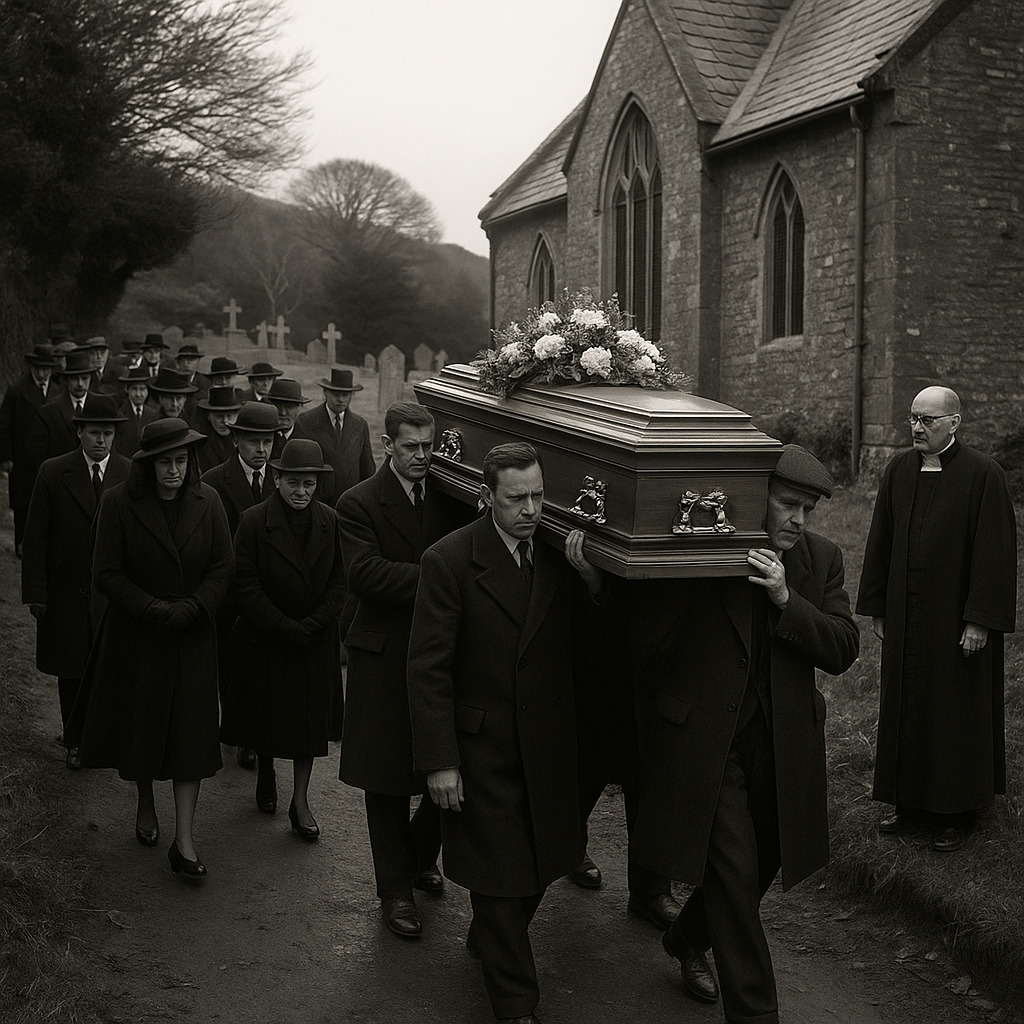
On this day the Western Morning News carried a full account of the funeral of Richard Wallis Cory (1854–1926), one of Devon’s largest landowners and a former High Sheriff of the county. Cory had died on 15 December at his Langdon Court home, aged 72.
The WMN described how the coffin was taken from Langdon Court on an estate wagon, then carried by estate workers down the steep path to St Werburgh’s Church on the cliff above Wembury Bay. The service, by Cory’s own wish, was very simple, with no music, conducted by the vicar, Rev. A. H. Duxbury, and the former vicar, Rev. C. Burgess.
The report listed a wide array of mourners: Cory’s widow, daughter, niece, Commander P. B. Crohan, along with naval and military officers, neighbours, tenant farmers, and estate workers. Numerous floral tributes were noted, from the Cory family, the Bastards of Kitley, the Kenyon Slaneys, the Pateys, Wembury Choir, the Down Thomas Social Club, and the estate’s staff.
The WMN also recalled Cory’s reputation as a brilliant scholar and linguist, his dislike of hunting (which he banned on his estate), and his generous restoration of St Werburgh’s in 1886. Today his name lives on in Cory Court in Wembury, and his family is commemorated in the church’s stained glass windows.
Source: Western Morning News, 20 December 1926.
The report of Richard Cory’s funeral sits alongside other key moments in Wembury’s modern history. Just as Mrs. Sebag-Montefiore would, a decade later, shape the parish’s landscape by gifting and covenanting land to the National Trust (1935–38), Cory had already shaped the parish physically and spiritually through his estate and his restoration of the church. Both figures are remembered less by monuments than by the living legacy of landscape, buildings, and community ties. In many ways, this continuity links Wembury’s 19th- and 20th-century landowners into the same narrative arc that includes the rebuilding of the churchyard wall in 1926, the creation of the Social Hall in 1939, and the eventual preservation of the cliffs and Yealm valley. Cory’s funeral is thus not only an ending but a marker within the long chain of stewardship of Wembury’s coast and parish life.
Entries are summaries and interpretations of historical newspaper reports.