
On This Day in Wembury — 20 October 1803
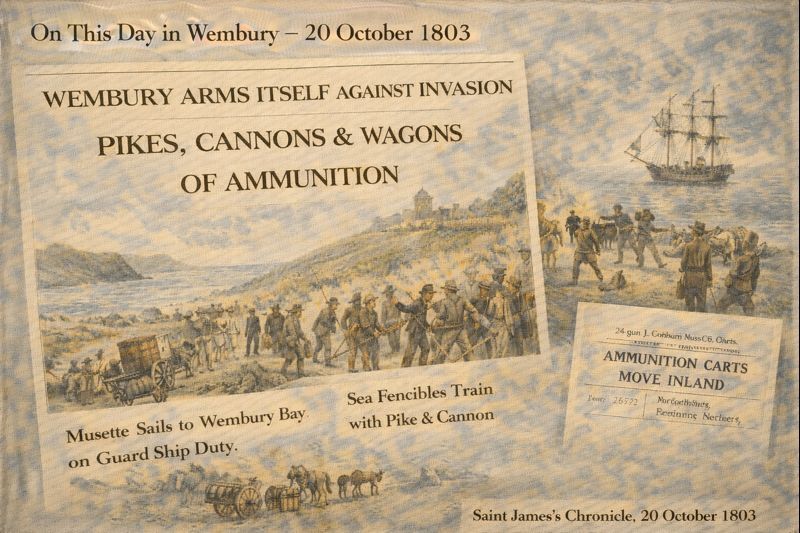
The Saint James’s Chronicle reported heightened military activity along the Devon coast during the wars with Napoleonic France. Orders had been sent down from the Transport Board to Lieutenant Clements, Agent for Transports, to provision six months’ salt stores for 600 tons of shipping. Speculative “politicians” wondered at the secrecy of the order.
That morning, the Musette, a 24-gun ship, sailed from her station at the entrance to the Yealm River to be floated as a guardship under jury-masts. Meanwhile, ammunition wagons carried pikes into the interior — Exeter among the destinations — for corps that could not be supplied with muskets and bayonets. Pikes and half-pikes were also issued to the Sea Fencibles at Plymouth and neighbouring ports. These local defence volunteers were reported to be making progress in their pike and great-gun drills, eager to excel with such “terrible instruments of war.”
A number of artillery wagons, with their drivers, were also seen carrying flint, powder, wadding, rammers, sponges, and handspikes from the arsenal to Wembury, for the use of the two batteries established there.
It’s striking how the paper spoke of pikes with the same awe as heavy artillery. For all the talk of “terrible instruments of war,” what you really see here is a community arming itself with whatever came to hand , a musket, a cannon, or just a sharpened pole. And Wembury, quiet as it seems now, stood bristling with weapons at the cliff’s edge, ready for a French landing that never came.
Source: Saint James’s Chronicle, 20 Oct 1803
Entries are summaries and interpretations of historical newspaper reports.