
On This Day in Wembury — 03 October 1826
Burial of John Horn, “melancholy hurt on the breakwater”
On 3 October 1826, John Horn, aged 39, was buried at St Werburgh’s Church, Wembury, with Sam Thomas officiating. The parish burial record notes that Horn had “died of a melancholy hurt on the breakwater”.
His surviving memorial stone gives the stark details. Horn had been injured on the breakwater, and later died at the Royal Hospital, Stonehouse, on 30 September 1826.
The headstone is a small slate stone, located under the west window of the south aisle, in the Old Yard at Grave No. 135. Local historian Peter Lugar photographed it in November 2005, noting that it was already disintegrating, and that the phrase “melancholy hurt” had intrigued him since childhood.
The wording is old-fashioned but powerful. In early 19th century English, “melancholy” here does not mean depression in the modern sense, but a tragic and distressing accident. It marks a life ended suddenly by a serious injury, recorded plainly in stone and parish ink.
Source: St Werburgh’s Combined Burial Records
Additional source: Peter Lugar Archive (photograph + transcription, Nov 2005)
Headstone inscription (slate):
“Sacred to the memory of John Horn who receiv’d a melancholy hurt on the breakwater and died in the Royal Hospital Stonehouse on the 30 of Sep. 1826 aged 39 years.”
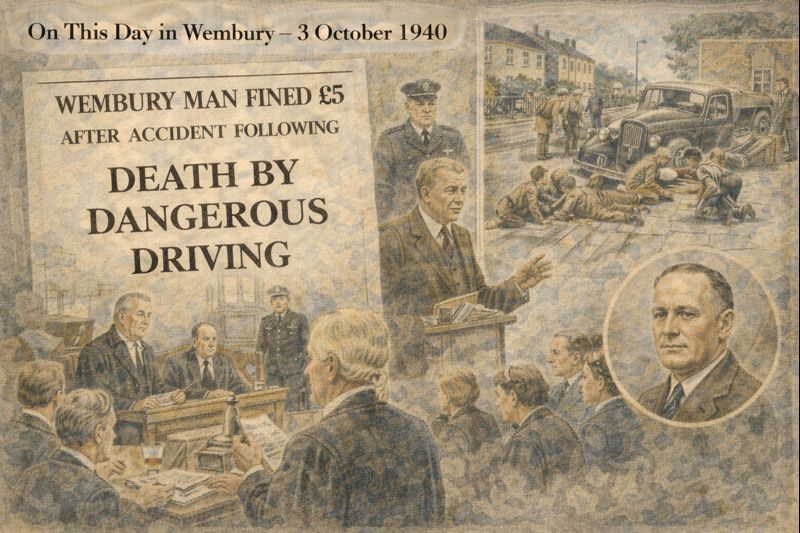
On This Day in Wembury — 3 October 1940
At Plymouth magistrates’ court, Frank Alfred Dawe, 41, a painter of Windy Ridge, Church Road, Wembury, was fined £5 with costs and had his licence endorsed after pleading guilty to dangerous driving.
The case followed a tragic accident at St. Budeaux on 20 August. Dawe’s car mounted the pavement, knocking down four pedestrians and killing one. The Deputy Chief Constable, W. T. Hutchings, said Dawe had come downhill at excessive speed, encountered a stationary lorry, and was unable to brake or steer away in time, the camber of the road forcing him onto the pavement.
Dawe’s counsel, H. Lawrence Spear, said his client was “completely baffled” by what had happened. Two workmen were passengers in the car, neither of whom had seen any cause for concern. “One second he was in the road and the next on the pavement,” Mr. Spear told the court. The car itself was found mechanically sound.
This case highlights the very different standards of road safety in wartime Britain. Motor traffic was lighter than today, yet the risks were no less deadly. The fine and licence endorsement may seem lenient by modern measures, but courts of the 1940s often treated such incidents as tragic misfortune rather than reckless crime.
Source: Western Morning News, 3 October 1940
Entries are summaries and interpretations of historical newspaper reports.