
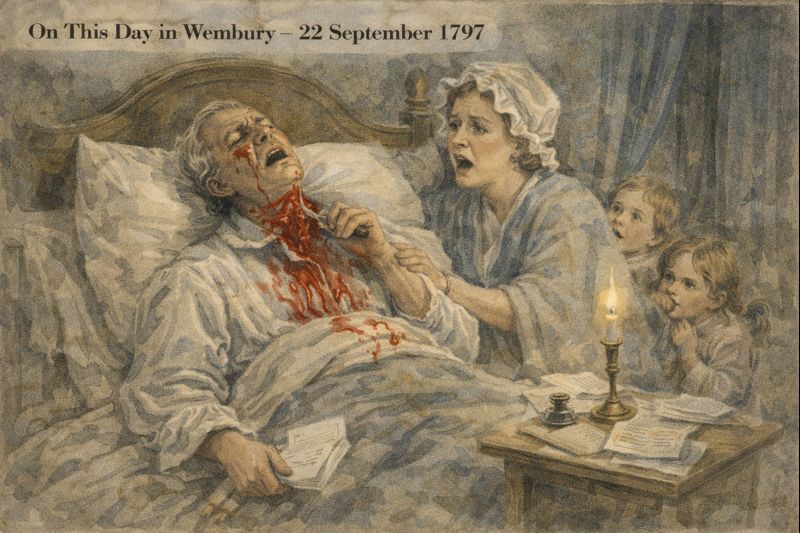
On This Day in Wembury – 22 September 1797
The Oxford Journal carried the report of the sudden death of the Rev. Mr. Love, Vicar of Wembury. While sitting up in bed at his Plymouth house during a long illness, he asked his wife for a penknife. In the course of a violent seizure — described at the time as “a rising of the lights and suffocation in the throat” — he tragically cut his own neck and died instantly, with his wife and children present.
The newspaper described it as an unhappy accident, and the dramatic account spread well beyond Devon, reflecting both the personal tragedy and the appetite of the late 18th-century press for sensational stories.
Source: Oxford Journal, 30 Sept 1797.
On This Day in Wembury – 22 September 1891
A major dispersal sale took place at Raneleigh Farm, Wembury, four miles from Plymouth. Auctioneers Endell & Symons sold 84 head of cattle, horses, colts, and a large collection of farm implements, the property of Mr. A. Tutoes.
Such farm sales were significant rural occasions, attracting neighbouring farmers, dealers, and townspeople, and often marked a turning point in the management or ownership of key Wembury holdings.
Source: Western Morning News, 5 Sept 1891.
On This Day in Wembury – 22 September 1943
A public inquiry was held into an appeal by Mr. A. S. Knight of Bournemouth, who sought permission to develop a field he owned at Wembury. Plympton Rural Council had refused the application, arguing that the land sat on a high ridge visible from sea and land, crossed by a public footpath, and any building there would spoil the rural skyline.
The Council’s clerk, Percy T. Loosemore, also criticised the way the land had been advertised for sale, warning buyers to check with planning authorities before assuming development rights.
On 11 November 1943, the Minister of Town and Country Planning dismissed the appeal, confirming the Council’s refusal and protecting the landscape from inappropriate development.
Source: Western Morning News, 1 Dec 1943.
Entries are summaries and interpretations of historical newspaper reports.