
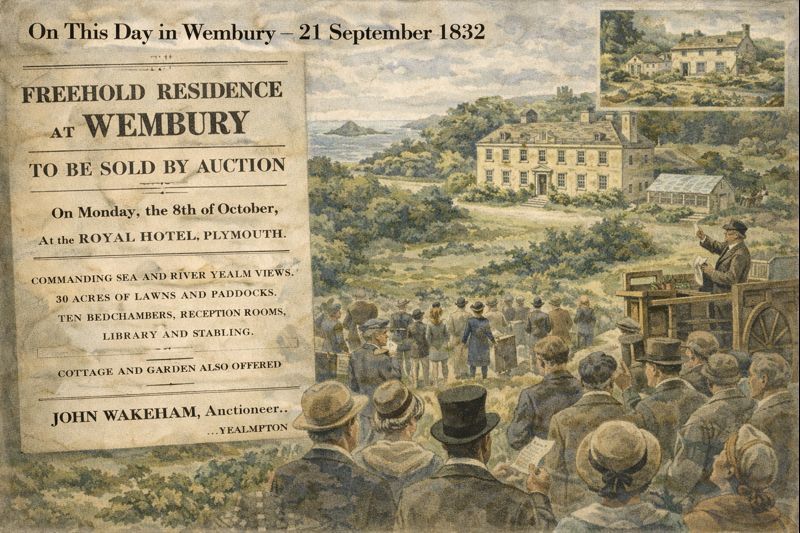
On This Day in Wembury — 21 September 1832
The London Evening Standard carried news of the sale of an elegant freehold residence at Wembury, formerly the property of Sir Edward Thornton, G.C.B.. Thornton, a distinguished diplomat, was leaving the area, and his estate was offered at auction at the Royal Hotel, Plymouth.
The mansion was described as a substantial and refined home, standing within thirty acres of richly timbered paddocks and pleasure grounds, with fine sea views and a commanding prospect over the River Yealm and its wooded valley. The house boasted ten bedrooms, two large drawing rooms (each about 32 by 20 feet), a library, dining parlour, water closets, domestic offices, stables for ten horses, and coach houses. Extensive gardens included greenhouses, a conservatory, and productive graperies, with a cottage and garden sold as a separate lot on the verge of the grounds.
The auction listing situated the estate only two miles from the sea, three miles from Saltram and Kitley, and seven from Plymouth—placing Wembury within the orbit of Devon’s most prestigious country seats.
This sale illustrates Wembury’s status in the early 19th century as a place attractive to the wealthy and well-connected, set between the rural calm of the Yealm estuary and the growing naval city of Plymouth. Sir Edward Thornton himself had served as Britain’s envoy to Sweden, Portugal, and Russia, and his decision to make Wembury a home—even briefly—shows how desirable the parish had become for those of rank. The estate’s rich description, with its conservatories and graperies, echoes later accounts of Wembury House (which this sale was surely of ) and Langdon Court, part of the continuous story of landed ambition and retreat along this part of the Devon coast.
On This Day in Wembury – 21 September 1935
The Wembury Bird Sanctuary was formally opened at 3.30 p.m. by Maj. Anthony Buxton, one of Britain’s best-known ornithologists and conservationists, under the auspices of the Devon Bird-Watching and Preservation Society. The event was signposted by the AA from Modbury and Kingsbridge to Wembury Church and on to the cliffs.
The opening marked the creation of a dedicated safe feeding and roosting ground for shore birds — the first such sanctuary in Devon. Visitors were welcomed to attend both the ceremony and a film exhibition that evening in Plymouth, where Maj. Buxton screened his rare bird films.
This moment became a milestone in the history of Wembury’s coastline: the first organised step to protect its wildlife and landscape, later forming part of the chain of efforts that led to National Trust stewardship.
Source: Western Morning News, 16 Sept 1935.
On This Day in Wembury – 21 September 1935
An auction was held at Spriddlestone Barton, Brixton, a farm just a few miles inland from Wembury and on the main bus route from Plymouth to the village.
The sale followed the death of Mr J. N. Atwill and was conducted by John Wakeham, auctioneer. The catalogue included a large range of farm implements—wagons, carts, a self-binder, ploughs, harrows, rollers, sheep troughs, turnip cutters, a sheep-dipping apparatus, and cider-making equipment—along with tools and around 40 young hens.
Also offered were items of household furniture such as tables, chairs, bureaus, carpets, beds, wardrobes, and kitchen ware, reflecting the complete dispersal of a working farmstead. Two cottages with vacant possession were also put up for sale.
This type of farm dispersal sale was a familiar event in the rural communities surrounding Wembury, often attracting neighbours, traders, and local smallholders looking to acquire practical equipment, livestock, or household goods.
Source: Western Morning News, 19 Sept 1935.
Entries are summaries and interpretations of historical newspaper reports.