
On This Day in Wembury — 7 September 1861
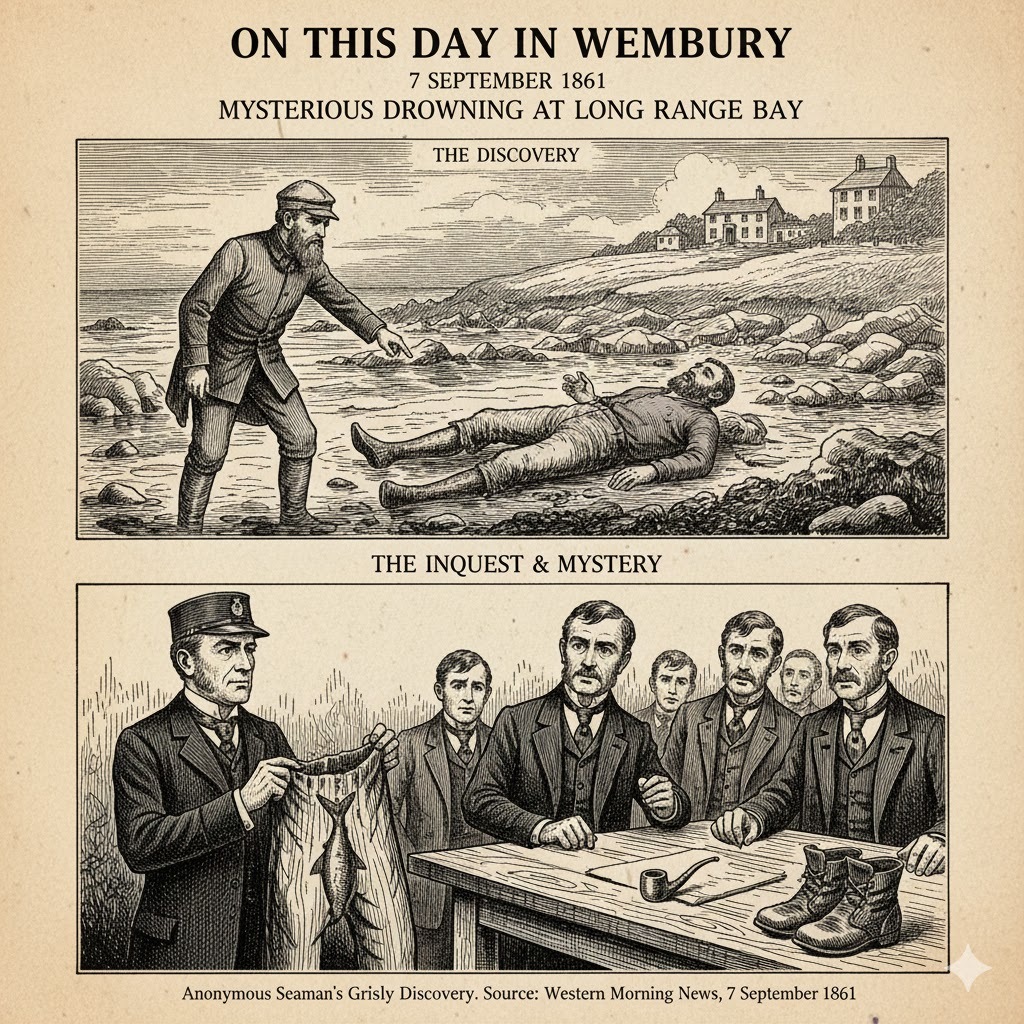
The Western Morning News reported the inquest into a body found drowned at "Long Range Bay" (?), Wembury. The discovery was made by gamekeeper Samuel Fosse, in the employ of Samuel Clark Jervoise of Langdon Court. The corpse, described as a man about five feet six inches tall, wore a red flannel shirt, fustian trousers, blue worsted stockings, and half boots. Though decomposed from long immersion, the clothes were intact, and no possessions were found except a short-stemmed tobacco pipe.
Policeman Henry Maddocks testified that all efforts to identify the body had failed. Marks on the skin were judged to be the result of sea creatures rather than violence. A grisly detail was noted: a dead dogfish was discovered trapped inside the man’s trousers, believed to have suffocated after entering post-mortem. With no clue to the man’s name or origin, the jury returned an open verdict of “Found drowned.”
Reflection:
This haunting case shows how the sea at Wembury often returned the dead in ways both tragic and mysterious. Without identification, the drowned man’s story ended as an anonymous footnote, a reminder of how perilous maritime life was in the 19th century. Such reports also underline the role of estates like Langdon Court and their keepers in local life—here, it was a gamekeeper who first witnessed the body adrift. In the sweep of Wembury’s history, the coast has been both livelihood and hazard, and the ocean just as likely to conceal as to reveal its secrets.
Source: Western Morning News, 7 September 1861.
On This Day in Wembury – 7 September 1901
A letter from L. Scarr of Wembury appeared in the Western Morning News, reflecting on the long-standing links between Lancashire and Devon.
Scarr noted that thousands of Lancashire families were then visiting Torquay and South Devon, and expressed the hope that some might explore “the nooks and corners” further afield, enriching rural homesteads with their patronage.
The letter highlighted the historic connections between the two counties, especially through Hugh Oldham (1452–1519), Bishop of Exeter from 1504–1519, who was of an old Lancashire family. Oldham established the arms of the See, founded schools and chantries, and helped endow Corpus Christi College, Oxford. His effigy still rests in Exeter Cathedral.
Scarr also recalled family ties between the Townleys of Lancashire and the Cliffords of Chudleigh, and closed with an anecdote about Bishop Oldham’s punctual dining habits — his servant delaying the house clock to match the Bishop’s schedule.
This letter shows how residents of Wembury took part in wider cultural and historical discussions, placing the parish within a network of national identity, heritage, and regional pride.
Source: Western Morning News, 10 Sept 1901.
Entries are summaries and interpretations of historical newspaper reports.