
On This Day in Wembury – 28 July 1845
Sale of the Manor of Wembury
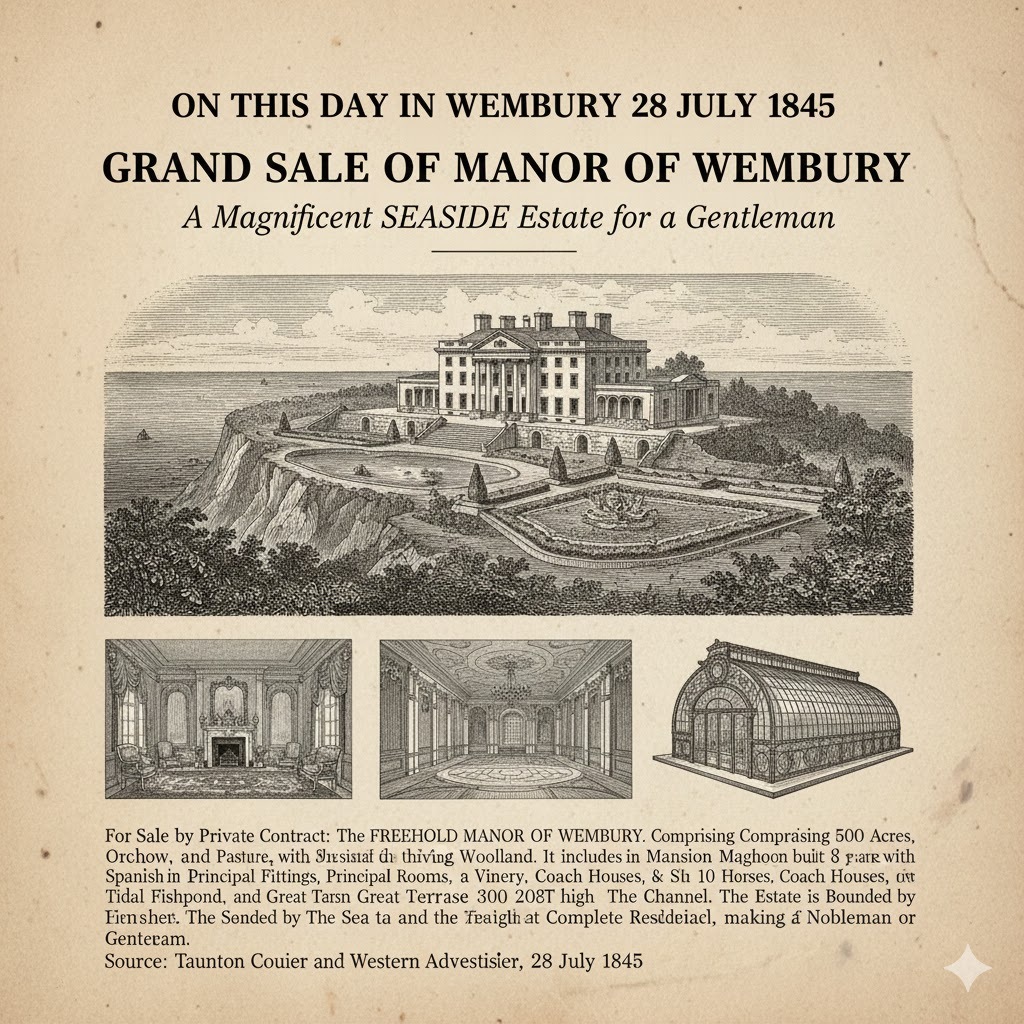
On 28 July 1845, advertisements announced the sale by private contract of the freehold Manor of Wembury. The estate comprised around 500 acres of meadow, orchards, and pasture land, along with more than 300 acres of thriving woodland. It included two farmhouses, a substantial mansion built about eight years earlier with Spanish mahogany fittings in the principal rooms, a vinery, greenhouse, coach houses, and stabling for ten horses. The grounds boasted a fishpond that replenished with the tide, and a great terrace 300 feet long and 30 feet high overlooking the Channel. The estate was bounded by the sea to the south and the navigable River Yealm to the east, marketed as a complete residence for a nobleman or gentleman.
Source: Taunton Courier and Western Advertiser, 28 July 1845.
This 1845 notice offers a vivid picture of Wembury House and its estate at a particular moment of transition. It highlights the grandeur and fashionable embellishments of the time — Spanish mahogany, vineries, and ornamental terraces — features that echoed the rising status of country houses across Devon. Linking back to earlier sales in 1814 and later ones in the 20th century, it shows how Wembury’s great estate was repeatedly on the market, shifting between aristocratic ambition and changing fortunes. The mention of the tidal fishpond and commanding terrace also underlines the unique combination of natural setting and designed landscape that made Wembury so distinctive.
On this day in Wembury — 28 July 1855
The Western Times reported a long and closely argued property dispute involving Wembury House. The plaintiff was Mr. Nathaniel Barwell, gentleman of fortune and then-owner of Wembury House, and the defendant was Mr. Lockyer, formerly a practising lawyer of Plymouth.
The case concerned a small triangular plot of land lying between the highway and the gate entrance to Wembury House. Barwell had attempted to enclose the piece of ground by building a wall, claiming it was part of his estate. Lockyer objected, pulled the wall down, and defended his action on the basis that the land had been opened to the public as a right of way and convenience many years earlier.
Barwell’s counsel, Mr. Serjeant Kinglake, produced a model of the estate and argued the land was always treated as part of the property. Numerous Wembury witnesses—including some of the “oldest inhabitants” such as Rev. Middleton, Theodore Bews, Elizabeth Parson, Fanny Avent, John Hockaday, William Webb, and others—testified to its private use.
Lockyer’s counsel, Mr. Collier, countered with evidence from Richard Anthony, Mary Ann Seppings, the Kingcome family, John Avent and others, claiming the ground had long been left open for the public when the estate was previously in Lockyer’s family and later sold to Sir Edward Thornton before passing to Barwell in 1822. Counsel argued that because it was not expressly included in the conveyance deeds, it had never legally transferred as private property.
The jury, however, quickly returned a verdict for the plaintiff, Mr. Barwell, confirming his right to enclose the disputed piece of land.
Context
This case illustrates the enduring tension between private estate ownership and public access around Wembury House. Small corners of land near gateways and lanes were often contested, as they could represent either useful shortcuts or symbolic markers of ownership. Lockyer’s claim to defend the public interest foreshadowed later 19th- and 20th-century disputes in Wembury over footpaths, rights of way, and coastal access—issues that still echo in local history today.
(Source: Western Times, 28 July 1855 — “Barwell v. Lockyer”)
Entries are summaries and interpretations of historical newspaper reports.