
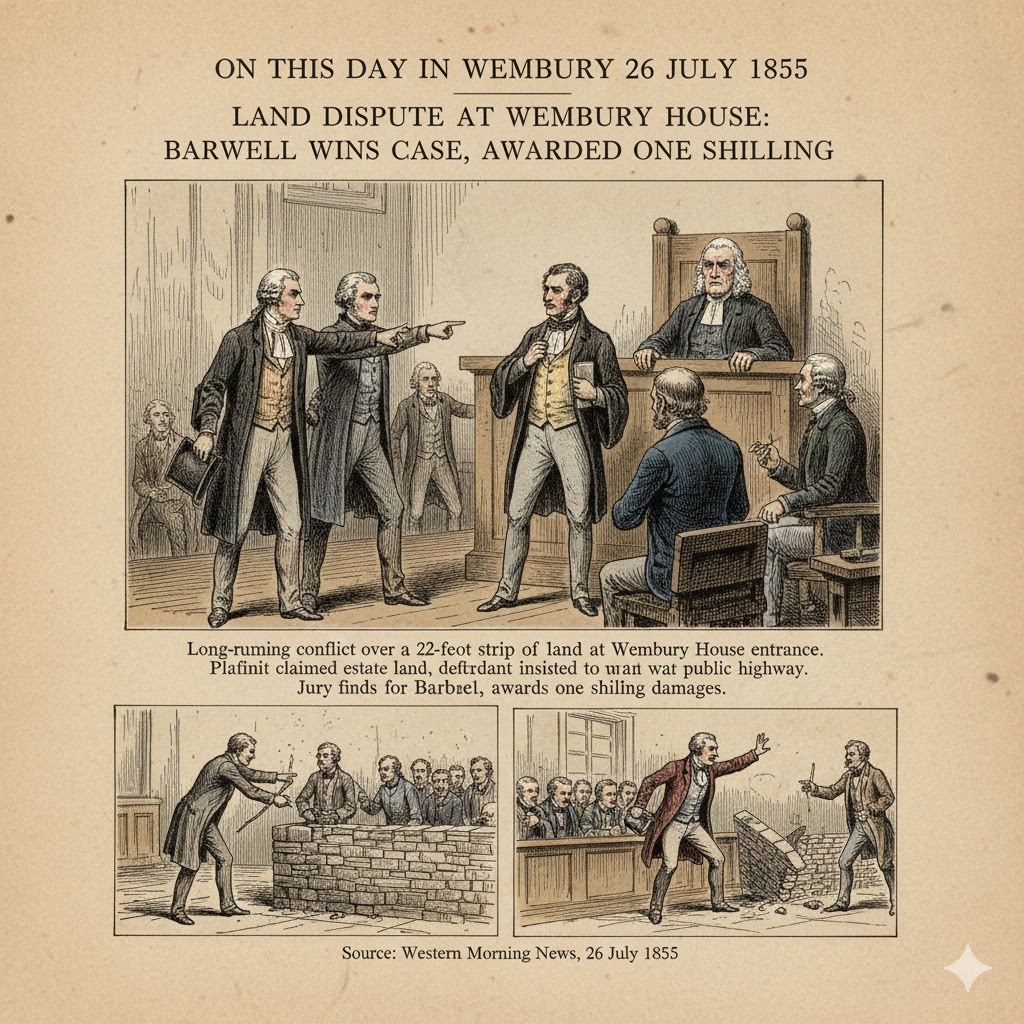
On This Day in Wembury – 26 July 1855
At the Exeter Assizes, a long-running dispute over a strip of land at the west entrance to Wembury House came before the courts. The plaintiff, Mr. Barwell, then owner of Wembury House, claimed the twenty-two-foot strip belonged to his estate. The defendant, Mr. Lockyer of Lower Wembury, a retired lawyer whose family had formerly owned Wembury House, insisted the land was part of the parish highway and open to the public.
The conflict began when Barwell built a wall to improve the approach to his property, only for Lockyer to pull it down, alleging trespass. Witnesses disagreed as to whether the ground had long been a public way or had become enclosed with the estate. The case drew in not only the two men but also the parish authorities, keen to protect public rights of way.
After eight and a half hours in court, the jury ruled for Barwell — but awarded him just one shilling in damages.
Reflection
This case highlights how deeply contested rights of way could become in 19th-century Devon. To landowners it was a matter of boundaries and property rights; to villagers and parishes, it was about protecting ancient access routes. The shilling damages suggest the jury felt Barwell had the stronger legal claim, but also that the case itself was more about principle than profit.
Entries are summaries and interpretations of historical newspaper reports.