
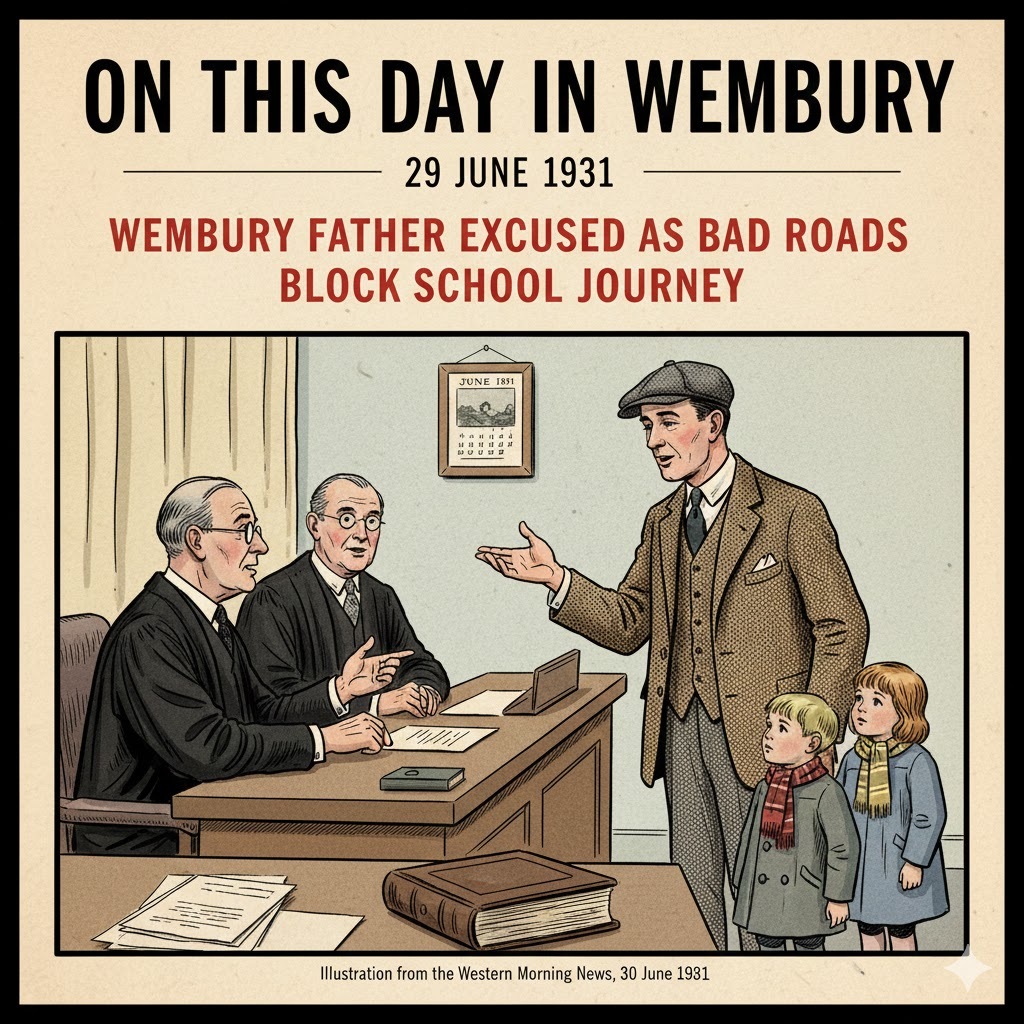
On This Day in Wembury – 29 June 1931
At Plympton court, A. Willingham of Wembury Point was summoned for failing to send his children to school regularly.
He explained that recent adverse weather had made the journey difficult: his children had to walk a mile and a quarter to reach the nearest bus, and the road was often in such poor condition that it was impassable. Willingham said approaches were being made to have the school bus collect the children directly from his door.
The magistrates accepted his explanation and dismissed the case with a warning, noting that conditions were expected to improve.
The hearing highlights the challenges of rural schooling in the early 20th century, where poor roads and long walks could easily disrupt attendance — especially in exposed areas like Wembury Point.
Source: Western Morning News, 30 June 1931.
On This Day in Wembury
29 June 1950 — “Sacrilege” at Wembury Church
A strongly worded protest was issued by Capt. P. G. E. Burrows on behalf of Wembury’s Parochial Church Council and churchwardens after repeated acts of vandalism and indecency at St Werburgh’s Church. Twice in recent months the alms boxes, sunk deep into the ancient stone walls, had been broken open and emptied. Worse still, the churchyard had been misused as a public convenience, and even the vestry was once treated in the same way. The perpetrators were believed to be day visitors. Burrows urged public awareness and argued there was a clear need for proper sanitary provision near Wembury Beach, a matter the parish council had already pressed without success.
Reflection: This episode shows the tension between growing postwar tourism and the protection of Wembury’s sacred and historic spaces. The anger of the parishioners reflects both the spiritual violation and the practical challenge of accommodating increasing numbers of visitors without adequate facilities.
Source: Western Evening Herald, 29 June 1950.
Entries are summaries and interpretations of historical newspaper reports.