ON THIS DAY IN WEMBURY
28 June 1930
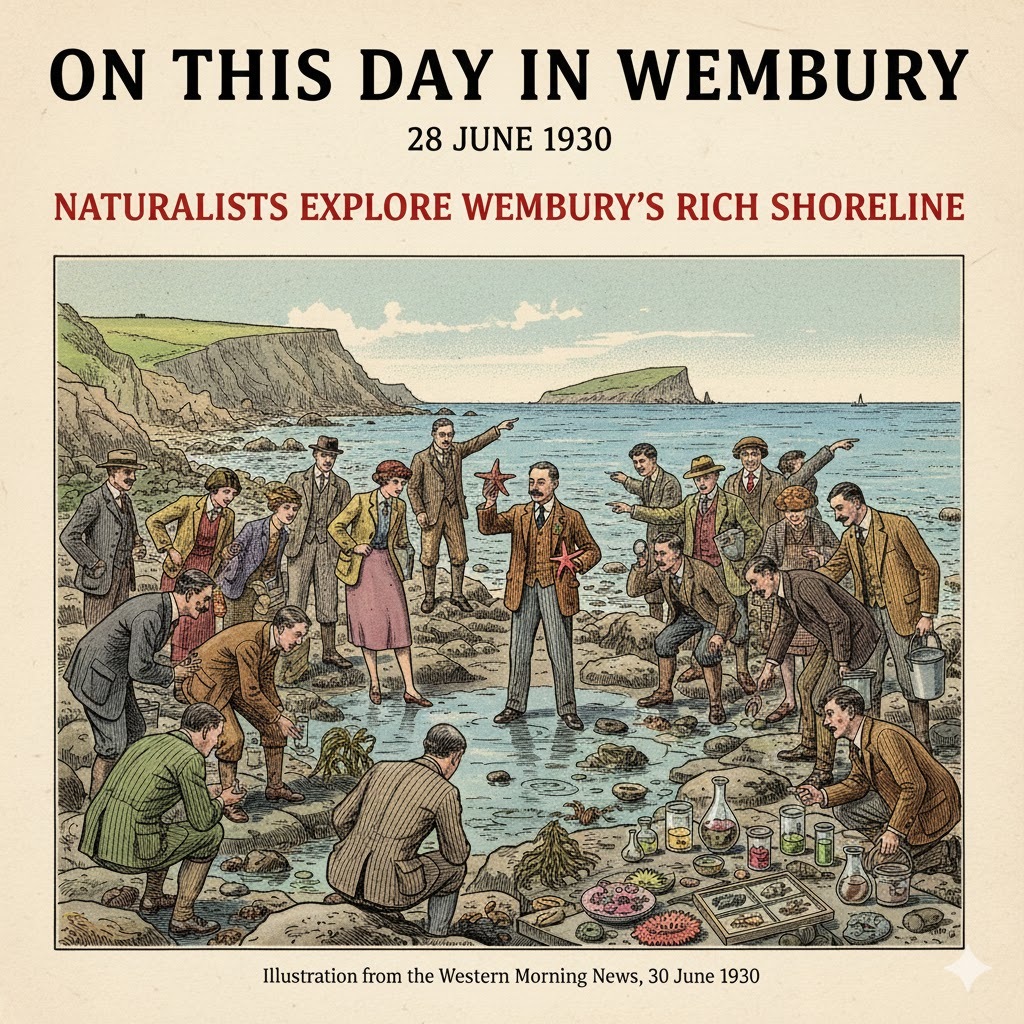
A joint field excursion to Wembury by the Plymouth and District Field Club and the Teign Naturalists’ Field Club took place on this date, as later reported in the Western Morning News. The group met for a picnic on the cliffs before heading down to the beach to investigate one of the richest stretches of intertidal shoreline in South Devon.
Their collected specimens were brought to a rendezvous point on the sands where Mr G. A. Steven of the Marine Biological Laboratory delivered a lecture demonstration. He highlighted a remarkable range of marine life gathered from the pools and rocks: shore fish, crabs, molluscs, sea cucumbers, starfish, sea anemones, and various marine worms. Steven drew attention to the zonation patterns that organise life on the shore, explaining how related species of seaweeds and invertebrates occupy distinct ecological bands.
The party also examined several edible seaweeds and discussed the practical uses of marine plants. In one sandy pool they found grass wrack, a true flowering plant adapted entirely to marine life. Steven noted that a related species was then being harvested for the manufacture of sound-absorbent matting, a material increasingly used in business offices to reduce noise — a reminder that even humble seashore plants played a role in everyday industry.
This excursion shows how Wembury’s foreshore was already recognised, long before the modern Marine Conservation Area, as a natural classroom and one of the most scientifically valuable coastal habitats in the region.
(Western Morning News, 30 June 1930)
Curated and written by Wembury Waves using material from the British Newspaper Archive.
Entries are summaries and interpretations of historical newspaper reports.
