
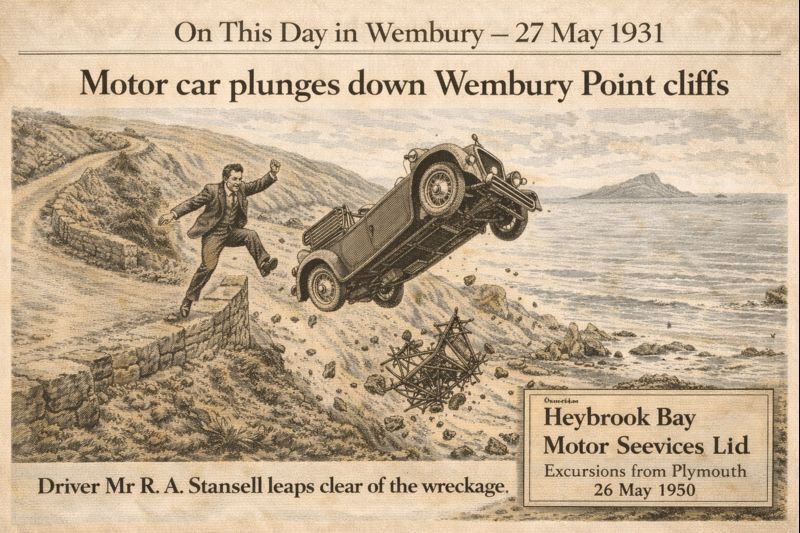
On This Day in Wembury – 27 May 1931
A dramatic accident at Wembury Point nearly cost a man his life when his motor car left the road and plunged down the cliffs.
The driver, Mr R. A. Stansell of Heybrook, near Plymouth, had been negotiating a sharp hairpin bend on the cliff road when his vehicle failed to take the corner. For a moment the car hung with its front wheels over the precipice. Mr Stansell managed to leap clear just in time, before the car toppled over the edge and crashed onto the rocks some 300 feet below, breaking into pieces.
Remarkably, he escaped without serious injury. The wrecked vehicle, however, was completely destroyed by the fall.
This incident, widely reported in the national press, underlined the hazards of early motoring on the narrow and twisting cliff roads around Wembury Point, long before modern safety barriers or road engineering improvements were in place.
Source: Dundee Evening Telegraph, 27 May 1931.
On This Day in Wembury — 27 May 1987
Two Plymouth boys were injured while playing a war game in the grounds of Wembury Infants School. Using “caps” inside a metal casing they had found at a funfair, they set fire to it, causing an explosion. One boy was hit in the leg by flying debris and another suffered an arm injury. Initial fears that the casing was an old armament shell linked to HMS Cambridge were dismissed by the Royal Navy. Spokesman James Gee stressed: “We have definitely established it wasn’t anything to do with HMS Cambridge.” He added that children meddling with objects that look like shells remained a persistent safety concern.
Source: Western Evening Herald, 27 May 1987
The episode captures the atmosphere of the 1980s, when Cold War echoes and wartime relics still loomed large in children’s imaginations. It also underlines the tension between play and danger in rural villages — where youngsters’ curiosity, schoolyard dares, and remnants of military history often collided.
Entries are summaries and interpretations of historical newspaper reports.