On this day in Wembury — 19 May 1990
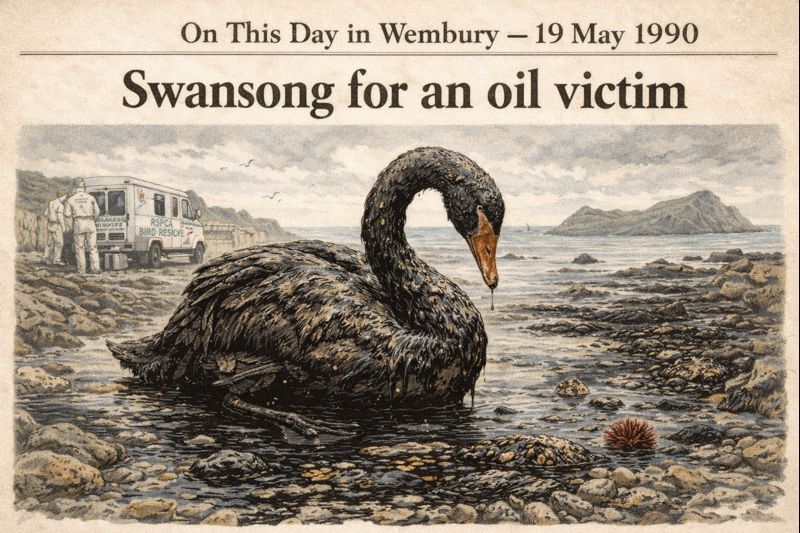
The Daily Mirror carried a sombre image under the headline “Swansong for an oil victim”, showing a blackened swan struggling after the devastating oil slick that had hit the South Devon coast earlier that week. The disaster had polluted beaches from Bigbury and Kingsbridge to Wembury, where the once-clear rock pools of the marine park were left coated in oil. The RSPCA worked around the clock to save hundreds of birds, but many perished despite frantic washing and rehabilitation efforts.
The slick had come from a ruptured supertanker and was blown ashore by shifting winds, smothering the intertidal zones that made Wembury such a vital site for marine life and research. At the time, marine experts feared that recovery would take decades.
In the years since, however, Wembury Beach has recovered remarkably well. Natural wave action, rainfall, and microbial activity gradually broke down the remaining oil, and careful stewardship by the National Trust, Devon Wildlife Trust, and Marine Biological Association has restored the site to health. Today the Wembury Marine Conservation Area is thriving once more — a living classroom for schoolchildren and scientists alike, teeming with anemones, crabs, and blennies.
The black swan that became a symbol of the disaster has faded from memory, but the lesson it carried remains: that even the most resilient coastlines need vigilant protection from pollution, and that nature, given time and care, can find a way to heal.
(Daily Mirror, 19 May 1990)
Curated and written by Wembury Waves using material from the British Newspaper Archive.
Entries are summaries and interpretations of historical newspaper reports.
