
On this day in Wembury — 18 May 1990
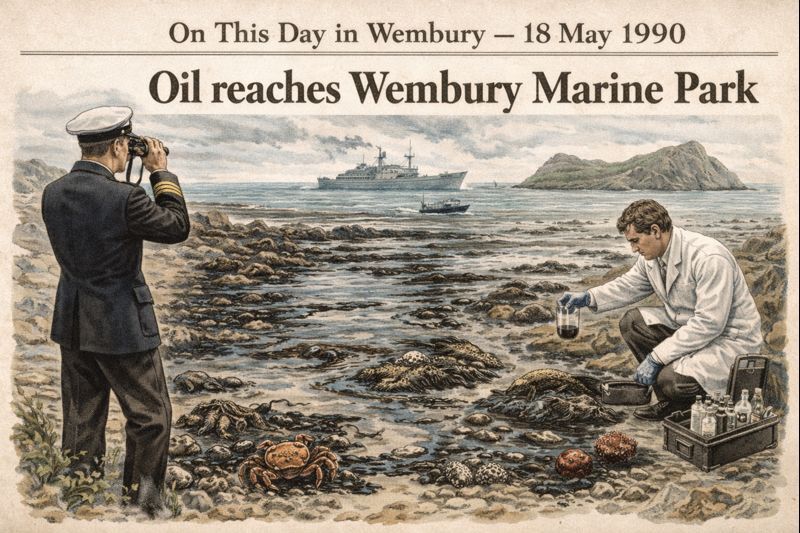
The Staffordshire Sentinel reported that an oil slick drifting along the South Devon coast had reached Wembury Marine Park, threatening one of Britain’s most important coastal wildlife reserves. The spill had already contaminated 15 miles of shoreline and, after an overnight change in wind direction, the oil was driven into the rock pools and coves of Wembury’s protected foreshore — an area famous for its seaweeds, limpets, crabs, and anemones studied by generations of marine biologists.
Royal Navy personnel were placed on alert in Plymouth Sound, and experts from the Plymouth Marine Laboratory warned that the pollution could have “devastating effects” on the marine park’s fragile ecosystems, especially as the slick crept toward the estuaries of the Yealm and Bovisand. Dr Peter Donkin, a senior researcher at the laboratory, cautioned that the mixture of oil and dispersant posed a particular danger to filter feeders and juvenile fish.
Environment Minister David Heathcoat-Amory urged the public not to abandon their coastal holidays, but it was clear that the event had struck at the heart of South Devon’s growing conservation movement. Wembury Marine Park, already a symbol of coastal education and stewardship, became a rallying point for awareness about pollution at sea — a reputation it still carries today as part of the Wembury Marine Conservation Area.
(Staffordshire Sentinel, 18 May 1990)
Entries are summaries and interpretations of historical newspaper reports.