
On this day in Wembury — 9 May 1957
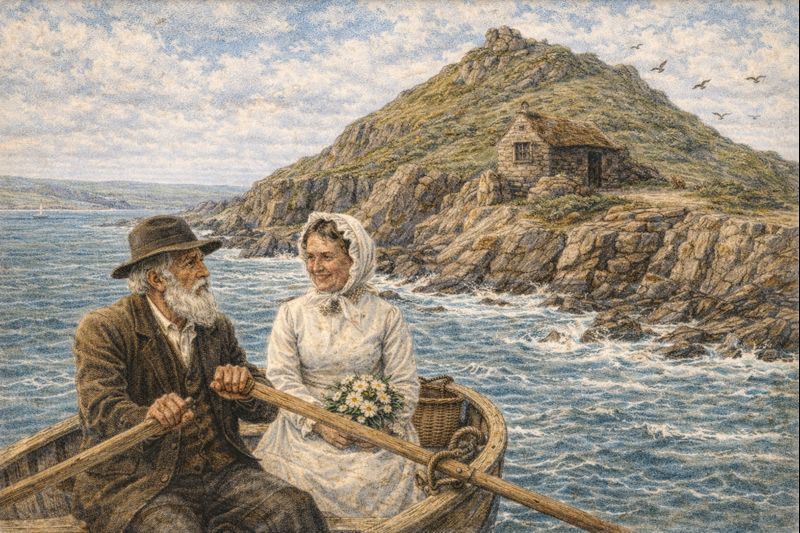
The Western Evening Herald revisited one of Wembury’s most remarkable local love stories — the 1834 “spring wedding” of Sam Wakeham, the famed hermit of the Mewstone, and his bride, known locally as his “girt Friday.” Though neither was young, their honeymoon was the most unusual imaginable: a short row in Sam’s boat from Wembury Beach to the rocky island he called home.
Sam had lived on the Mewstone rent-free thanks to Squire Calmady of Langdon Court, who allowed him to stay in exchange for keeping down the rabbit population. He built a small dwelling there — “very like a tar barrel with the bung knocked out,” as one Plymouth magazine joked — and entertained curious visitors from the mainland with tea, home-grown vegetables, rabbits, and sea views. Sam turned his isolation into enterprise, advertising himself in the Monthly Museum and welcoming guests who signalled him from Wembury Beach with a white handkerchief.
His spelling was eccentric but his hospitality genuine. “We got bewtifull Kayl (bowling green) fur to play ninepins,” he wrote, offering tea “boyled in the kittle and hand out the tay pot from the winder.” He even carved “two thrones” into the rock for visitors to admire the Channel view.
The idyll ended when Revenue officers grew suspicious of “unofficial imports” from passing ships. Squire Calmady withdrew permission, and Sam returned to Plymouth as a boatman on the Barbican. A century later, in April 1934, another couple made headlines when the Hon. Margaret Thesiger married Mr. John Goldman, whose wedding gift to his bride was none other than the Mewstone itself — bought as a weekend retreat.
Sam Wakeham’s marriage and eccentric island life remain one of the most enduring romantic tales in Wembury’s history — part fisherman’s fable, part social history, and part enduring local legend.
(Source: Western Evening Herald, 9 May 1957 — “Though it was a spring wedding at Wembury Parish Church”; Monthly Museum, Plymouth, 1830s; Wembury Archive.)
Entries are summaries and interpretations of historical newspaper reports.