
- Home
- On this day in Wembury
- 04-16
On this day in Wembury — 16 April 1837
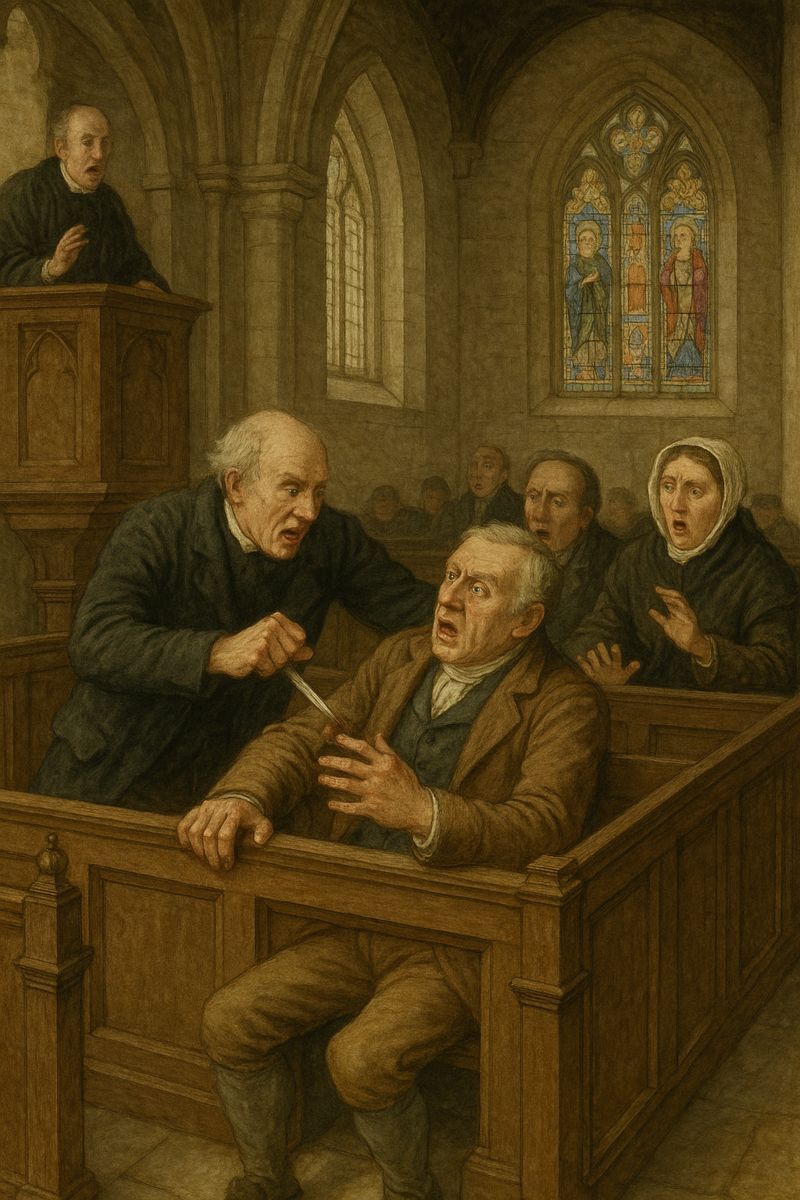
During Sunday service at Wembury Church, a shocking act of violence took place that would be remembered for years. Seventy-two-year-old John Prideaux Hensleigh, a long-standing parishioner, suddenly turned on his neighbour William Bunker and stabbed him in the arm with a knife. The attack, carried out inside the church itself, horrified the small congregation and broke one of the deepest social taboos of the time — violence within a place of worship.
Hensleigh was quickly arrested and later charged at the Devon Assizes with “stabbing with intent to do grievous bodily harm.” The Western Times recorded that he was found guilty and sentenced to “death recorded” — a form of mercy that spared him the gallows while formally entering the capital sentence in the record. The official Assizes register lists him by name, age 72, under the grim heading of “Death,” later commuted to imprisonment.
Old and frail, Hensleigh did not long survive his punishment. Records show that he died on 3 March 1839, barely two years after the incident. His outburst remains one of the most startling episodes in Wembury’s parish history — a moment when rage intruded on sanctity, and a quiet coastal village briefly found itself in the pages of national justice.
(Western Times, 22 and 29 July 1837; Devon Assizes Register, 1837, p.183; death record, March 1839)
On this day in Wembury — 16 April 1929
The Western Morning News announced the upcoming sale of the Wembury Estate, to be auctioned in lots at the Duke of Cornwall Hotel in Plymouth. The sale drew national attention, with prospective buyers expected from across the country. Wembury was described as “a charming old-world village close to the coast,” now increasingly connected to the city by regular bus services — a sign of how swiftly rural life was modernising between the wars.
Among the most desirable properties listed were Train House and West Wembury House, both “very charming residences with extensive grounds.” The catalogue also included cottages, fields, agricultural holdings and building plots — seventy-two lots in all, each to be offered separately with vacant possession.
It was part of a pattern across Devon in the late 1920s as old estates were broken up and sold off in smaller parcels, ending centuries of single-family ownership. For Wembury it marked a quiet turning point, the shift from landed estate to mixed village community. The sale opened the way for new residents, smallholders and families who would shape the parish’s next century, replacing the great estate era with the Wembury we recognise today.
(Western Morning News, 16 April 1929)
Entries are summaries and interpretations of historical newspaper reports.