On this day in Wembury — 12 April 1845
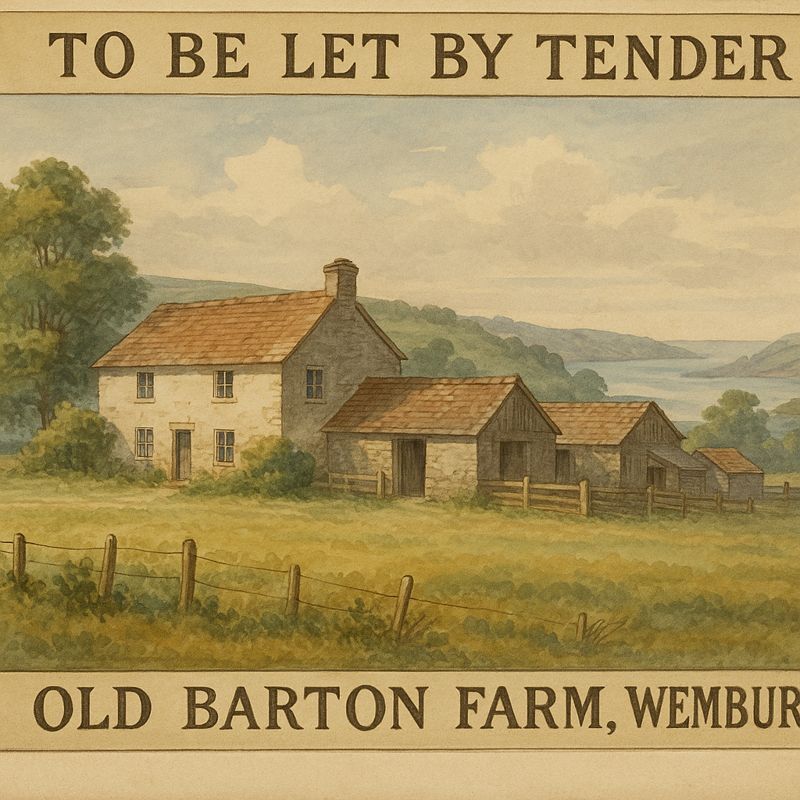
The Exeter and Plymouth Gazette carried a notice offering Old Barton Farm in Wembury to let by tender for seven or fourteen years from Lady Day 1846. The farm, advertised as a “capital estate,” was being vacated by tenant Samuel Popplestone, and comprised about 196 acres of arable, meadow, orchard and pasture. The auctioneers Lockyer and Bulteel of Princess Square, Plymouth, described it as “a respectable farm house with suitable outbuildings,” well-watered and in “a high state of cultivation.”
The advertisement highlighted one of Wembury’s greatest assets — its proximity to the sea. The estate lay close to the banks of the Yealm estuary, and tenants were promised “sea sand, seaweed and other manure to be taken, free of expense.” These were highly prized resources before the widespread use of chemical fertilisers, as farmers along the coast gathered seaweed to enrich the thin soils of South Devon.
Old Barton remains a name known in the parish today, its land stretching inland from the coast toward what later became the model dairy built by the Sebag-Montefiore family. In 1845 it represented the backbone of rural life — a working farm sustained by sea, soil and labour, standing at the threshold of the agricultural reforms that would reshape Victorian Devon.
(Exeter and Plymouth Gazette, 12 April 1845)
Curated and written by Wembury Waves using material from the British Newspaper Archive.
Entries are summaries and interpretations of historical newspaper reports.
