
- Home
- On this day in Wembury
- 02-08
On This Day in Wembury — 8 February 1896
A Sexagesima Sunday Service at St Werburgh’s by the Sea
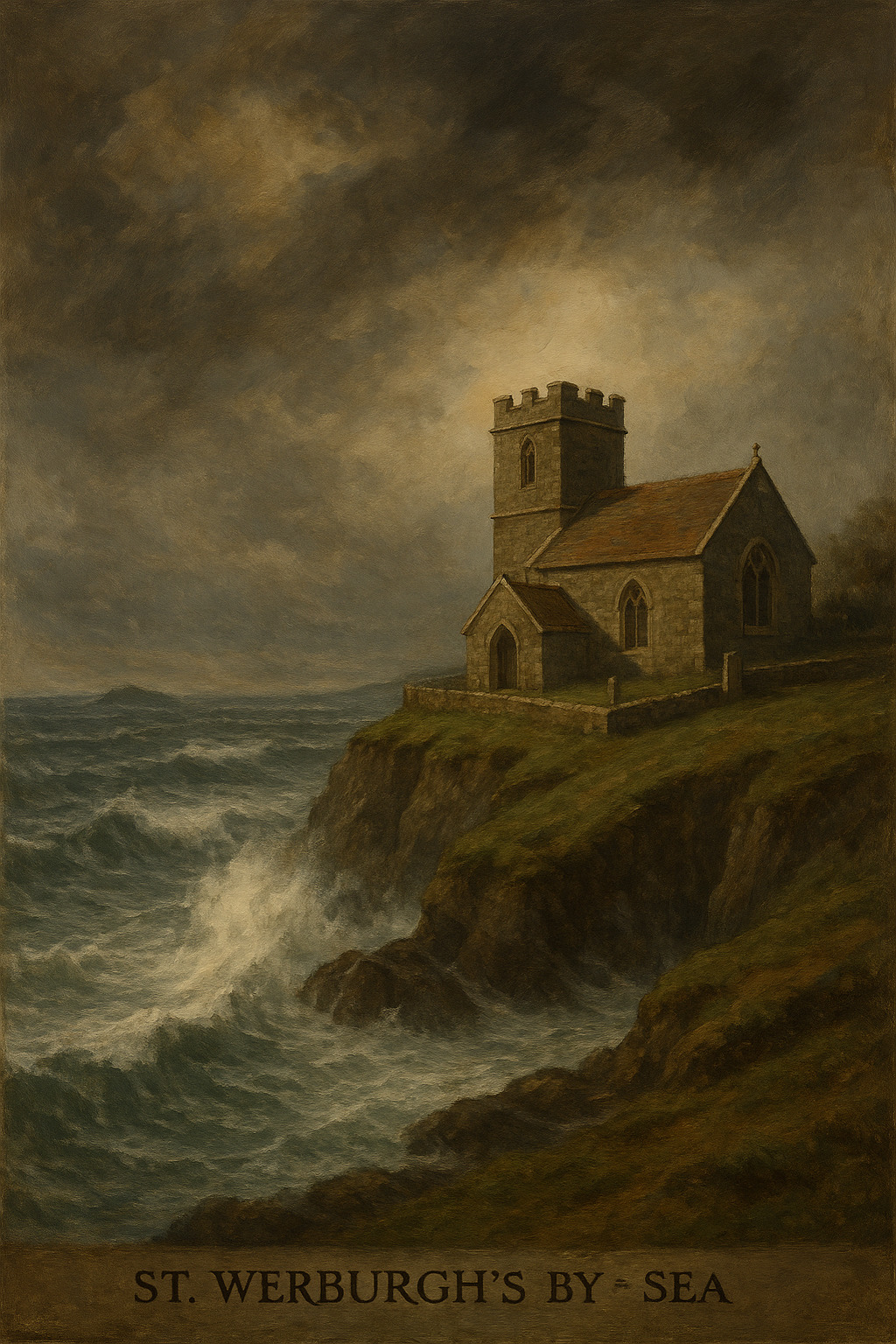
On Sunday 8 February 1896, the Western Evening Herald described a remarkable scene at St Werburgh’s Church, standing high on the cliff above Wembury Bay. The writer called it “the little church perched on a cliff just above the shore,” a place of fascination and wonder, “isolated and lonely,” and yet full of life and worship. From the deck of passing steamers, he had often seen it and marvelled how “our forefathers in their wisdom chose so difficult a place to build their church.” Now, on this wild February morning, he found himself there in person.
The weather was fierce. The wind swept hard off the Channel, “wild and loud,” and the sea hurled long-backed breakers against the rocks. Waves crashed and flung their spray across the cliffs. The writer took shelter “under the weather-beaten walls of Wembury church,” as “all around the wind was crying wild and loud.” He paints the scene like a living canvas of noise and movement — “the long-backed bounding billows coming in with mighty roar, dashing madly over the ill-fated ship’s ribs and the old sunken quay.”
Inside, the service was beginning. The vicar, Rev. Charles Burgess, a kindly man newly come from Devonport, was robing in the vestry beneath the church tower. The organist — a visitor who had come over from Plymouth — was playing a voluntary on the small American organ. The choir, made up of “half a dozen singers, chiefly the gentler sex,” led the congregation in hymns. The vicar’s voice was “clear and distinct” as he began the familiar call, Dearly beloved brethren…, and read from St Paul’s Epistle to the Galatians about resisting evil and living by faith. The sermon was on “Devil Worship,” but his meaning was not harsh. He reminded his small congregation that it was not superstition or fear that drew people to God, but “the great and rushing principle by which alone mankind were drawn to goodness.”
The writer observed the human warmth of the moment — the rustle of hymnbooks, the little harmonium in the south aisle, the pale winter light through the windows, and the congregation huddled together against the cold. The church was small, and the sound of the waves outside mingled with the singing within. When the Blessing was given, there was no collection; the vicar simply closed with the familiar words, The peace of God, which passeth all understanding....
After the service, the visitor wandered back through Knighton and the lanes above the River Yealm, describing primroses, crocuses, violets, and the first buds of spring. He saw birds “flitting from twig to twig in the blithest fashion” and remarked how even in February the valley was filled with a sense of renewal. He passed by “Michael, the stout and somewhat asthmatic pony,” waiting patiently in the stable while his owner attended church, and noted the bright waters of the Yealm shining below “like silver lighted by summer day.”
The article ends with affection and reverence. “The sanctuary, small as it is,” wrote the observer, “seems their Bethlehem of hope.” Beneath the grey tower of St Werburgh’s, surrounded by sea and sky, generations of Wembury people had worshipped, married, and been laid to rest. “All honour,” he concluded, “to the hand that built and the hearts that have kept alive the old spirit of faith by the sea.”
Source: Western Evening Herald (Plymouth), Monday 17 February 1896 — Pulpit and Pew: At Church by the Sea, A Sexagesima Sunday Service (describing the service of Sunday 8 February 1896).
Entries are summaries and interpretations of historical newspaper reports.