|
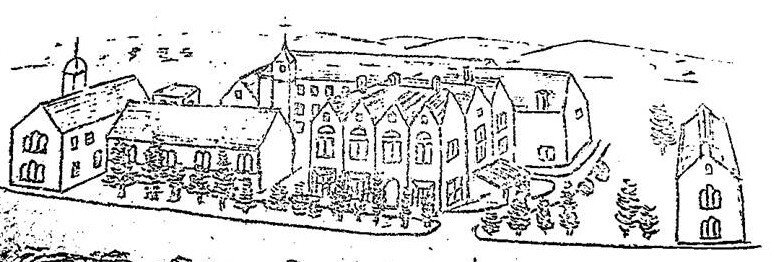
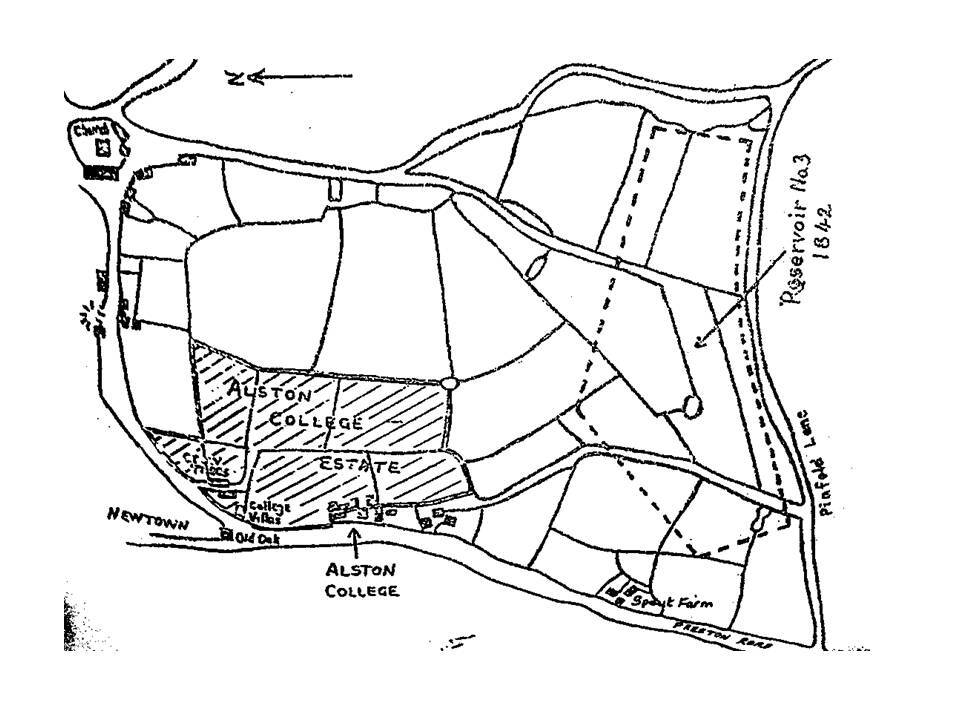
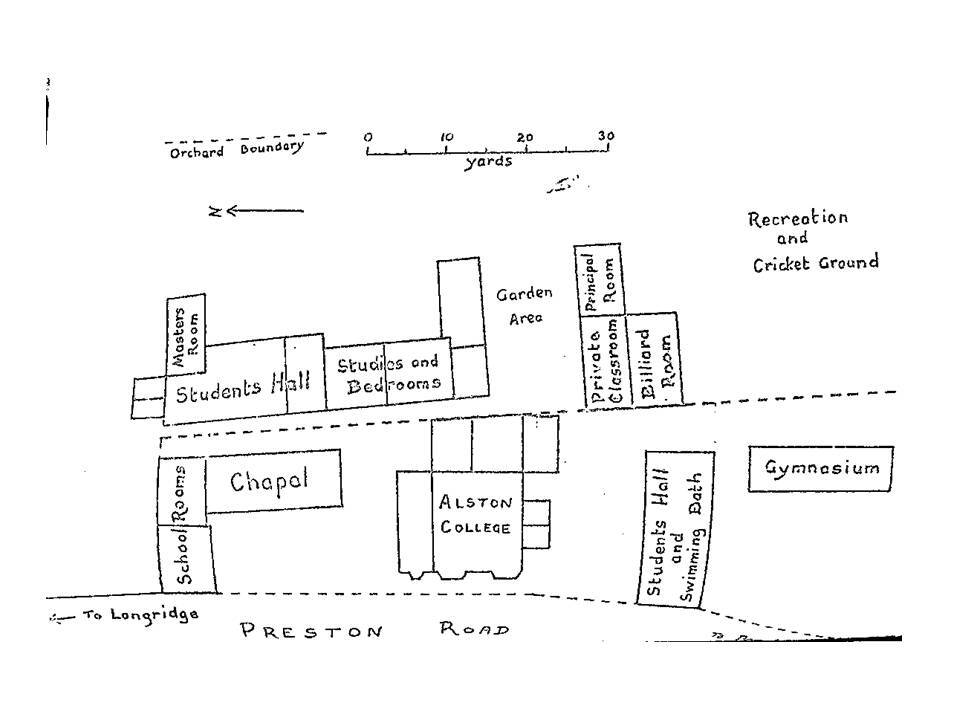
The following article was originally published in Volume 4 of the Longridge & District Local History Society Review, 1977. Soon after leaving Longridge on the Preston road one passes the site of a nineteenth century public school. The site is no longer accessible because it lies beneath the banks of Alston Reservoir No. 2. The life of Alston College was short, but eminently successful. The college was the brainchild of the Reverend Thomas Abbott Peters, M.A. Of this gentleman Tom Smith in his “History of Longridge” writes, ‘Born of humble parents at Preston, Mr Peters is in an eminent degree a self made man. In early manhood he started a night school in Alston, and becoming well known for his training abilities, he was soon enable to build his first school, Alston College, in 1854. The venture proved a great success entirely through the Principal’s untiring energy and perseverance.’ This, indeed, must have been a remarkable man. The Census of 1861 states that he was then 26 years old and was born at Brockholes. He must, therefore, have been born about 1835 (this is confirmed in the 1871 census) and must have been only about 19 years old when he founded the College in 1854. One is left impressed that he had acquired a Master of Arts degree by that early age and had, even earlier, engaged in night school teaching. Mr Peters built his academy on land which was part of the orchard of a farm which was positioned between the present College Villas and Spout Farm. The orchard and nearby farm was owned by Henry Parkinson. It seems likely that, at first, Peters purchased a plot measuring about 49 yards of road frontage and 23 yards in depth (1,078 square yards). On this plot the first buildings were erected. They consisted of the main building, chapel and two schoolrooms. Later as the college expanded more land was needed. By this time the orchard and farm were owned by Jonathan Openshaw. Peters bought a smaller adjacent plot of 616 square yards and built on it a students hall and swimming bath with a gymnasium nearby. A more ambitious scheme followed in 1869 when the Rev. Peters entered into an agreement to buy Crow Trees Farm from its owner, Mr Edward Riddell of Cheeseburn Grange, Northumberland. The cost was £1,200. This money Peters borrowed from Riddell and repaid with 4% interest over the next five years. The payments were completed on 13th October, 1874. During the time that the land was mortgaged (1870) a small portion of 644 square yards was sold to William Nuttall. On this plot Nuttall built “College Villas”. Having acquired about 16 acres of land adjoining the college buildings Peters was able to expand eastwards and build another students hall, studies, bedrooms, classroom, masters room, billiard room and Principal’s room. Several acres were converted into a recreation and cricket ground complete with pavilion and flag staff. Seven years after the foundation of the college there were 16 students in residence. The Census of 1861 states that along with Thomas Peters (26 yrs) and his wife Annie (24 yrs) there was a staff consisting of one assistant master, William Lund (18 yrs) of Ribchester, Elizabeth McNally (29 yrs), general servant from Ireland, Mary Meadowcroft (14 yrs), kitchen maid and James Davies (15 yrs), page boy. Of the sixteen students two were girls. Their ages ranged from 17 years down to 5 years. Six came from Preston – the remainder from Liverpool (2), Bury (2), Bacup, Salford, Birkenhead, Accrington, Whitehaven and Warbrick. The ten years between 1861 and 1871 saw a great expansion of the college. The Census of 1871 records 105 residents of whom 88 were students. They appear to have been accommodated in three buildings – 55 people in one, 37 in another and 13 in the third. The Headmaster and his wife were assisted by a Secretary, an Academic Staff of seven masters (Music, French, Mathematics, Classics 2, General 2), a Cook, two Butlers, a Chambermaid, a Page and a Servant. The 88 students were all male, ranging in age from 10 years to 22 years. The reputation of the college was clearly widely known as its scholars were world wide in origin. 41 came from England, 32 from Ireland, 4 from Scotland, 4 from Australia, and one each from Wales, Jamaica, Malta, Sierra Leone, Nova Scotia, Barbados and Italy. An academic establishment of this magnitude would appear to require considerable space for classrooms, dormitories, kitchen, dining hall and staff quarters. It is not surprising, therefore, that a contemporary etching of the college shows a magnificent array of buildings suitably befitting its excellent reputation . It is interesting to recall that at this time T. Abbott Peters was only 36 years old. The students appear to have been typical of all boarding schools. Of them an article in the Longridge News (unknown date) states, “… the students, whom, it seems, included a large number of foreigners , were not beyond sliding down knotted sheets after lights out to nip across the road to the Old Oak for a bottle of whiskey, for which they paid the sum of three shillings and sixpence.” A few months before making final payment on his mortgage for Crow Trees Farm the Rev. Peters negotiated the purchase of the “Hermitage Estate” in Grimsargh from the Chadwicks. On 6th December, 1873 Peters obtained a mortgage of £4,000 from the Trustees of the Preston Permanent Benefit Building Society. With this money he acquired,
The total area of the estate was more than 22 acres. The Building Society required security against this loan and in addition to the Hermitage Estate included the land and school buildings of Alston College existing on the two plots of “orchard”. Six years later on 26th April, 1879 the Rev. Peters mortgaged his entire Alston College Estates to the Carlton Permanent Benefit Building Society. It is possible that he required money to finance the further development of the Hermitage site. Two years later in 1881 the Carlton Society was dissolved. It exercised power of sale and conveyed the Alston College Estates to the Borough of Preston for a sum of £2,250. The rapidly increasing population of Preston was presenting the Waterworks Company with problems. It was clear that further water storage facilities would eventually be required. To this end the Company purchased the land of the Alston College Estate which led to the closure of the college. A new reservoir was not constructed immediately for in 1886 the present No. 3 was deepened. However, droughts in 1887, 1888 and 1889 caused work to begin in 1894. The College buildings as well as Crow Trees Farm were demolished and water first entered the new reservoir (present No. 2) in 1899. The only buildings to survive the flooding were those of “College Villas” which still remain opposite the Old Oak Inn. The Longridge News article quoted previously also states, “A souvenir of the Alston College is to be found in the belfry of the Parish Church, for when the college buildings were demolished the bell which tolled the students to their studies was presented to the Parish Church, where even today it calls people to church services.” It is also said that doors and other items of woodwork found their way into the cottages of nearby Newtown. Thus ended the comparatively short life of Alston College. It will be noticed that for 8 years Peters owned both Alston College and The Hermitage. It is not clear exactly how he used them, but it has been suggested that at first The Hermitage was employed as a preparatory school for the College. This theory is supported by the prospectus of the Hermitage which states that it had “Special Advantages for Junior Pupils”. In its early years the Grimsargh school was known as “The Hermitage”, but the name was changed to “St John’s College” probably at the time of the construction of the college chapel in 1882. The following is Tom Smith’s account of the college (c. 1888): "One of the few high-class schools in the district is St John’s College, Grimsargh, the old residence of the Chadwick family, then known as “The Hermitage”. The College is prettily situated a little way from the high road to Preston, and close to Grimsargh Station. The school is fitted up with the most modern improvements, including airy and pleasant class-rooms, a large swimming bath and gymnasium, besides cricket and football fields of nine acres in extent. There is also a beautiful chapel attached to the school, which is licensed by the Bishop. We do not suppose that in any school in England better provision is made for the bodily comforts of the boys than at St John’s College – a matter, though of such vital importance to growing youths, which is often neglected. “Mens sana in corpore sano” is evidently the motto of the Rev. T. Abbott Peters, M.A., the respected Principal, and Mrs Peters. The successes attained by the pupils at the various Universities, the Army, and Civil Service, prove conclusively that every attention is paid by the masters of the school to developing the mental faculties of the students. A list of these successes during the last few years would fill many pages of this book. A striking proof of the fame which the College has attained is afforded by the number of pupils, which is now upwards of 100. We may add that the sanitary condition of the school is excellent". This college eventually closed about the turn of the century. It is interesting that both of Peters’ colleges had similar lengths of life. To them the Rev. Peters devoted the greater part of his life. It is perhaps sad that no trace remains of Alston College, but St John’s still survives as “The Hermitage Restaurant” [now a private home] in the entrance hall of which there hangs a portrait of the Reverent Thomas Abbott Peters.
The following sources have been found most helpful in the compilation of my account: The history of Longridge by T. Smith Water Supplies to Preston through Three Centuries by Oakes Census returns of 1861 and 1871 (Public Record Office) Tithe Award for Alston, 1837 (Lancashire Record Office) [now Lancashire Archives] O.S. 6inch map of 1845 Longridge News Mortgage Indentures concerning Crow Trees Farm and the Hermitage (Lancashire Record Office) [now Lancashire Archives] Plan of Alston College Estate and further mortgage details most kindly supplied by the North West Water Authority Prospectus and other documents relating to St John’s College most kindly lent by Mr Arthur Lord of Chipping
J.M. Till 1977 |