
On This Day — 24 November 1824
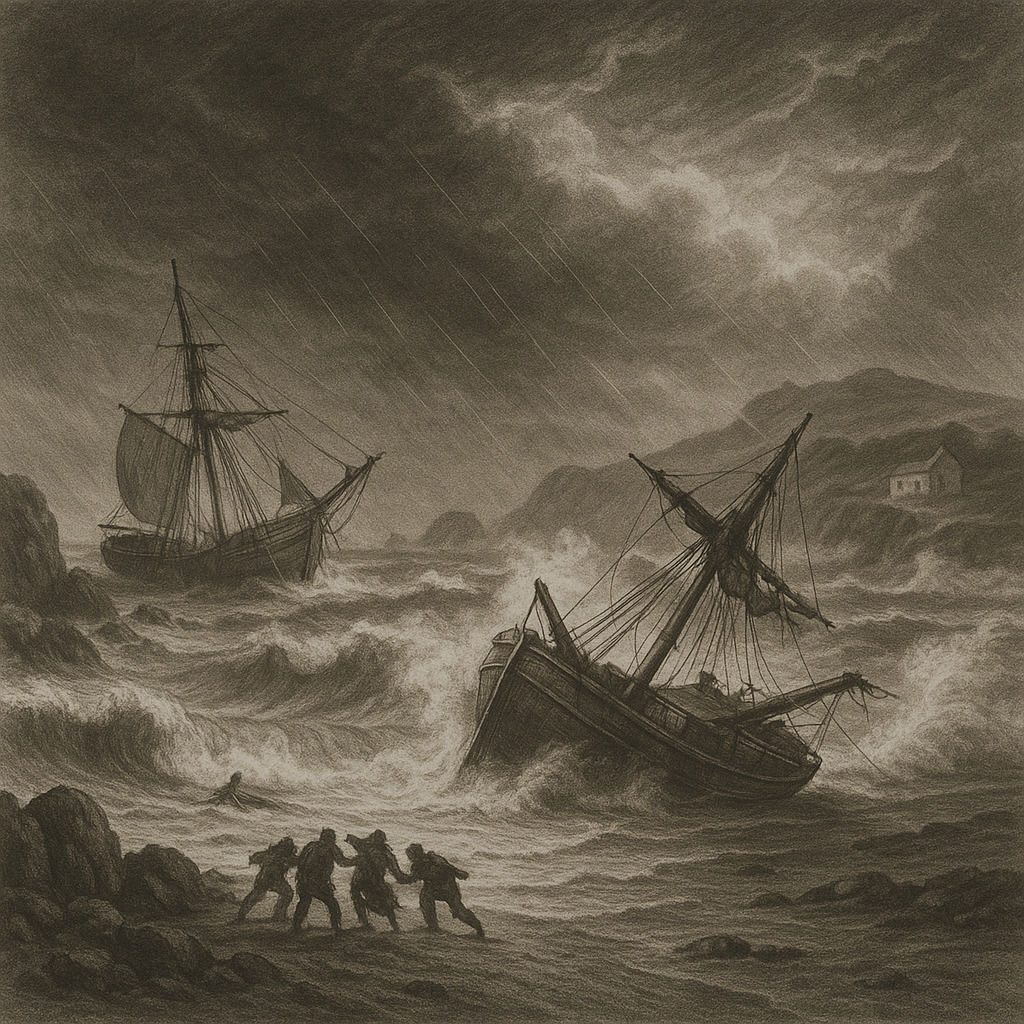
The Great Storm of 1824 wreaked devastation along the South Devon coast. Reports from Plymouth told of thirty-three ships wrecked or stranded, cargoes strewn ashore, and losses of life and property estimated at over £400,000.
At Wembury Beach, the John of Bideford, carrying silks from Leghorn, was wrecked. Her captain and crew were drowned, though his wife was miraculously found alive in the cabin and carried ashore in a grievous state. Nearby, the Welcome from the Canary Islands was driven high onto the sands at Wembury; her crew were saved, and much of her cargo thought recoverable. Preventive crews stationed at the Yealm took part in the rescues, braving the seas that destroyed many other coastguard boats along the Channel.
The storm’s effects were widespread: houses at Cawsand and Portland were washed away, harbours choked with wrecks, and families swept into the sea. Yet amid the ruin, survivors clung to life through the courage of neighbours and coastguards.
Source: British Press, 27 November 1824; reports from Plymouth dated 24 November
The 1824 storm stands as one of the greatest natural disasters in Wembury’s recorded history, later echoed in local memory alongside the 1930s cliff falls, the 1949 gorse fire, and oil pollution scares of the 20th century. The image of a captain’s widow pulled from the wreck on Wembury Beach is haunting — one of many reminders that this coast, beautiful and bountiful, has always demanded a price.
On this day in Wembury 24 November 1951
The Wembury Sleepwalker: A Remarkable Case from Rose Villa
In November 1951, Rose Villa at Knighton, Wembury, became the setting for one of the strangest court cases ever connected with the village.
Leonard James Paltridge was a 34-year-old Royal Navy lieutenant and former schoolmaster, employed at the Royal Naval Hospital in Plymouth. He lived at Rose Villa with his wife, Marion, and by every account theirs was a happy marriage. Friends and relatives later described him as a devoted husband. Marion herself said there had been no serious quarrels and no reason whatsoever for him to wish her harm.
Yet during the night of 24 November, something dreadful happened.
Marion awoke to find pressure on her throat. She remembered little more until she regained consciousness with the light on and her husband trying to give her brandy. There was blood on her pillow, and Leonard appeared pale and horrified.
Marion had suffered a fractured skull, injuries to her throat and other wounds. An axe lay nearby.
Leonard later told the police:
“I woke up and found myself with my hands around her throat.”
He believed that he must have used the axe, although he had no memory of doing so. After realising what had happened, he took the axe downstairs, apparently so that Marion would not see it. He then telephoned the police himself.
A man living in a dream
The case came before Exeter Assizes in February 1952. Leonard was charged with attempting to murder his wife and with causing grievous bodily harm.
His defence was unusual. He did not plead insanity. Instead, his barrister argued that Leonard had been sleepwalking and had acted without any conscious purpose.
Evidence was given that he had walked in his sleep before. While serving in a naval hospital in 1946, he had once awakened in a straitjacket with no memory of the previous night.
Dr Hugh Scott-Forbes, a consultant psychiatrist at the Royal Devon and Exeter Hospital, explained that a sleepwalker might carry out a series of disconnected actions while still under the influence of a dream. Such a person, he said, could act without understanding what he was doing and without forming a conscious intention.
The prosecution had to prove that Leonard intended to kill or seriously injure his wife. If he had been asleep and incapable of forming that intention, then in law the case could not stand.
The jury took only ten minutes to find him not guilty.
“A perfect husband”
Throughout the trial, Marion stood by Leonard. When asked whether there was any reason why he should have attacked her, she replied:
“Absolutely none.”
Witnesses called him “a perfect husband”, and after the verdict the couple left the court together. Newspaper photographs showed them side by side, Leonard solemn beneath his hat and Marion beside him.
They returned to Rose Villa and, so far as the surviving records show, resumed their life in Wembury.
Leonard had been born in Plympton in 1917. He and Marion Hopkins married in Monmouthshire in 1942, and their daughter, Ann, was born in 1945.
Marion died young, on 10 April 1961, aged only 44, at Frenchay Hospital in Bristol. She was buried at Ebbw Vale Cemetery, close to her family roots in South Wales. Her probate record described her home as Rose Villa, Knighton, Wembury.
Leonard remained in the Royal Navy and had reached the rank of lieutenant commander by the time of Marion’s death. He died in Plymouth in 1978, aged 61.
The case of the Wembury sleepwalker was reported across the country. It was a dramatic story of violence, but also one of loyalty, bewilderment and a court faced with an extraordinary question: can a man be guilty of a crime committed while he is still dreaming?
In Leonard Paltridge’s case, the jury decided that he could not.
On This Day in Wembury – 24 November 1988
At Plymouth Crown Court, two teenagers from Wembury admitted to what the prosecution called an “orgy of destruction” after breaking into a neighbour’s house in Church Road, Wembury, while the family were away on holiday.
XXXXXXX XXXXXXXXX, 18, of St Werburgh Close, and XXXXXXX XXXXX, 17, of Hawthorn Park Road, caused nearly £8,000 worth of damage and stole goods worth more than £5,000 from the home of TV presenter Christopher Richman.
The court heard they poured paint over a car, smashed antiques and stereo equipment, ripped up clothes, slashed two valuable oil paintings, surfboards, and a guitar, and even made a hole in the ceiling. They also stole five shotguns, a rifle, and ammunition, which they later fired at a National Trust hut on Wembury Beach during a spree of target practice.
The destruction only came to light when XXXXXXXXX’s father discovered used cartridges and confronted his son, leading to police involvement. Both teenagers admitted burglary, criminal damage, and firearms offences, claiming that what began as a dare escalated once their “adrenalin began to flow.”
A third Wembury youth, XXX XXXXXX, 17, also appeared in court after pleading guilty to handling stolen property linked to a separate burglary at Coombe Dean School, where a computer was taken and later exchanged for cash and a guitar.
The case shocked the village, not only for the sheer scale of the vandalism but also for how quickly a reckless impulse had spiralled into serious crime.
On this day in Wembury — 24 November 2024
Wembury lost one of its most remarkable seafarers when Bob Salmon of Mewstone Avenue passed away aged 78. Known across the sailing world as the man who helped bring solo ocean racing within reach of ordinary sailors, Bob’s legacy endures in the thousands who have followed his wake across the Atlantic.
In 1977 he founded the Mini Transat, a bold experiment in low-cost single-handed ocean racing for 21-foot yachts, setting off from Penzance to Antigua with a stop at Tenerife. Working with his wife Beryl, Bob organised four biennial races from Cornwall, even competing in the first two himself. When the event moved to France in 1985, it blossomed into an international proving ground for sailors — among them future stars like Dame Ellen MacArthur — and remains a cornerstone of the solo racing world to this day.
Bob later skippered two fully-crewed Whitbread Round the World Yacht Race entries — Norsk Data (1985–86) and Liverpool Enterprise (1989–90) — extending his reputation for courage, ingenuity and integrity. Fellow sailor and meteorologist Chris Tibbs, who crewed with him on both voyages, recalled: “Before meeting Bob, the opportunity of racing a maxi around the world was unthinkable. Sailing as mate gave me the knowledge and confidence to continue my career as well as providing a great adventure.”
From his quiet home overlooking Wembury Bay and the Mewstone, Bob Salmon reshaped ocean racing, making it less about privilege and more about passion and perseverance. As he once said, “The technology has changed, but people are still the same.” His spirit, and that vision of fairness on the open sea, will remain part of Wembury’s story for generations to come.
Source: Western Evening Herald, 24 Nov 1988.
Entries are summaries and interpretations of historical newspaper reports.