
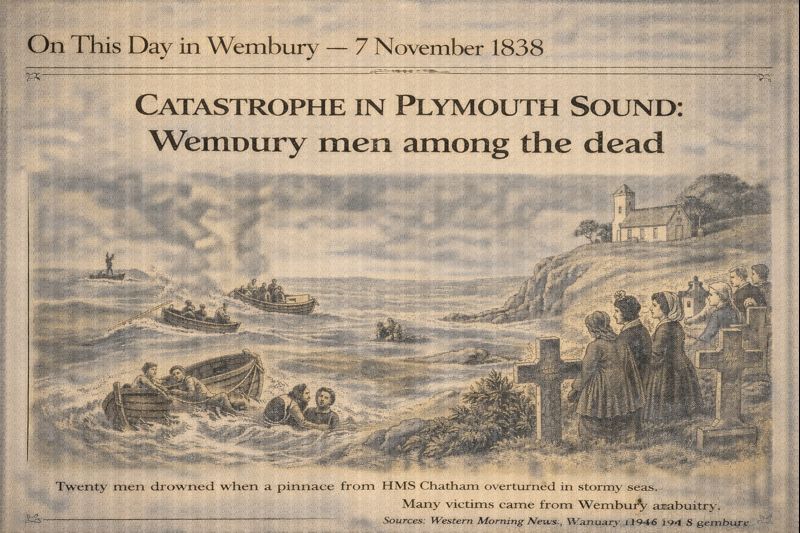
On This Day in Wembury — 7 November 1838
Catastrophe in Plymouth Sound: Wembury men among the dead
A violent south-westerly gale struck Plymouth Sound, producing sudden squalls and a confused sea where the ebb tide met the swell near the Cobler buoy. Three pinnaces left HMS Chatham at the Breakwater with about twenty labourers each, bound for the Oreston quarries. Only two arrived. The second pinnace capsized near the Cobler; twenty men were lost.
Among the dead were many from Wembury: Robert Cobbledick (widow and seven children), William Cornish (widow), Thomas Nutt (widow and four children), William Luxam (widow and six children), Joseph Blake (widow and five children), plus the unmarried William Davis and David Deeting. In total the tragedy left 14 widows and 51 orphans.
Although the boat was sound and her steersman, William Sampson of Plymouth, was experienced, the sudden sea proved overwhelming. From shore, three men were seen clinging to the Cobler buoy but were washed off before help came — unlike other buoys in the Sound, the Cobler lacked the lifelines known as preservers.
Public grief was immediate. Relief subscriptions were begun at Plymouth Guildhall and in local churches to aid the bereaved families.
The 1838 pinnace disaster is one of the darkest maritime episodes linked to Wembury, binding the parish into Plymouth’s wider story of loss at sea. It stands alongside the 1806 Hibernia launch calamity at Wembury, the 1828 wreck of the Lord Mulgrave, and later tragedies such as the Fritonia in 1845. Together they remind us how often the coast here has been both a livelihood and a grave.
The detail of families left destitute — Cobbledicks, Cornishes, Nutts, Luxams, Blakes — transforms this from a shipping report into a human disaster that scarred a small community for a generation. One can almost picture Wembury Churchyard filled with mourners from households now headed only by widows, the Sound behind them still heaving from the same storm that took their men. The sea, so close and ever-present, has shaped the fate of Wembury not just in its scenic calm, but in these violent reckonings.
Entries are summaries and interpretations of historical newspaper reports.