
On This Day in Wembury – 29 September 1927
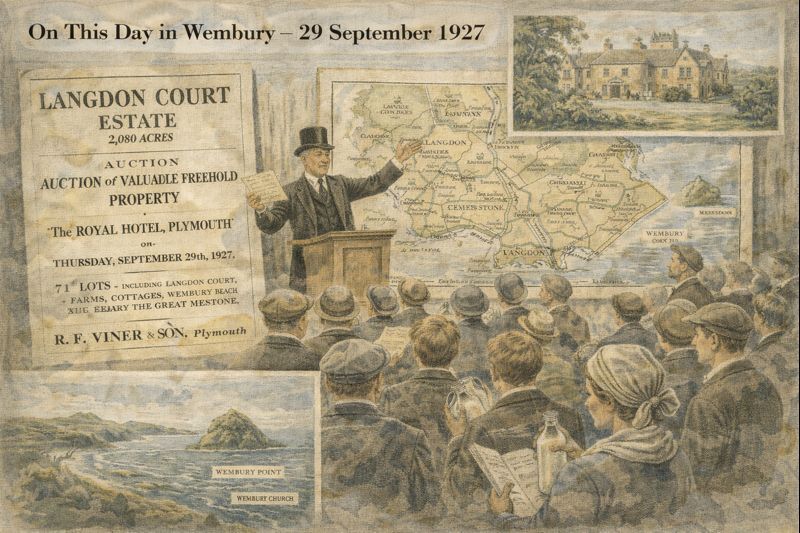
The Langdon Court Estate went under the hammer at the Royal Hotel in Plymouth. It was one of the most sweeping property sales South Devon had ever seen, covering some 2,080 acres. The estate stretched from Down Thomas in the northwest to Heybrook Bay in the southwest, Wembury Church and Mill in the southeast, and Hollacombe in the northeast.
Seventy-one lots were catalogued, including Langdon Court itself, numerous cottages, 14 working farms (among them Sherwell, Traine, Knighton, West Wembury, Higher Ford, Langdon Barton, Raneleigh, and Barton Taylor’s), plus both the New Inn at Down Thomas and the Jubilee Inn at Knighton. Even Wembury Beach and the Great Mewstone were listed.
The sale came in the shadow of the 1920s economic downturn, so many properties failed to reach their reserves. Those that did sell still seem almost unbelievable by modern standards. Knighton Farm fetched £3,700, while West Wembury Farm went for £4,700 (around £40 per acre). Langdon Barton Farm made £5,650, while Church Walk Wood (16 acres) reached £770.
Wembury Point, with 102 acres of coastal land, fetched £3,000, labelled in the brochure as “building land.” And the Great Mewstone itself sold for £500 — about the price of two Morris Cowleys or Austin Sevens in 1927. In today’s money that’s around £35,000 — still staggeringly cheap for an island that dominates the bay.
Auctioneer R. F. Viner’s firm handled the sale, and his son (writing decades later) remembered it as a landmark event in South Devon estate history.
Sources: Exeter & Plymouth Gazette, 9 Sept 1927; Western Evening Herald, 12 Nov 1991 (recollections of R. F. Viner, Chartered Surveyor).
Reflection
The sale marked a turning point in Wembury’s story. What had once been a single landed estate was broken up into dozens of lots, passing into many different hands. Farms that had been tenanted for generations were suddenly up for grabs, inns and cottages became investments, and even the Mewstone changed ownership. In a sense, the 1927 sale symbolises the shift from the old world of big estates to the more fragmented, suburban, and commuter-driven Wembury we know today. It reminds us how quickly the patterns of land and power can change, and how local communities live with the legacies of those sales for generations.
On This Day in Wembury – 29 September 1995
A piece of naval history arrived at Wembury Point when the great figurehead of Queen Victoria was moved from the Royal Naval Engineering College at Manadon to the gunnery school, HMS Cambridge.
The four-metre, four-ton carving was originally made in 1856 for the Navy’s gunnery training ship in the Hamoaze, later renamed HMS Cambridge. It had spent fifty years in the grounds at Manadon, rescued from the cruiser HMS Drake, but with the college closing down, the decision was taken to return it to the coast where the Cambridge name still lived on.
Hoisted onto a lorry, the monarch made the journey “in state” to Wembury. Once restored and cleaned — work carried out by Weapon Engineer Mechanic Stuart Dingley — the statue was placed on a plinth before the mainmast at the naval school, a striking reminder of Britain’s longest-serving sovereign keeping watch over the training ground.
Source: Western Morning News, 29 Sept 1995.
Entries are summaries and interpretations of historical newspaper reports.