
On This Day in Wembury – 6 September 1824 / 21 March 1825 (Trial)
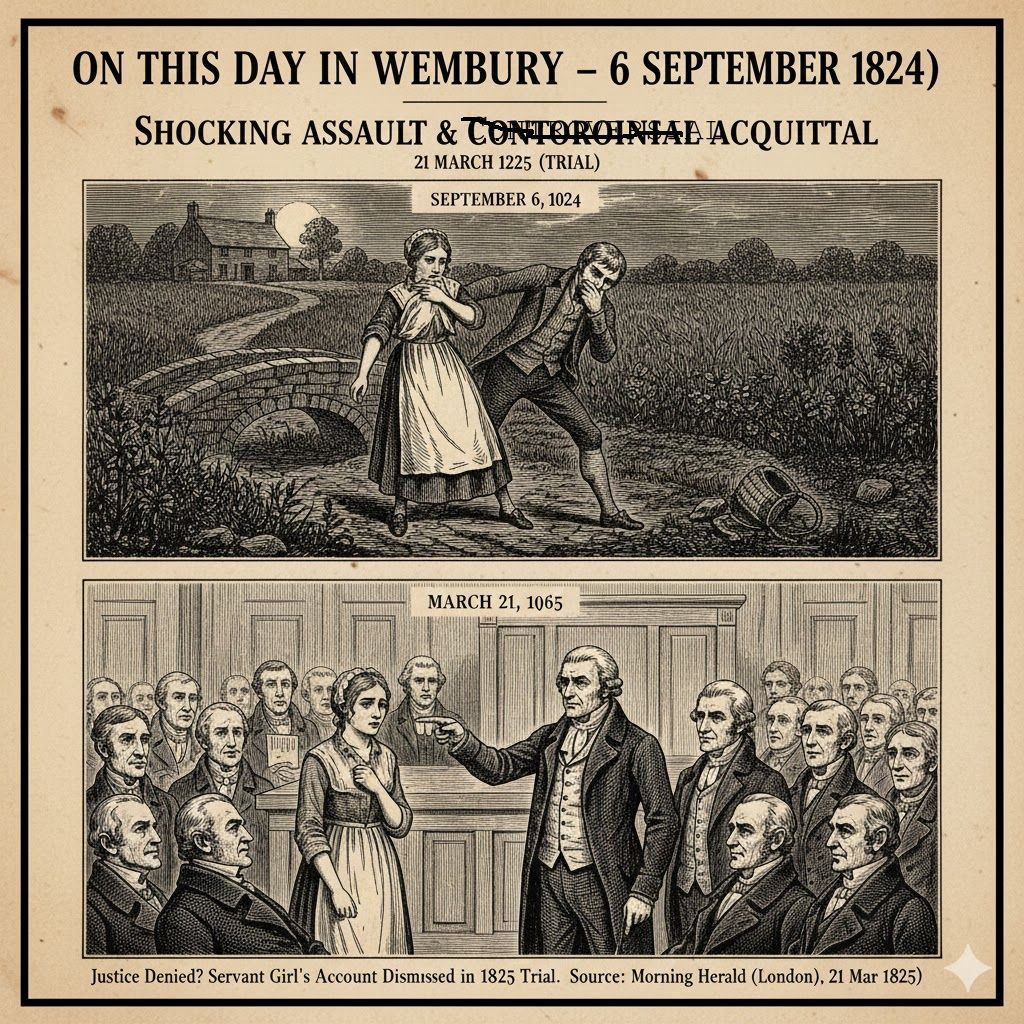
At the Exeter Crown Court, William Dunn of Knighton was indicted for a serious assault on Elizabeth Avent, a young servant employed by farmer Mr. Hill of Wembury.
On the evening of 6 September 1824, Elizabeth was walking home from work to her father’s house. At Gabber Bridge, midway on her journey, Dunn accosted her, suggesting they walk together up a secluded lane. When she refused, he threatened to kill her, dragged her into a field, and stuffed her apron into her mouth to prevent her from crying out. She later told her cousin what had happened but delayed reporting the matter to the authorities for six weeks.
At the trial on 21 March 1825, Mr. Justice Burrough stressed that her delay in making a formal complaint cast doubt on the case, and instructed the jury accordingly. Dunn was acquitted.
From today’s perspective, the case shows the heavy burden placed on women in early 19th-century courts. Their credibility often hinged less on the assault itself than on whether they had reported it “quickly enough” or told the “right” person — standards that frequently worked against victims.
Source: Morning Herald (London), 21 Mar 1825.
On This Day in Wembury – 6 September 1933
A domestic service advertisement in the Western Morning News revealed the household arrangements at Thorn, Wembury.
The Hon. Mrs. Sebag-Montefiore sought a scullerymaid, “a strong girl not under 17,” to divide her duties between Wembury and London. The ad carried the telephone listing “Wembury Bay 219,” a reminder of how relatively few households in the parish had private lines at that date.
Placed alongside other local adverts for housemaids and cooks, it illustrates the continuing reliance of large country houses on domestic staff during the interwar years — even as many young women sought different careers.
Source: Western Morning News, 6 Sept 1933.
On This Day in Wembury – 6 September 1938
At Plympton court, Stanley John Cam, of Pixiewell, Wembury, was fined £1 for assaulting his wife, Mary Bain Cam.
Mrs Cam told the magistrates that during a quarrel her husband had struck her, leaving her with two black eyes. Cam admitted the offence but claimed the marriage had failed after only twelve months. He said tensions worsened when the couple went to live with his wife’s mother at Wembury.
The Bench imposed a fine rather than a custodial sentence.
Cases like this underline how domestic violence was often treated with relative leniency in the 1930s, with modest fines considered a sufficient punishment even where clear physical injury was admitted.
On This Day in Wembury – 6 September 1952
Princess Marie Louise, granddaughter of Queen Victoria, visited Wembury to open a fete in the grounds of Wembury House, then the home of MP Henry Studholme. The event was held to raise funds for the 1st Wembury Group of Boy Scouts, who were seeking a hut to use as a Scout den with training and storage facilities.
Addressing the boys, the Princess stressed that the future of the country and Empire rested on their shoulders. “Each one of you is a cog in the machine,” she told them, urging daily acts of kindness and a sense of duty.
Air Vice Marshal T. C. Traill described the Scout movement as the finest youth movement in the world, while Maj.-Gen. J. E. Leech-Porter, County Commissioner, highlighted the difficulty of finding Scoutmasters and appealed for new leadership.
The fete featured Scout and Cub displays, fencing from the Plymstock Fencing Club, judo by cadets of the 1934 (Plymouth) Squadron ATC, and nautical performances by the Girls’ Nautical Training Corps, accompanied by Plymouth Silver Band. In a nearby field, the 15th Devon District Scouts held a weekend camp, which Princess Marie Louise also inspected.
Source: Western Morning News, 8 Sept 1952.
Entries are summaries and interpretations of historical newspaper reports.