
On This Day in Wembury: A Lost Painting of Wembury in the Mist
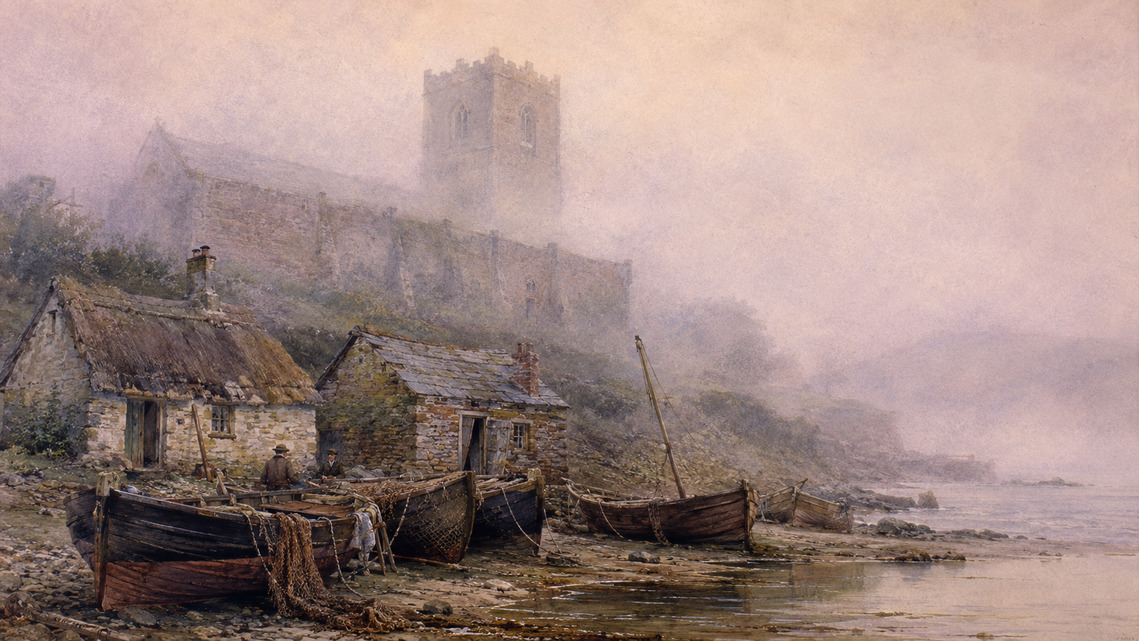
On 5 September 1876, the Western Daily Mercury published a review of a watercolour exhibition which included a substantial painting entitled Wembury Mist.
The artist was William Gooding Cook, usually known as William Cook of Plymouth. Born in Plymouth in 1840, he was the younger son of the respected West Country watercolourist Samuel Cook.
After his father’s death, William initially worked as a painter in the family decorating business. By the 1871 census, however, he was describing himself professionally as an artist. He travelled throughout Devon and Cornwall, painting harbours, fishing villages, cliffs, wrecks and coastal landscapes.
Cook was particularly fond of pinks, greens, purples and earthy browns. His surviving paintings combine careful observation of boats, rocks and buildings with an idealised interpretation of the landscape. He sometimes altered the topography to make a stronger composition rather than attempting a completely literal record.
The Western Daily Mercury reviewer considered Wembury Mist one of Cook’s most successful works. It was described as a painting of considerable size in which the artist had relied upon his own judgement in choosing the subject, atmosphere and colouring.
In the foreground Cook had painted fishing boats and what the newspaper called primitive cottages. These were carefully and convincingly executed. Behind them rose the heavily buttressed wall and tower of Wembury, almost certainly St Werburgh’s Church, enveloped in thick sea mist. The higher ground beyond was barely distinguishable.
The reviewer concluded that it was a skilful and successful work.
This was an important period in Cook’s career. Most of his known paintings date from between 1870 and 1890, while Wembury Mist appeared shortly before he began exhibiting at the Royal Society of British Artists in London. Four of his Cornish paintings were subsequently shown there between 1877 and 1879.
Cook never achieved the lasting reputation of his father, but his paintings now appear regularly at auction. Surviving subjects include Polperro Harbour, Kynance Cove, St Michael’s Mount, Newquay and shipwreck scenes around the Cornish coast. He died in Plymouth in 1897, aged only 57.
Despite extensive searching, I have found no photograph, catalogue illustration or auction record that can confidently be identified as Wembury Mist. Its present whereabouts are unknown. It may survive under a different title in a private collection, or it may have been lost entirely.
The newspaper description nevertheless preserves something valuable. It tells us that in 1876 a Plymouth artist stood on the Wembury shore and saw fishing boats and humble cottages below St Werburgh’s Church, with its tower and buttressed walls gradually disappearing into a bank of sea mist.
The accompanying picture is not the original painting. It is a reconstruction based upon the contemporary description and the colours, composition and detailed treatment found in Cook’s surviving watercolours.
Background: Cornwall Artists Index biography, Tate artist record and an illustrated account of a surviving William Cook watercolour.
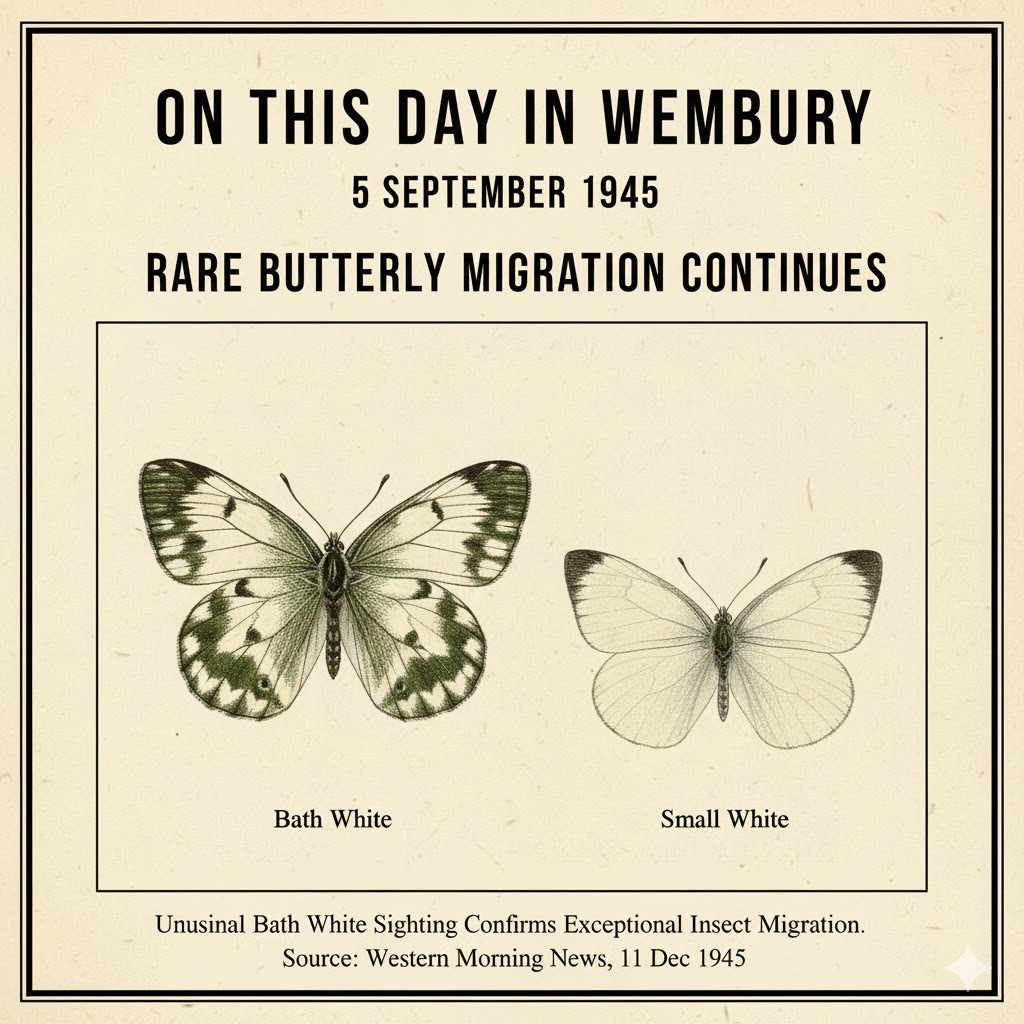
On This Day in Wembury – 5 September 1945
Another Bath White butterfly was observed at Wembury, confirming that the unusual migration seen earlier in the summer was continuing into autumn. The Bath White’s green-and-white patterned underwings made it easy to distinguish from local species, and its presence emphasised how exceptional 1945 was for insect migration across Devon.
Source: Western Morning News, 11 Dec 1945.
On This Day in Wembury – 5 September 1991
A fatal car crash on 5 September 1991 in Southland Park Road, Wembury, claimed the lives of three pensioners: Clive Soppett (71), Marion Soppett (74), and their friend Kathleen Andrews (73). The trio had been returning home from a gathering when their car veered off a bend and collided with a wall.
At the inquest, authorities revealed Mr. Soppett had over twice the legal alcohol limit in his system, and their decision not to wear seatbelts intensified the tragedy. The coroner recorded verdicts of accidental death, cautioning that even small amounts of alcohol can impair driving—a timely warning underscored by this incident.
Source: Wembury burial records (Clive Soppett interred 5 Sep 1991) wemburyhistory.org.uk. Also originally reported in Western Morning News, 11 Dec 1991.
Entries are summaries and interpretations of historical newspaper reports.