
On This Day in Wembury – 4 September 1947
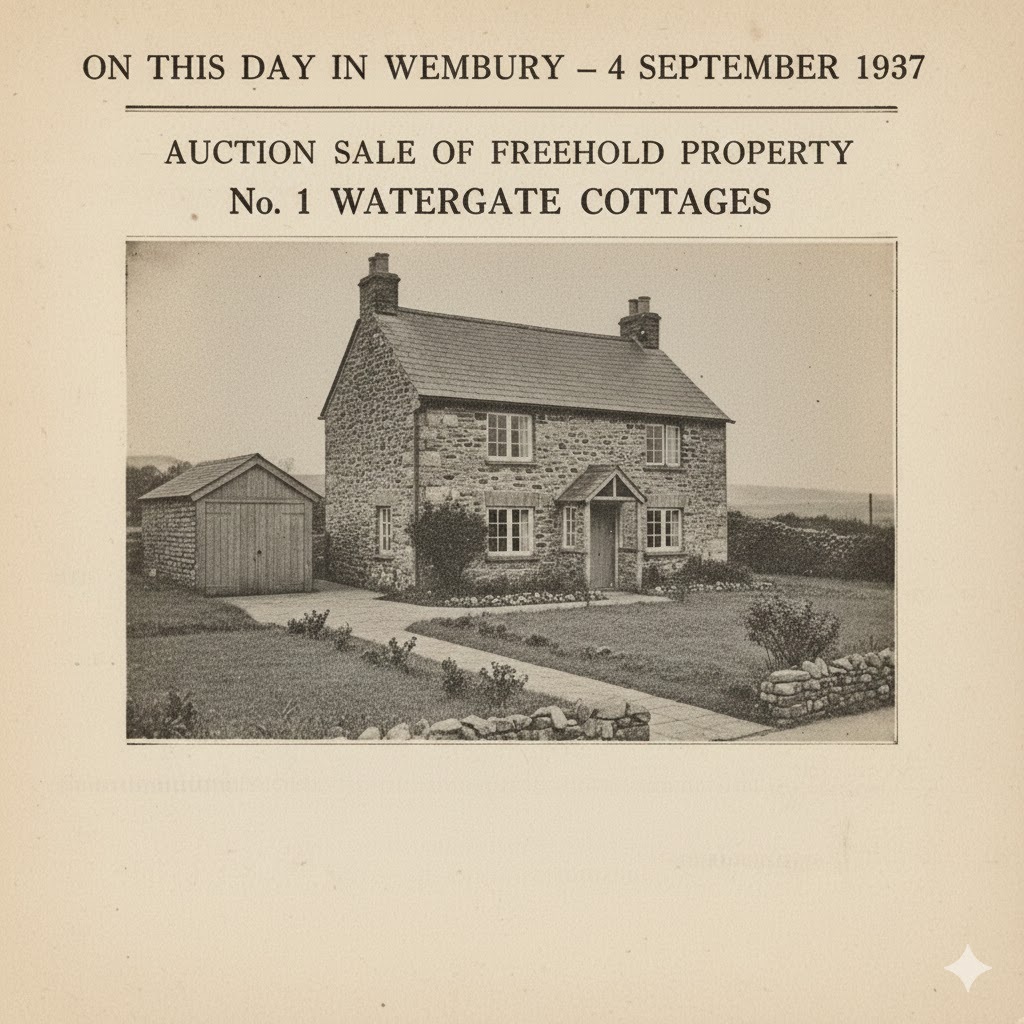
An auction was announced for the freehold cottage at No. 1 Watergate Cottages, Wembury, to be sold at the Law Chambers, Princess Square, Plymouth.
The stone-built, cement-faced cottage with slate roof included:
-
Sitting room and kitchen.
-
Small scullery with sink.
-
Two bedrooms (the rear bedroom with a bath alcove).
-
Built-in cupboards, electric heater, and outside w.c.
-
Garage and small front garden.
The property had modern services for its time: mains drainage, electricity, and water supply. It was located close to the bus route to Plymouth and within a mile of Wembury Beach. Vacant possession was offered on completion.
The auction was conducted by Viner, Carew & Co., with legal particulars managed by Shelly & Johns, solicitors of Plymouth.
This sale reflects the post-war demand for modest but modernised homes in Wembury, as village cottages were increasingly marketed for their convenience and proximity to Plymouth and the coast.
Source: Western Morning News, 28 Aug 1947.
On This Day in Wembury: A Royal Visitor for the Scouts
On 4 September 1952, the Western Morning News announced that Princess Marie Louise, a granddaughter of Queen Victoria, was coming to Wembury to open a fundraising fête for the 1st Wembury Scout Troop.
The fête was to be held two days later, on Saturday 6 September, in the grounds of Wembury House. Its purpose was to raise money for a permanent headquarters for the village Scouts, including a room where equipment could be stored and training carried out.
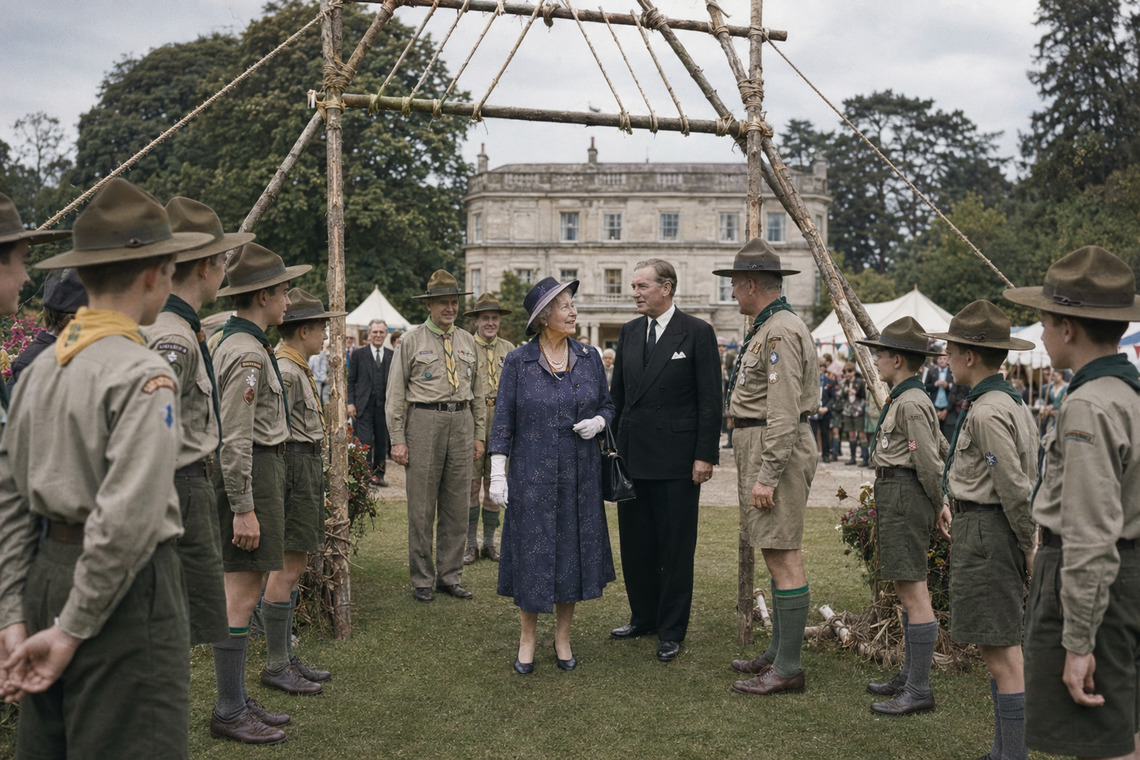
Visitors would enter through an elaborate ceremonial Scout gate specially constructed by the 1st Ivybridge Troop. Princess Marie Louise was expected to inspect the gate before formally opening the fête at three o’clock.
The Princess was then 80 years old. Born at Cumberland Lodge in Windsor Great Park in 1872, she was the daughter of Princess Helena, Queen Victoria’s third daughter. Following the breakdown of her marriage, she devoted much of her life to charities, hospitals, youth organisations and the arts. She also helped inspire the creation of Queen Mary’s famous Dolls’ House. Princess Marie Louise lived until 1956 and was one of Queen Victoria’s last surviving grandchildren.
The Princess would be welcomed by the Countess of Mount Edgcumbe, the Commanding Chief of the Plymouth Division of the Girls’ Nautical Training Corps, and by the Honourable Mrs John White.
Wembury House was then the home of Henry Gray Studholme, the Conservative Member of Parliament for Tavistock, the constituency which included Wembury. In September 1952 he was also serving in Winston Churchill’s government as Vice-Chamberlain of the Household, a position he held from 1951 until 1956. He had served in the Scots Guards and had been wounded by gas during the First World War. He later became Sir Henry Studholme when he was created a baronet in 1956. He represented Tavistock from 1942 until 1966, when he was succeeded by Michael Heseltine.
The fête offered far more than the usual stalls and refreshments. Around 60 Scouts were camping near Wembury House as part of the Number 15 Devon District Camp. Visitors could watch demonstrations of cooking and camping, woodcraft, handicrafts and different methods of lighting fires and ovens.
There were displays by the Plymouth Fencing Club, judo demonstrations by cadets of Number 1934 Squadron Air Training Corps and a sword dance and hornpipe performed by the Girls’ Nautical Training Corps.
The combined bands of the Girls’ Nautical Training Corps and the Plymouth Sea Cadet Corps were to perform a ceremonial retreat. Senior Scouts would provide a guard of honour for the Princess.
The distinguished guests also included Air Vice Marshal T C Traill, Air Officer Commanding Number 19 Group of Coastal Command, and Major General J E Leech-Porter, the County Commissioner for Devon.
The occasion brought together Wembury village life, the Scout movement, the armed services and the Royal Family in the grounds of one of the parish’s most important houses. Behind all the ceremony, however, was a thoroughly practical local ambition. The young Scouts of Wembury needed a building of their own, and the village was raising the money to provide it.
The accompanying reconstruction depicts Princess Marie Louise passing beneath the handmade Scout gate at Wembury House, welcomed by Henry Studholme and a Scout guard of honour.
Entries are summaries and interpretations of historical newspaper reports.