
On this day in Wembury – 3 September 1884
Source: Express & Echo, 4 September 1884
Langdon Barton Stock Sale
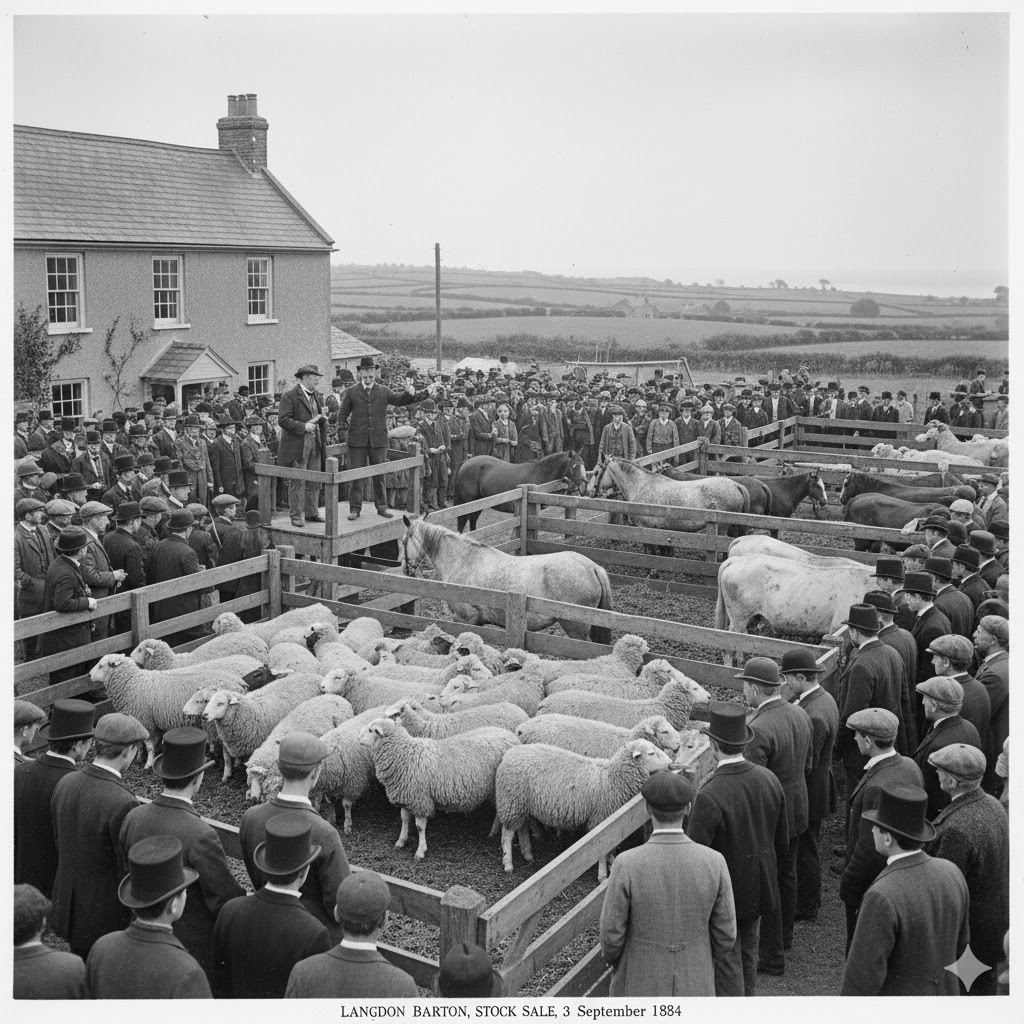
On Wednesday, 3 September 1884, Messrs. Bourne, Son & Vosper of Rousdon and Plympton held a major auction of livestock at Langdon Barton, Wembury, on behalf of Mr. T. J. Petrie.
The sale attracted a very large attendance of leading agriculturists and dealers, and was described as one of the most spirited sales of the season.
-
Sheep: Over 400 sold, described as the best flock submitted to the hammer locally that year. Breeding ewes fetched 58s–51s each; two-tooth ewes 50s–40s; ewe lambs 43s 6d–32s; wether lambs 45s–30s.
-
Cattle: Around 60 bullocks offered. Cows in calf reached up to £25 5s; cows in milk £21–£17; young heifers £19 5s–£14 5s; pairs of young steers £28–£26; fat steers £27–£26 15s; fat bull £26 5s.
-
Horses: Several valuable horses and colts sold. Six mares in foal or with foals fetched 21½–13½ guineas; a grey horse (8 years) sold for 17 guineas; two-year-old cart colts made 22–21 guineas.
The stock was widely praised for quality, particularly the sheep, which were regarded as outstanding in the district.
On This Day in Wembury – 3 September 1939
Britain declared war on Germany at 11:15am, and in Wembury, as across the country, the news marked the start of years of uncertainty and sacrifice.
One villager later recalled hearing Prime Minister Neville Chamberlain’s broadcast while home on weekend leave from HMS Impregnable at St Budeaux. As a young boy seaman, he packed his few belongings into the traditional blue handkerchief bundle while his mother wept, uncertain when she might see him again. Called back to his unit, he marched off “like a hero” — only to be released again later that afternoon, blue bundle intact. That fleeting moment of departure, however, left a lasting impression, and the anguish of his mother’s tears stayed with him throughout the war.
For Wembury, the conflict was no abstraction. The village endured air raid sirens, bombs falling uncomfortably close, and the loss of sixteen residents from a population of around 800. Along the shore, a concrete pillbox at Wembury Beach was built to guard against invasion. Sixty years later, its eroded remains still stood, battered by waves, a silent reminder of the long struggle and the sacrifices made.
As the villager reflected in 1999, “Many did not come back — and their mothers cried.”
Source: Western Evening Herald, 4 Sept 1999 (60th anniversary reflection).
Entries are summaries and interpretations of historical newspaper reports.