
On this day in Wembury 1924
A serious cycling accident at Wembury left a young Plymouth woman fighting for her life after what should have been an enjoyable ride to the coast.
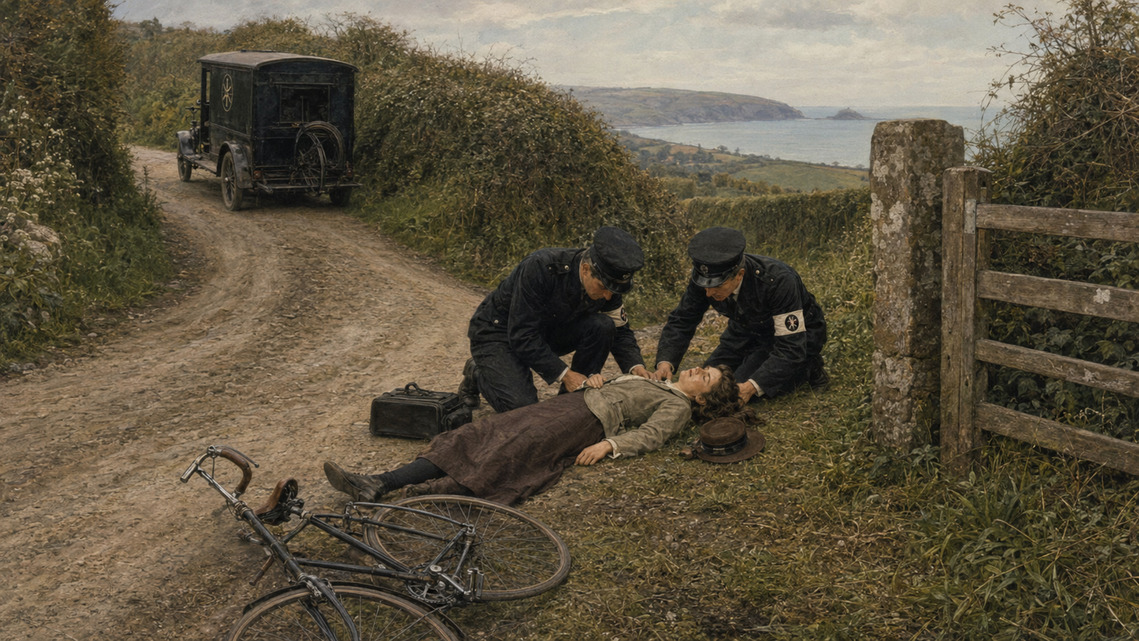
Miss Olive Andrews, aged 22, of Frobisher Terrace, Plymouth, was cycling down the steep hill towards Wembury Beach when she lost control of her bicycle. At the sharp bend near the bottom of the hill she crashed heavily into a gatepost.
Olive was found unconscious and it quickly became clear that she had suffered a severe head injury. Plymouth St John Ambulance was called and Sergeant Skinner and Driver Chaffe attended. After giving first aid at the scene, they carried her to the ambulance and took her to the South Devon and East Cornwall Hospital in Plymouth.
Doctors discovered that Olive had suffered a severe compound fracture of the skull. An emergency operation was performed immediately. Her condition later that night remained serious, although the hospital reported that she was satisfactory for the time being.
There is good reason to believe that Olive survived. Records show an Olive May Andrews later living at the same address, 7 Frobisher Terrace. She married Harry Parkhouse and was living there with him by 1941. The matching name and exact address make it very likely that this was the young cyclist, although I have not yet found a record that proves the connection beyond doubt.
Sadly, Olive was to experience another tragedy only a few years later. Her husband Harry became an Air Raid Precautions warden during the Second World War. He was killed at Friary Station during the Plymouth Blitz on 20 March 1941, aged only 35. Official records identify him as the husband of Olive May Parkhouse of 7 Frobisher Terrace. Olive was named as the beneficiary of his estate.
The accident report ends while Olive was still dangerously ill, leaving its original readers uncertain whether she would survive the night. The later records appear to supply the missing ending. She seems to have recovered from an injury which could very easily have killed her, only to lose her husband to the bombing of Plymouth a few years later. Behind this short newspaper report was not simply a cycling mishap, but the beginning of a much longer and more difficult human story
On this day in Wembury, 29 August 1934
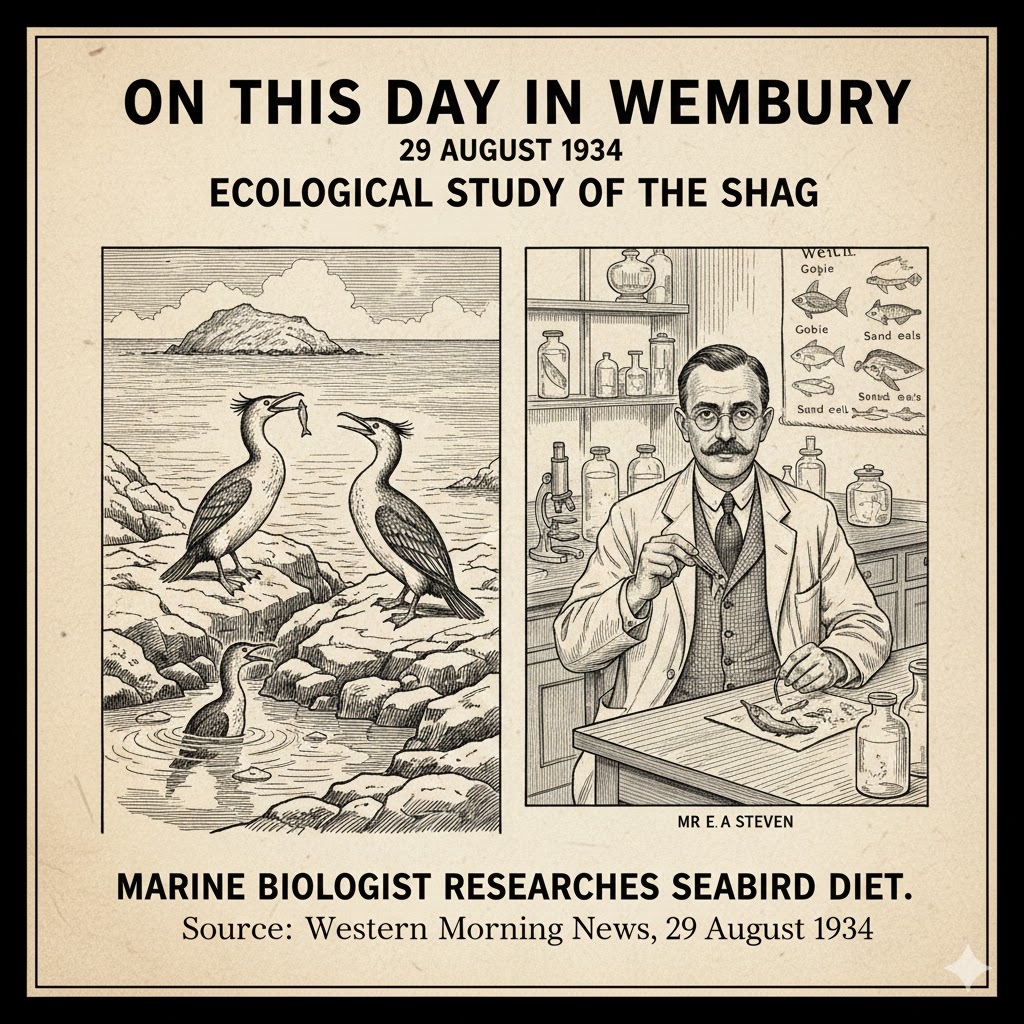
A short natural history note in the Western Morning News drew attention to new research into the feeding habits of the shag, a familiar seabird along the Wembury and Yealm coastline. The investigation, carried out by Mr E A Steven of the Marine Biological Association in Plymouth, examined the diet of shags and cormorants and compared their behaviour.
The report explained that although the shag is fond of marketable fish, it survives largely on small species such as gobies and sand eels. The writer argued that, given this evidence, the shag deserved a place on the protected list. It offers a glimpse of the early ecological work taking place on our local shores, long before the modern conservation movement.
Source, Western Morning News, 29 August 1934.
Entries are summaries and interpretations of historical newspaper reports.