ON THIS DAY IN WEMBURY – 22 August 1908

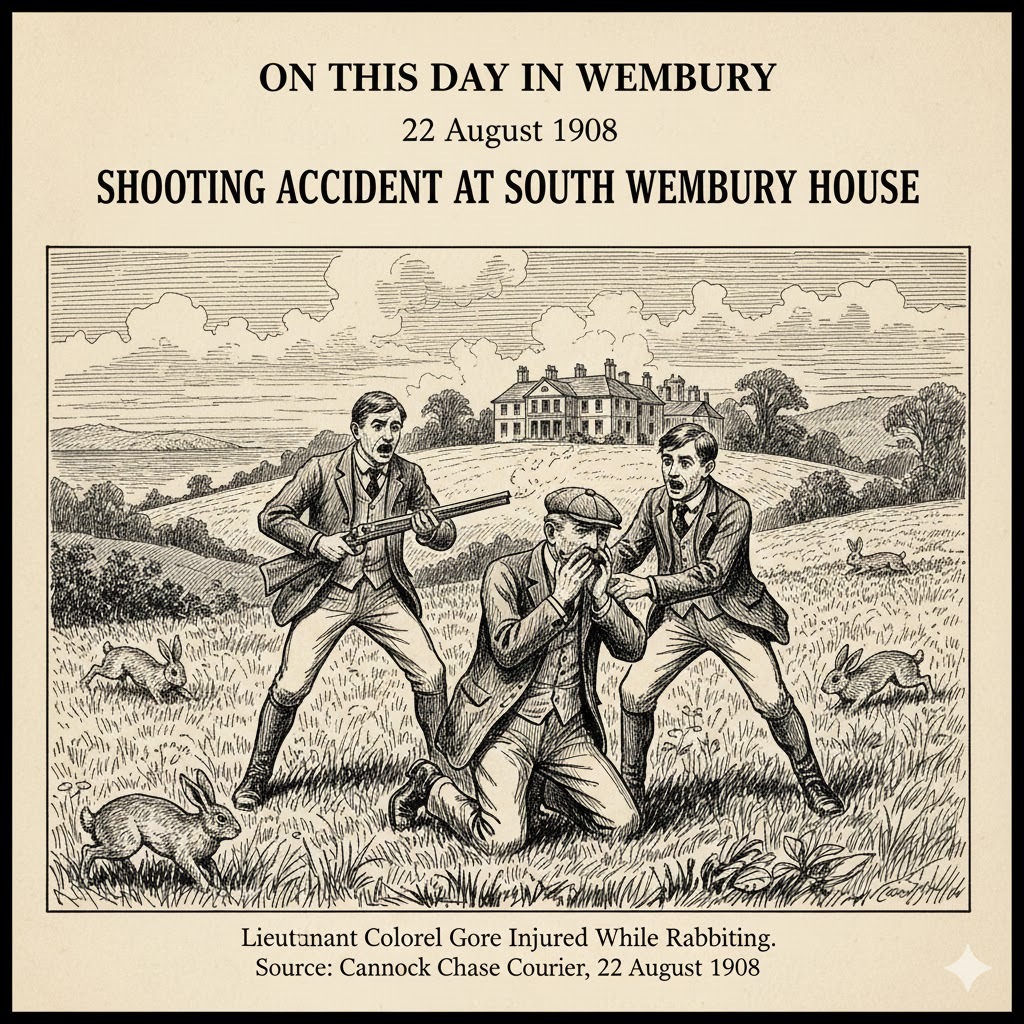
Lieutenant Colonel G A E Gore of South Wembury House suffered a frightening shooting accident while out rabbiting on his own estate. Accounts say his gun discharged unexpectedly and he was struck in the face at close range. For a time there were real fears he might lose his sight, a serious concern not only for his health but for the running of the large South Wembury property, where he was a well-known local figure.

The report emphasised that although the injury was severe, his recovery was progressing well, and the household expected him to regain much of his strength. For Wembury residents at the time, news of a wounded landowner would have travelled fast, especially given the importance of the big estates in local employment and daily life. It also reflects how common and hazardous estate shooting parties were in the early twentieth century, long before modern gun-safety rules.

Source, Cannock Chase Courier, 22 August 1908.
08-22.jpg


ON THIS DAY IN WEMBURY – 22 August 1930

A serious accident occurred on Wembury Road when five-year-old Sylvia Griffin, of Fletcher’s View, was struck by a passing bus while attempting to cross the road near her home. She suffered severe head injuries and shock. St John Ambulance volunteers treated her at the scene and rushed her to the South Devon and East Cornwall Hospital in Plymouth, where her condition was reported as very serious.

Looking back now, the incident marks the beginning of a particularly painful period for the Griffin family. Just two years later, in 1932, they would face an even greater tragedy with the death of Alfred Cecil Griffin, aged twenty-seven, whose inquest revealed deep emotional strain and financial distress. Seen together, these events paint a picture of a family who endured repeated hardship during the interwar years, in a village where every such blow was felt keenly by neighbours and friends.

Source, Western Morning News, 23 August 1930.

🌊 ON THIS DAY IN WEMBURY — 22 AUGUST 1932

THE BOY WHO TRIED TO OUT-CRUISE CRUSOE

On this day in 1932, the Daily Herald reported the remarkable adventure of Alister Marshall, a boy from Heybrook Bay who decided to build his own raft—and discovered that the sea had plans of its own.

According to the newspaper, Alister believed he could “out-cruise Robinson Crusoe without the help of any Man Friday.”

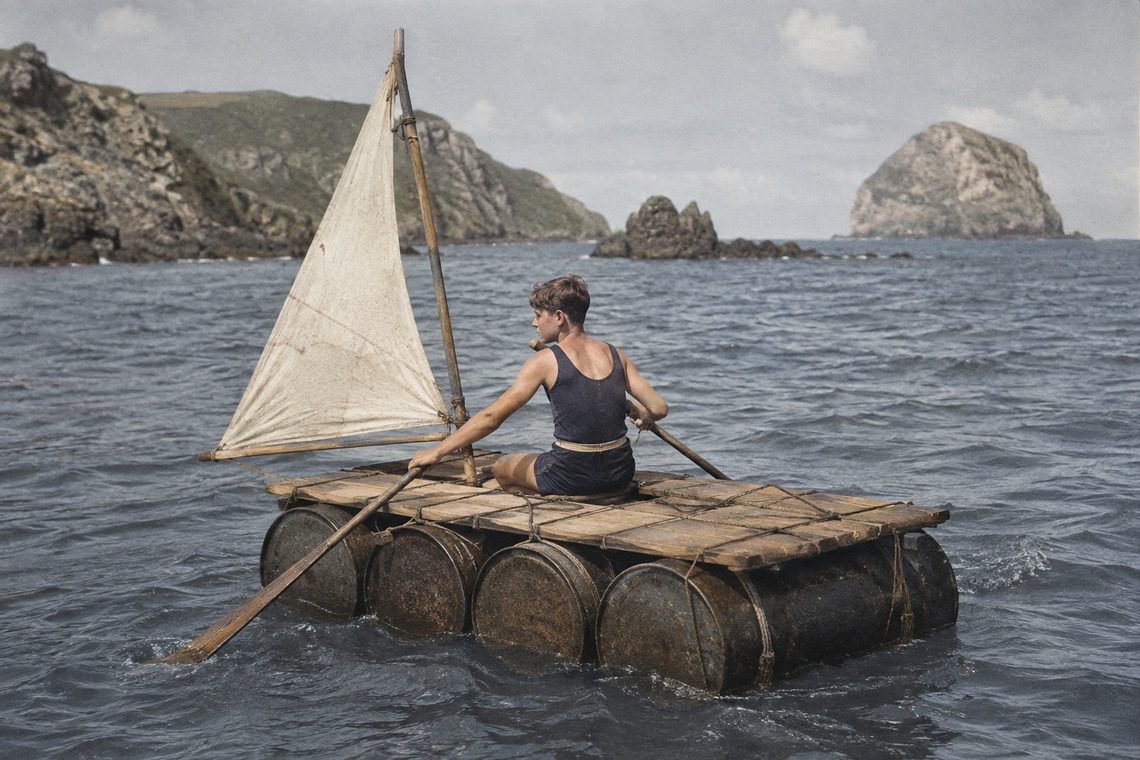
Using several wooden planks and four empty oil drums, he constructed a homemade raft. He fitted it with a small sail and made himself a pair of paddles.

Then he launched it and set off.

At first, his miniature voyage must have seemed a tremendous success. A breeze filled the little sail and carried the raft out into Wembury Bay. Unfortunately, Alister had failed to take the strength and direction of the tide into account.

Before long, the wind and water were carrying him farther out to sea.

Realising that his raft could not be controlled, Alister made a bold decision. He abandoned his vessel, dived into the water and began swimming towards Shaggy Rock.

The newspaper described it as a difficult swim, but after “a tussle” he succeeded in reaching the rock.

There he sat, marooned in Wembury Bay, and waited patiently until a passing boat spotted him and brought him safely ashore.

Alister was apparently none the worse for his adventure—and reportedly became the envy of his playmates.

The story did not quite end there.

His abandoned raft continued its unmanned voyage across Plymouth Sound and was eventually recovered on the Cornish coast. Alister’s clothes were still aboard.

With no sign of the owner, coastguards in both Devon and Cornwall became concerned that an unknown boy had been lost at sea. Only later was the empty raft connected with the young castaway who had already been rescued from Shaggy Rock.

REFLECTION

It is easy to understand why this story delighted the newspapers. It has everything: an adventurous boy, a homemade sailing raft, an unexpected voyage, a daring swim and an unmanned vessel turning up on the opposite coast.

There is something wonderfully inventive about Alister building a working raft from planks and discarded oil drums. It was the sort of childhood experiment that could probably have happened only in an age before buoyancy aids, mobile telephones and anxious adults tracking every movement.

But beneath the newspaper’s playful “Robinson Crusoe” treatment was a genuinely dangerous incident. The tides around Wembury and Plymouth Sound are powerful, and even a capable swimmer can quickly be overwhelmed. Alister’s decision to abandon the raft and swim for the nearest rock was courageous—but he was also extraordinarily fortunate.

His adventure remains a vivid glimpse of childhood beside the sea in the 1930s: ingenious, independent, slightly reckless and very nearly tragic.

📷 The accompanying image is a modern historical interpretation. It imagines Alister aboard his oil-drum raft as the breeze carries him across Wembury Bay. His appearance and the precise design of the raft are not known.

Source: Daily Herald, Monday 22 August 1932.

#OnThisDay #Wembury #WemburyWaves #HeybrookBay #WemburyHistory #PlymouthSound #ShaggyRock #LocalHistory #RobinsonCrusoe

22aug1932im.jpg


On this day in Wembury, 22 August 1996

The Western Evening Herald profiled Clive Fairweather, the travelling storyteller who appeared regularly at historic sites, outdoor festivals and coastal events across the West Country. That summer he was promoting a programme of evening storytelling sessions, including one on Wembury Beach on Thursday 22 August at six thirty, where visitors could sit on the sand, listen to tales of sailors, smugglers and Elizabethan shipwrecks, and watch the light change over the bay.

Fairweather believed strongly in reviving old traditions of oral storytelling at a time when screens were taking over children’s imaginations. He drew on local history, Celtic lore, rural memories and his own family’s stories, presenting them with humour and theatrical flair. The article explained how he saw storytelling as a link to the past, a way of reconnecting people with the landscapes and communities around them. His Wembury Beach session was part of a wider summer programme of coastal events designed to bring history alive right where it happened.

Source, Western Evening Herald, 13 July 1996.

Curated and written by Wembury Waves using material from the British Newspaper Archive.
Entries are summaries and interpretations of historical newspaper reports.