
🏕️ ON THIS DAY IN WEMBURY — 21 AUGUST 1929
ST ANDREW’S WOLF CUBS RETURN FROM CAMP
On this day in 1929, the Western Morning News reported that the 17th Plymouth Pack of Wolf Cubs had returned from a week’s summer camp at Knighton, Wembury.
The pack was connected with St Andrew’s Parish Church in Plymouth. According to the report, the boys had enjoyed “seven happy days under canvas” through the kindness of Mr Sherwill.
The Cubs were following a relatively young movement. Scouting had been founded by Robert Baden-Powell in 1907, while the Wolf Cubs—created for younger boys—were formally established in 1916. By 1929, Cub camps offered boys from towns and cities an opportunity to experience the countryside, learn practical skills and develop independence and friendship.
During their week at Knighton, the boys slept in canvas tents and would have cooked, played and carried out their daily camp duties in the surrounding fields.
On the Wednesday, a large number of parents and friends travelled out to visit the camp. For families coming from Plymouth, the day would have offered a welcome excursion into the countryside as well as a chance to see how the boys were managing under canvas.
On Sunday, the Cubs attended a service at Wembury Church, accompanied by three Scouts. The service and sermon were conducted by the Reverend E. Duxbury, the Vicar of Wembury.
Cubmaster K. Jeatt was in charge of the camp. The report says that he was ably assisted by Rovers R. Searle and C. Jeatt, Mrs Jeatt and Miss Money.
WHERE WAS THE CAMP?
The newspaper tells us that the camp was at Knighton and was made possible through the kindness of “Mr Sherwill”, but it does not identify the particular field.
There is good reason to wonder whether it stood somewhere on Knighton Farm. A 1923 trade directory names John Maurice Sherwill as the farmer of Knighton Farm, Wembury. The property remained associated with the Sherwill family during the following decade. Kelly’s Directory of Wembury, 1923
Knighton Farm was a substantial holding. Earlier records describe it as extending to roughly 180 acres, while the 1927 sale of the Langdon Court Estate listed Knighton Farm among the estate’s working farms. There would therefore have been ample meadow or recently harvested ground suitable for a small summer camp. Knighton Farm history
It is tempting to picture the bell tents standing in one of the fields near the old farmhouse—perhaps close enough for Mr Sherwill to keep an eye on his young visitors, but far enough away to give the Cubs the adventure of camping independently.
Unless a photograph, camp logbook or more detailed parish record survives, the precise location must remain speculation. Nevertheless, the connection between Mr Sherwill and Knighton Farm makes its surrounding land the strongest possibility.
REFLECTION
This modest newspaper report preserves a wonderfully peaceful picture of Wembury between the wars: canvas tents in a Knighton field, Plymouth children discovering country life, families arriving for visiting day, and a line of Wolf Cubs walking to Sunday service at the church.
For the boys, it was probably one of the great adventures of their childhood. For the adults who organised it—and for the farmer who offered the land—it represented a considerable act of trust, generosity and community spirit.
The campsite has disappeared and the boys themselves would now be names in family albums and parish records. Yet the fields around Knighton remain, allowing us to look across them and wonder exactly where those tents stood during seven happy August days in 1929.
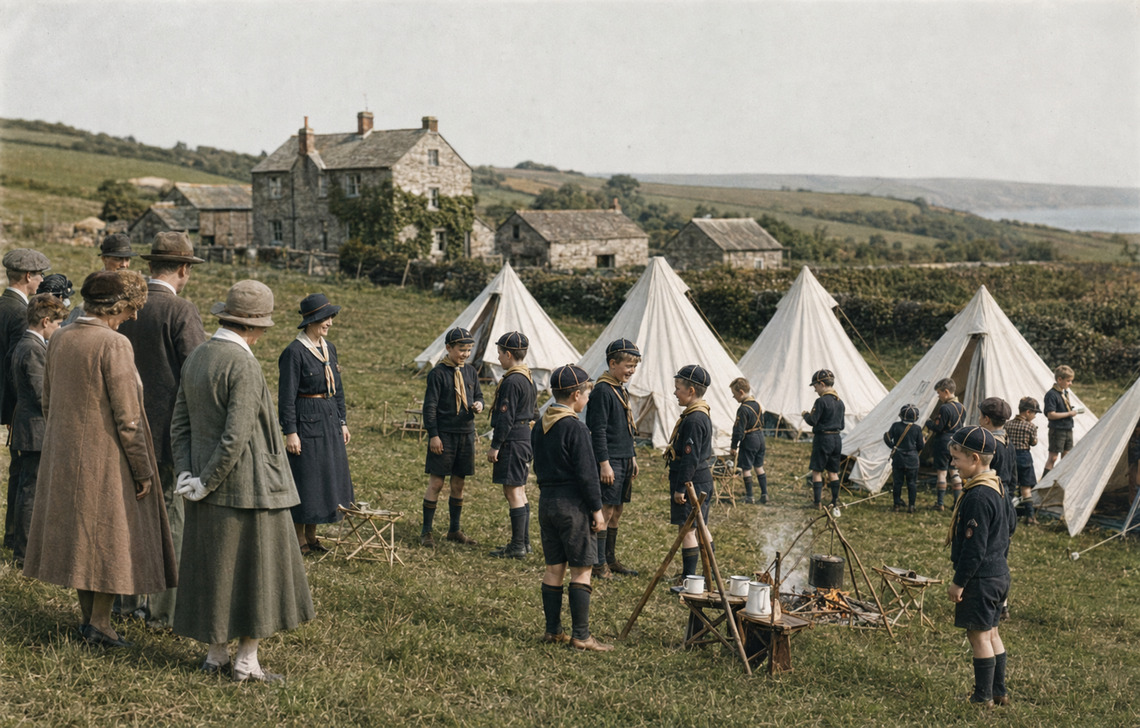
📷 The accompanying image is a modern historical interpretation of the camp. It imagines the Wolf Cubs receiving visitors in a field near Knighton Farm; the exact campsite and the appearances of those depicted are not known.
Source: Western Morning News, 21 August 1929.
#OnThisDay #Wembury #WemburyWaves #Knighton #KnightonFarm #WolfCubs #ScoutingHistory #PlymouthHistory #LocalHistory
On This Day in Wembury
21 August 1951 — Enforcement Orders and a Wembury Hut
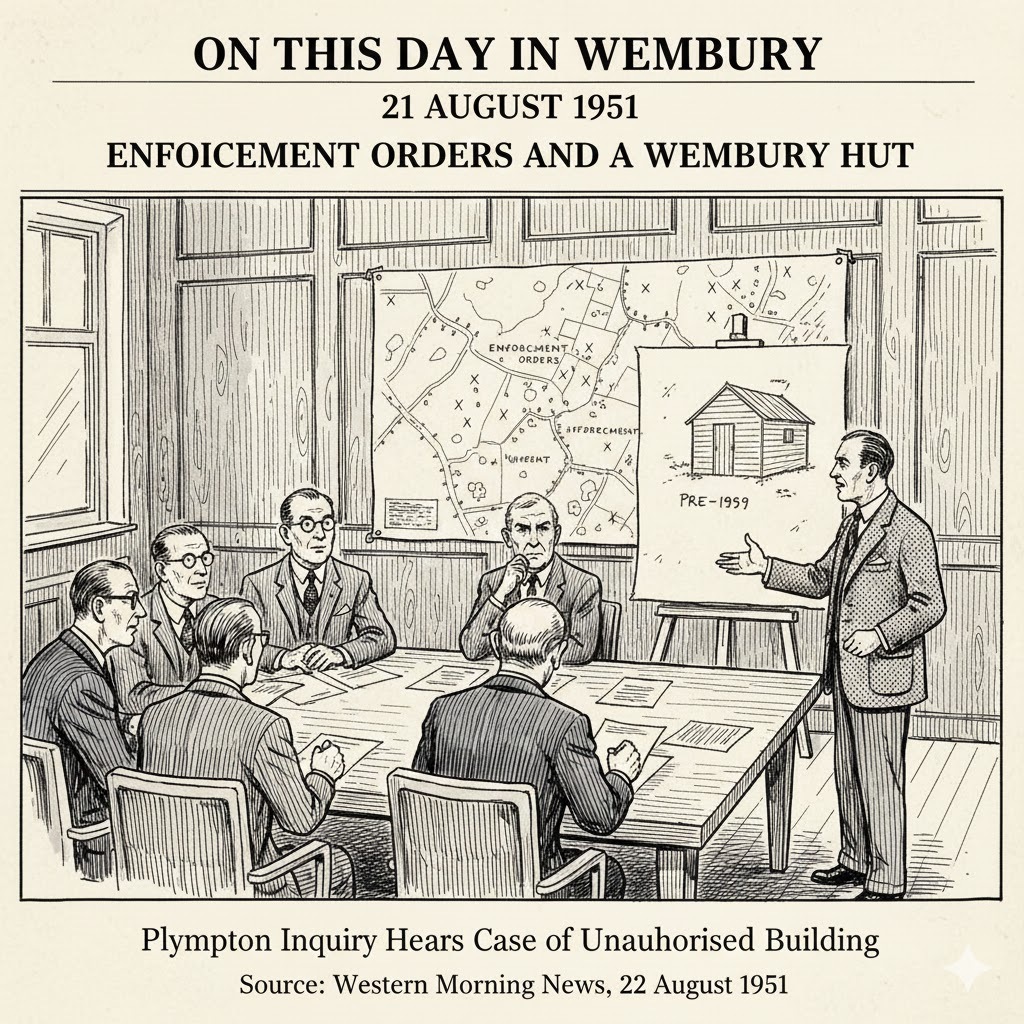
Nearly 200 enforcement orders concerning properties in the Wembury area were reported by Devon County Council’s Divisional Planning Officer at a Plympton inquiry. The case in question involved Mr. Bernard Lovett-Flint of Wembury, who appealed against refusal of permission to improve a hut at the rear of his home, Fairfield on Wembury Road. Originally a builder’s shed, the hut had been made habitable during the war and continued in use. Lovett-Flint argued that, since the hut pre-dated planning controls of 1939, improvements should be permitted. The Council countered that it had become, in effect, a new building, and that applications had twice been refused. With work continuing despite refusals, the authority pursued enforcement. The inspector concluded the inquiry on 21 August 1951.
Reflection: This dispute reflects the wider postwar struggle in Wembury between informal, often wartime, adaptations of buildings and the new planning regime aimed at controlling “unfortunate development.” The hut symbolised the tension between family need for housing and official insistence on regulating the landscape.
Source: Western Evening Herald, 22 August 1951 (reporting on inquiry of 21 August 1951).
Entries are summaries and interpretations of historical newspaper reports.