
- Home
- On this day in Wembury
- 08-19
🌊 ON THIS DAY IN WEMBURY — 19 AUGUST 1861
THE UNKNOWN WOMAN OF LANGDON CLIFFS
On this day in 1861, a deeply sad report appeared in the local press under the heading “Mysterious Death Near Plymouth.”
It concerned the body of an unknown woman discovered on the beach at Wembury, just east of the entrance to Plymouth Sound.
William Axworthy, who lived at the boathouse at Langdon, found her lying in Long Range Bay, beneath Langdon Farm. She was below one of the highest water marks and appeared to have been in the sea for a considerable time.
Mr Coombe of Langdon took responsibility for the remains, and an inquest was held at Langdon Farm before A. B. Bone, Esq.
The woman could not be identified.
Her body was already in an advanced state of decomposition, but the authorities recorded every detail that might help somebody recognise her.
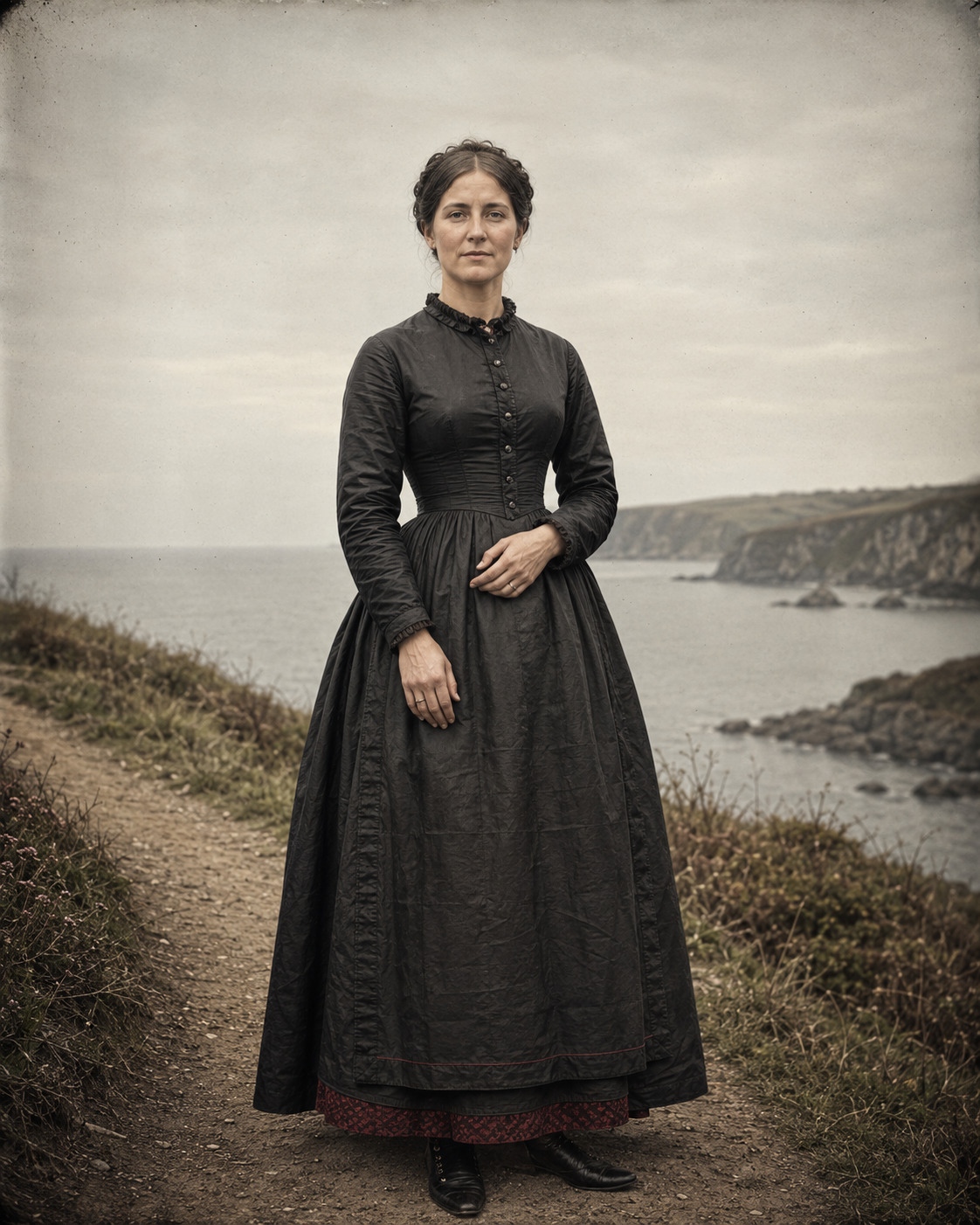
She was unusually tall for a Victorian woman, standing approximately 5 feet 8 inches. She was dressed in:
• A black silk dress, fastened at the front
• Cloth goloshes, laced at the sides with leather
• Red-and-black woollen stockings
• A red-and-black “stuff” skirt
• Black stays
• Two flannel petticoats
• A black Cobourg-cloth apron
• A nightdress marked “S.P. No. 4”
• A chemise marked “S.P. No. 7”
There was also the mark of a ring on the fourth finger of her left hand—but the ring itself was gone.
Who was she?
Did the initials “S.P.” belong to her, or were they simply laundry marks? Was somebody waiting for her to return? Did she have a husband, a family or a home somewhere across Plymouth Sound—or much farther away?
The inquest could provide no answers. Its verdict was simply:
“Found Dead.”
Wembury’s burial register records that an unknown woman found drowned beneath Langdon Cliffs was buried in the Old Yard of Wembury churchyard on 20 August 1861. The service was conducted by the parish incumbent, Richard Lane.
No name was entered in the register. She was laid to rest only as “UNKNOWN.”
More than 160 years later, her identity remains a mystery. Yet the careful description of her clothes, the initials sewn into her garments and the pale impression left by a missing ring allow us to glimpse something of the person she had once been.
Perhaps she had travelled far. Perhaps the sea carried her to Wembury. Perhaps somebody searched for her but never discovered where she was buried.
She lost her name, but she should not be forgotten.
And perhaps, one day, the unknown woman of Langdon Cliffs will have a song of her own:
The sea never told us your name,
only carried you into the bay;
with a ring-mark pale on your finger,
where beneath Langdon’s cliffs you lay.
Source: Contemporary newspaper report, 19 August 1861, and the Wembury parish burial register.
#OnThisDay #Wembury #WemburyWaves #WemburyHistory #LangdonCliffs #PlymouthSound #LocalHistory #VictorianHistory #UnknownWoman
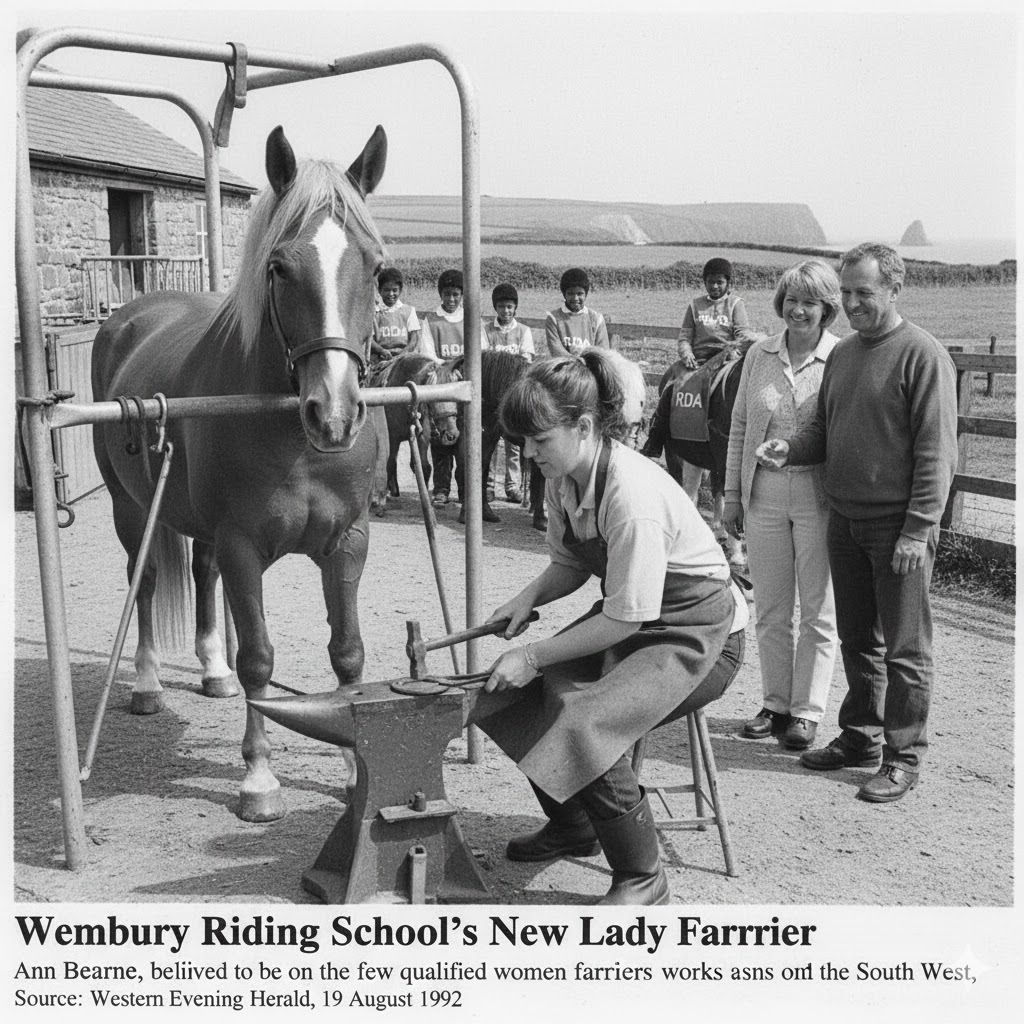
On this day in Wembury, 19 August 1992
The Western Evening Herald reported on a distinctive achievement at a local stables: Wembury Riding School now had its own lady farrier, Ann Bearne, believed at the time to be one of only a handful of qualified women farriers in the South West.
The article explained that Ann had trained formally and was fully registered, able to carry out all farriery work from routine shoeing to remedial care. For the riding school this meant horses could be treated promptly on site, reducing delays and giving young riders the chance to see skilled equine work up close. Ann described how much she enjoyed the physical and technical demands of the job and the close working relationship with the horses.
The riding school itself was busy with lessons, RDA riding for disabled sessions, and preparation for local gymkhanas. Owners Ann and Tony stressed the value of having a qualified farrier as part of the team, particularly during the summer months when visitors and holidaymakers brought extra activity to the yard. The story offers a snapshot of Wembury’s equestrian community in the early nineties and highlights the steady breaking down of gender barriers within traditional rural trades.
Source, Western Evening Herald, 19 August 1992.
Entries are summaries and interpretations of historical newspaper reports.