
On this day in Wembury — 3 August 1939
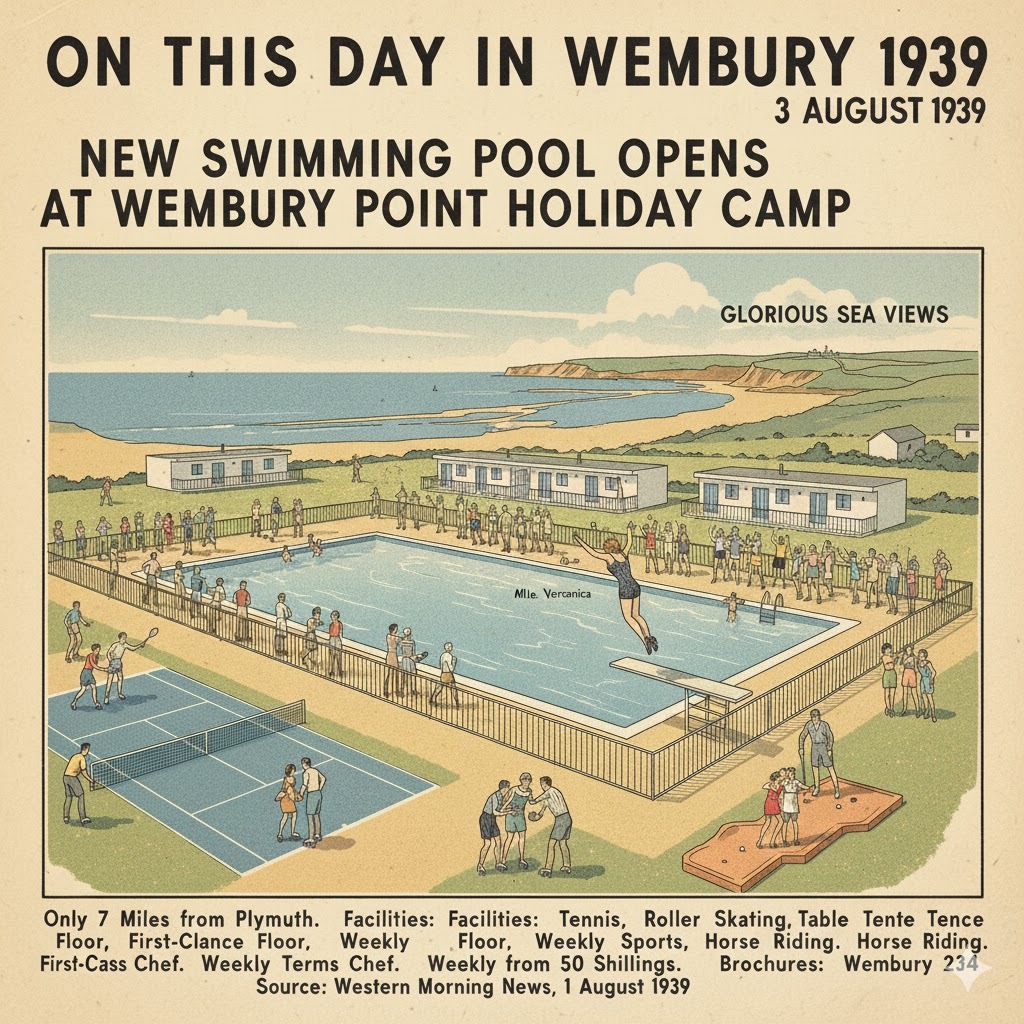
The Western Morning News announced the opening of the new swimming pool at the Wembury Point Holiday Camp, Heybrook Bay, with the ceremony performed by Mlle. Veronica, a performer appearing that week at the Alhambra Theatre, Devonport.
The advert described the camp as “only seven miles from Plymouth, with glorious sea views of Plymouth Sound and the beautiful River Yealm.” Facilities included putting, tennis, roller skating, table tennis, a first-class dance floor, weekly programmes of sport and horse riding, and modern two-room chalets fitted with hot and cold running water. Catering was promised by a first-class chef, with weekly terms from 50 shillings. Brochures could be obtained by writing or phoning Wembury 234.
Context and history
The Wembury Point Holiday Camp was a late-1930s development, part of the South Devon seaside leisure boom that also produced the Heybrook Bay Lido and the Rendezvous tea-house. Positioned on the clifftop near Heybrook Bay, it traded on the spectacular coastal setting and good bus links from Plymouth.
Its timing, however, was ill-fated. Within weeks of the swimming pool’s opening, the Second World War broke out. In 1940, Wembury Point was requisitioned by the Admiralty and became HMS Cambridge, a naval gunnery training school. The camp’s leisure facilities, including the pool, were swallowed into the military estate, and holidaymaking on the headland ceased.
The site remained under naval control until 2001, when HMS Cambridge closed and the National Trust purchased the land, demolishing the camp and training buildings and restoring public access to Wembury Point. Today, nothing remains of the holiday camp, but its brief existence marks a fascinating “last summer” of seaside optimism before the war transformed the coastline.
(Source: Western Morning News, 3 August 1939 — “Wembury Point Holiday Camp” advert; Wembury Archive notes on Heybrook Bay leisure sites and HMS Cambridge history.)
Entries are summaries and interpretations of historical newspaper reports.