
- Home
- On this day in Wembury
- 06-25
ChatGPT said:
On This Day in Wembury — 25 June 1844
At the Devon Lammas Assizes in August 1844, the Crown heard the remarkable case of James Elliott, indicted for assaulting and obstructing Jeremiah Murphy, a veteran officer of Her Majesty’s Customs, in the execution of his duty at Down Thomas, near Wembury, on 25 June that year.
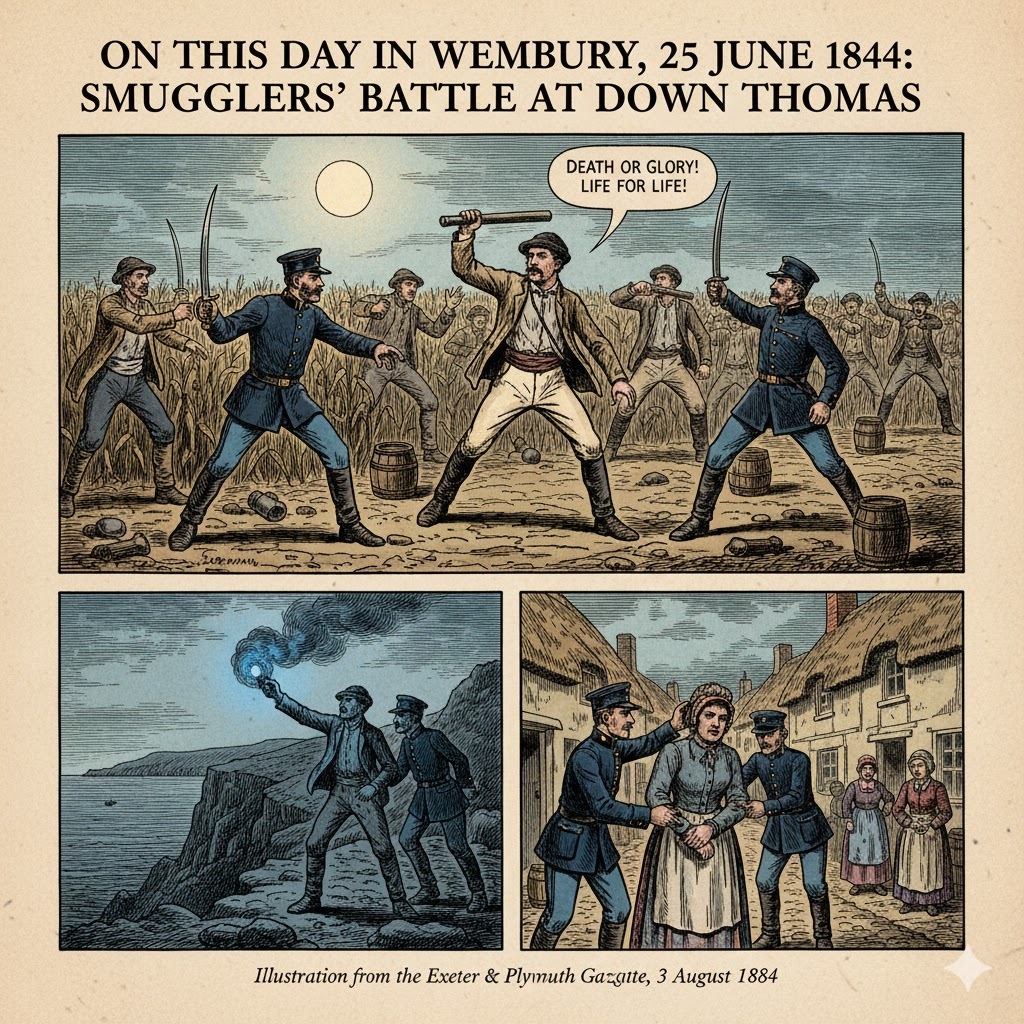
Murphy, described as a staunch and weather-beaten Preventive Service man, and his colleague Kendall, set out on night patrol from Roborough Town Coastguard station. The moon was bright, and after skirting the lanes of Down Thomas they crossed fields when Murphy suddenly saw a group of men with tubs and casks in a standing cornfield. He leapt the bank, declared himself a Customs officer, and seized one man.
At once the cry went up from the smugglers: “Death or glory, life for life, let go or we’ll murder you!” Murphy recognised among them Elliott, clad in light trousers, a canvas smock and sou’wester, who hurled a bludgeon and a stone at him. Drawing his cutlass, Murphy fought back with Kendall at his side, but the two officers were overpowered by sheer numbers. Pinned down, they watched as the kegs and tubs were carried off. Before leaving, the smugglers mockingly pressed a flagon of spirits on the officers, threatening that if they would not “kiss the flagon” they would “make their bludgeons kiss them.”
Undeterred, Murphy and Kendall lit blue lights to summon aid and pursued the gang back into Down Thomas. There they encountered three figures in women’s clothing. Suspicious, Murphy pulled off the cap of the middle “woman” and revealed Elliott in disguise. Soon Coastguards under Lieutenant Cornish arrived and Elliott was taken under arrest.
At trial, Elliott’s counsel stressed that he had been examined and discharged by local magistrates three times before committal, and brought character witnesses who professed ignorance of his smuggling habits. Mr. Rogers, Recorder of Exeter, for the Crown, pressed the vivid testimony of Murphy and Kendall. The jury, exercising what the judge called their “constitutional discretion,” acquitted Elliott with a verdict of Not Guilty.
Source: Exeter and Plymouth Gazette, 3 August 1844.
This episode is one of the most dramatic in Wembury’s smuggling history — featuring moonlit chases, disguises, cutlasses, blue lights and the mocking rituals of the contraband trade. It shows both the risks Customs officers faced and the reluctance of juries, drawn from communities entwined with smuggling, to convict.
Extra information from local historian Robert Rowland
Since publishing this story, local historian Robert Rowland has kindly added some fascinating extra background about James Elliott and his family. His notes suggest that the 1844 Down Thomas case may not have been an isolated brush with the smuggling world, but part of a much wider family and social story.
Robert points out that James Elliott’s father, Henry Elliott, had also been apprehended for smuggling as early as 1804, together with Francis Avery and John Lake. They were reportedly caught at night on Tavistock Road in Plymouth, travelling with contraband and two loaded ponies. This places the Elliott family in connection with the contraband trade some forty years before James himself appeared at the Devon Lammas Assizes.
James Elliott was born in 1807, only three years after that earlier incident involving his father. By 1818 he had been apprenticed to the local farmer Thomas Matthews. His brother William Elliott had earlier been apprenticed, in 1809, to John Prideaux Hensleigh. These apprenticeships suggest a family trying to place its children into useful rural work, but Robert’s wider research also points to real poverty in the family background.
James’s grandmother, Grace Elliott, was receiving parish relief from 1798 to 1811. That detail is important, because it reminds us that smuggling was not always the romantic adventure of popular imagination. In coastal and rural communities, it was often entangled with poverty, loss of land, uncertain employment, and the hard economics of everyday survival.
Robert also notes that Henry Elliott first married Lucy Tingcombe in 1789. She died on 15 December 1794. Within a month, Charles Avent also died, together with two of his children. Henry Elliott later married Charles Avent’s widow, Mary Avent, née Prouse. Robert adds that Mary was born at Kingston, a place with its own strong smuggling associations. This may hint at the sort of family and village networks through which coastal smuggling knowledge, contacts, and opportunity could pass.
Perhaps the most thought-provoking part of Robert’s information concerns land. He says the Elliotts were originally husbandmen of Down Thomas, with a cottage and perhaps 10 to 20 acres of land. However, during the enclosures of the late eighteenth and early nineteenth centuries, they appear to have lost land to larger local interests, including men such as James Hooke and Robert Taylor.
If this is correct, it gives the James Elliott story a deeper social background. The 1844 case is dramatic enough on its own, with moonlight, casks, cutlasses, disguises and blue lights. But behind that drama there may also have been a longer story of a family pushed down the rural ladder: from small landholding husbandmen, to parish relief, apprenticeships, and involvement in the risky world of contraband.
Robert’s contribution helps shift the story from a colourful courtroom episode into something more human. James Elliott was not simply a name in an assize report. He came from a Down Thomas family shaped by poverty, changing land ownership, local apprenticeship, coastal connections, and perhaps an inherited familiarity with smuggling. It is another reminder that Wembury’s history is often at its richest when the newspaper report is joined to local memory, family history, and careful parish research.
With thanks to Robert Rowland for this additional information.
Entries are summaries and interpretations of historical newspaper reports.