
- Home
- On this day in Wembury
- 06-25
ChatGPT said:
On This Day in Wembury — 25 June 1844
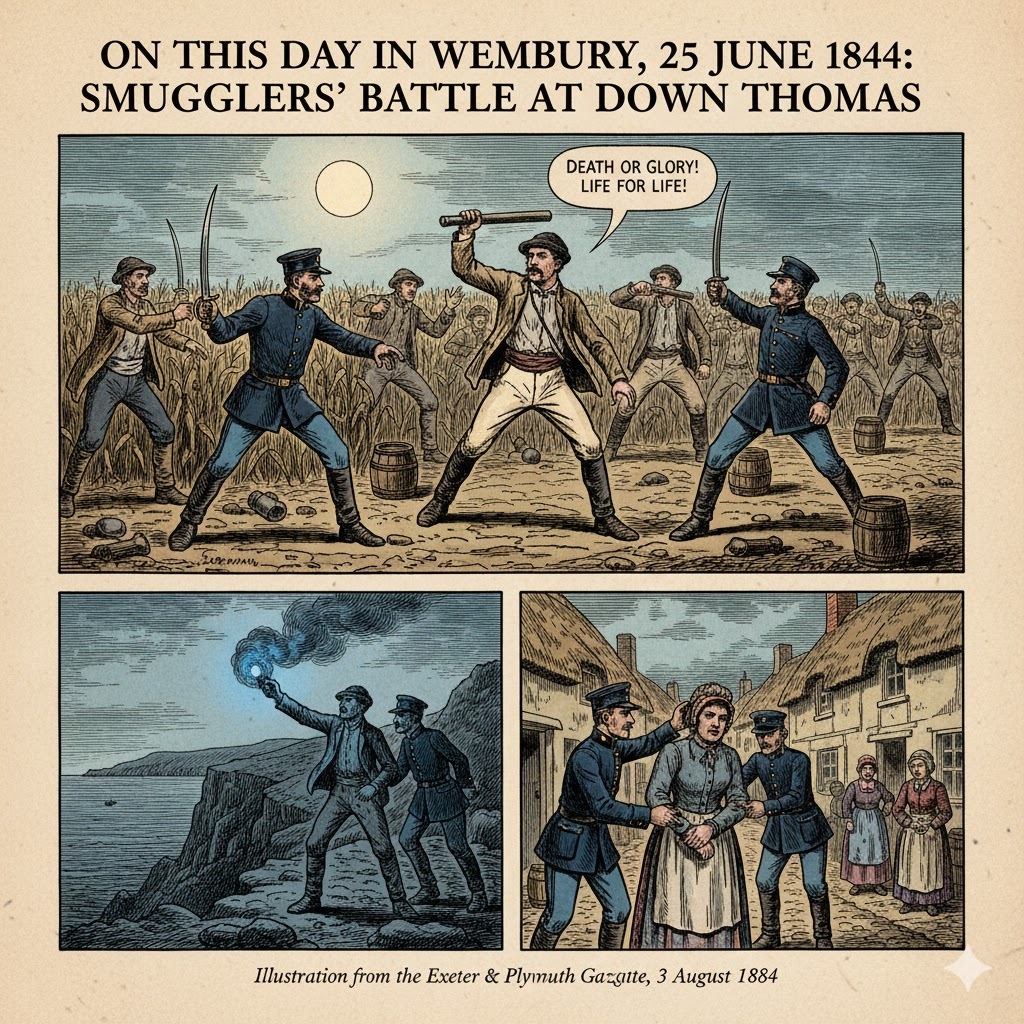
At the Devon Lammas Assizes in August 1844, the Crown heard the remarkable case of James Elliott, indicted for assaulting and obstructing Jeremiah Murphy, a veteran officer of Her Majesty’s Customs, in the execution of his duty at Down Thomas, near Wembury, on 25 June that year.
Murphy, described as a staunch and weather-beaten Preventive Service man, and his colleague Kendall, set out on night patrol from Roborough Town Coastguard station. The moon was bright, and after skirting the lanes of Down Thomas they crossed fields when Murphy suddenly saw a group of men with tubs and casks in a standing cornfield. He leapt the bank, declared himself a Customs officer, and seized one man.
At once the cry went up from the smugglers: “Death or glory, life for life, let go or we’ll murder you!” Murphy recognised among them Elliott, clad in light trousers, a canvas smock and sou’wester, who hurled a bludgeon and a stone at him. Drawing his cutlass, Murphy fought back with Kendall at his side, but the two officers were overpowered by sheer numbers. Pinned down, they watched as the kegs and tubs were carried off. Before leaving, the smugglers mockingly pressed a flagon of spirits on the officers, threatening that if they would not “kiss the flagon” they would “make their bludgeons kiss them.”
Undeterred, Murphy and Kendall lit blue lights to summon aid and pursued the gang back into Down Thomas. There they encountered three figures in women’s clothing. Suspicious, Murphy pulled off the cap of the middle “woman” and revealed Elliott in disguise. Soon Coastguards under Lieutenant Cornish arrived and Elliott was taken under arrest.
At trial, Elliott’s counsel stressed that he had been examined and discharged by local magistrates three times before committal, and brought character witnesses who professed ignorance of his smuggling habits. Mr. Rogers, Recorder of Exeter, for the Crown, pressed the vivid testimony of Murphy and Kendall. The jury, exercising what the judge called their “constitutional discretion,” acquitted Elliott with a verdict of Not Guilty.
Source: Exeter and Plymouth Gazette, 3 August 1844.
This episode is one of the most dramatic in Wembury’s smuggling history — featuring moonlit chases, disguises, cutlasses, blue lights and the mocking rituals of the contraband trade. It shows both the risks Customs officers faced and the reluctance of juries, drawn from communities entwined with smuggling, to convict.
Entries are summaries and interpretations of historical newspaper reports.